BROOKLYN, NY / ACCESS Newswire / May 19, 2026 / In today’s financial markets, the key differentiator is no longer access to information, but the speed and effectiveness with which it can be processed.
Investors are now operating in an environment saturated with content-earnings calls, executive interviews, investor briefings, and an expanding ecosystem of financial podcasts. Much of this information is valuable, yet it is increasingly delivered in formats that are not immediately structured for analysis.
This shift is quietly changing how research workflows are designed.

The Shift From Structured Data to Spoken Information
For decades, financial analysis has relied on structured datasets such as earnings reports, balance sheets, and macroeconomic indicators. These inputs are clean, comparable, and easy to integrate into models.
However, a growing portion of meaningful insights is now delivered through spoken communication rather than written reports.
Earnings calls have become a primary example. They are not just presentations of financial results, but real-time discussions where management teams explain strategy, respond to analysts, and signal future expectations.
At the same time, podcasts and interviews have evolved into informal but increasingly influential sources of market information.
The challenge is that these formats are inherently unstructured.
Why Transcription Is Becoming a Core Research Layer
The growing importance of audio to text transcription is closely tied to how investors consume information today. Rather than listening to long recordings in full, market participants increasingly rely on structured text to extract meaning efficiently.
This is especially relevant in time-sensitive environments where even small delays in interpretation can matter.
In practice, converting spoken content into text allows investors to quickly scan discussions, isolate key statements, and compare narratives across different companies or time periods.
Expanding Beyond Traditional Financial Content
The scope of relevant research material is also expanding beyond formal disclosures.
Many investors now analyze podcasts, conference discussions, and industry conversations alongside traditional filings. These sources often contain early signals that do not yet appear in official documents.
In this context, being able to process formats such as MP3 audio file to text has become increasingly useful, particularly for teams that track recurring themes across multiple spoken sources.
Similarly, video-based content-such as recorded earnings calls or investor presentations-can now be converted efficiently through MP4 to text free workflows, making previously inaccessible material easier to incorporate into research processes.
From Unstructured Content to Usable Intelligence
Once audio or video content is converted into text, its value increases significantly.
Instead of being locked in time-based recordings, information becomes:
Searchable across large datasets
Comparable across reporting periods
Compatible with quantitative and qualitative analysis tools
This transformation allows investors to move from passive consumption to structured interpretation.
It also enables a more systematic approach to identifying changes in tone, emphasis, and narrative across different communication channels.
Practical Applications in Investment Workflows
Earnings Call Interpretation
Transcripts make it easier to track how management communication evolves over time. Subtle changes in wording or emphasis can provide early indications of strategic shifts or changing expectations.
Cross-Source Analysis
By combining different spoken sources-such as earnings calls, interviews, and industry discussions-investors can identify recurring themes that may not be visible in formal reports.
Efficient Research Retrieval
Instead of revisiting full recordings, analysts can directly search text-based content to locate relevant statements, improving both speed and accuracy in decision-making.
Content Transformation in Financial Media
Financial publishers are also increasingly using transcription to convert audio and video into written content. This improves accessibility and expands distribution across search channels.
In practice, workflows that integrate audio to text transcription, along with MP3 audio file to text and MP4 to text free conversion capabilities, are becoming part of a broader content infrastructure rather than standalone tools.
Technology Is Reducing the Barrier
Recent improvements in artificial intelligence have significantly reduced the friction involved in transcription.
Tasks that once required manual effort can now be completed in minutes, allowing both institutional and individual investors to incorporate spoken content into their research processes more easily.
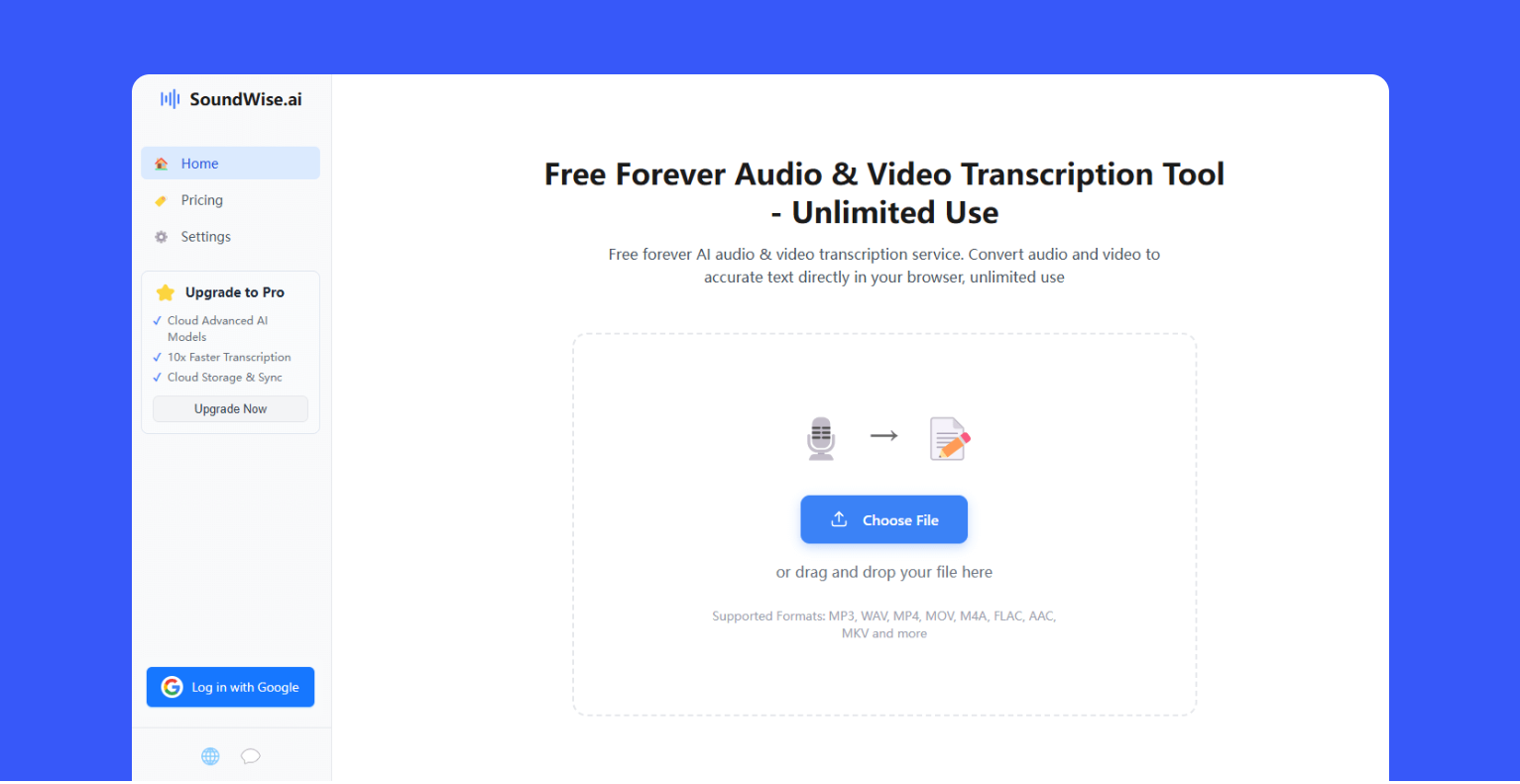
Platforms such as Soundwise.ai reflect this shift by making audio and video conversion into structured text more accessible and efficient without requiring technical expertise.
A Subtle but Structural Advantage
Unlike more visible innovations in financial technology, transcription operates at a more foundational level.
It does not change what information exists in the market-but it changes how quickly and effectively that information can be processed.
In environments where marginal gains accumulate over time, this improvement in processing efficiency can translate into a meaningful analytical advantage.
Looking Ahead
As financial communication continues to evolve, spoken formats are likely to become even more prominent.
This makes the ability to convert audio and video into structured, searchable data increasingly important for modern investment workflows.
The broader shift is clear:
From static financial data consumption → to dynamic, multi-format information processing
Conclusion
Financial markets are not constrained by a lack of information, but by an excess of it.
Transcription provides a practical mechanism for turning unstructured spoken content into usable data. Whether through MP3 audio file to textor MP4 to text workflows, the ability to structure information more efficiently is becoming a critical component of modern financial analysis.
In an increasingly complex information environment, this capability is quietly moving from optional to essential.
Contact Details:
Email: [email protected]
Website: https://soundwise.ai/
SOURCE: Soundwise