Market Overview
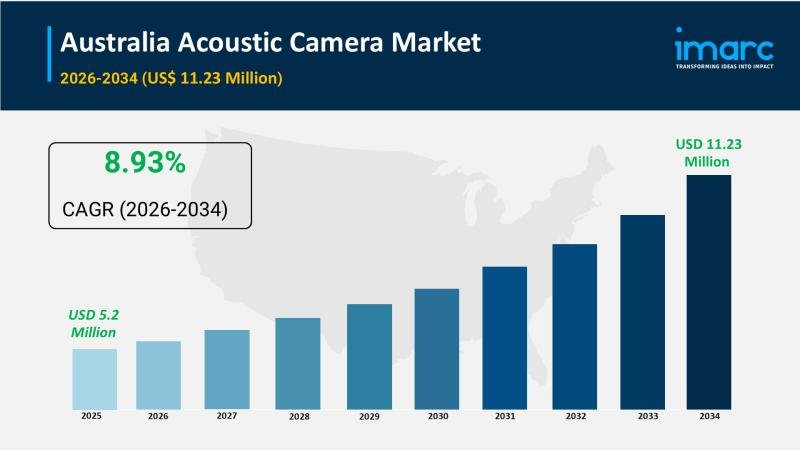
The Australia acoustic camera market size reached USD 5.2 Million in 2025 and is projected to reach USD 11.23 Million by 2034, growing at a CAGR of 8.93% during 2026-2034. The market is driven by stringent noise regulations mandating sophisticated acoustic monitoring across multiple sectors, rapid expansion of renewable energy infrastructure requiring comprehensive noise compliance and predictive maintenance capabilities, and the growing emphasis on electric vehicle NVH testing as Australia transitions to cleaner transportation technologies. Increasing integration of artificial intelligence in acoustic analysis systems is enhancing detection accuracy and operational efficiency, further expanding the Australia acoustic camera market share.
The Australia acoustic camera market is gaining momentum due to increasing demand for advanced noise monitoring and sound visualization technologies across industries such as automotive, construction, and aerospace. Rising focus on environmental noise control and workplace safety regulations is accelerating adoption of these systems. Additionally, technological advancements in real-time sound analysis and growing use in predictive maintenance and quality testing are positioning the market for steady growth and innovation.
Request for a sample report PDF: https://www.imarcgroup.com/australia-acoustic-camera-market/requestsample
Australia Acoustic Camera Market Summary
• Stringent and evolving noise regulations enforced by state Environmental Protection Authorities across construction, industrial, and renewable energy sectors are establishing acoustic monitoring as a mandatory operational requirement
• Australia’s unprecedented renewable energy expansion – with renewable sources accounting for 36% of total electricity generation in 2024 and 59 large-scale projects totalling approximately 9.9 GW under construction as of December 2024 – is driving sustained acoustic monitoring demand across wind, solar, and battery storage facilities
• The implementation of the New Vehicle Efficiency Standard from 2025 is accelerating EV adoption and intensifying demand for advanced NVH testing infrastructure tailored to the unique acoustic characteristics of electric powertrains
• AI integration within acoustic camera systems is enabling automated noise classification, real-time source localization, and predictive maintenance capabilities that reduce reliance on specialized acousticians
• Market segmentation spans array type (2D and 3D), measurement type (far field and near field), application (noise source detection, leak detection, others), end use (aerospace and defense, infrastructure, energy and power, automotive, others), and region
• Drone-mounted acoustic inspection systems are gaining traction for offshore and remote wind turbine condition monitoring, introducing new competitive dynamics in the energy and power end-use segment
• Competitive landscape includes international acoustic technology providers, domestic acoustic consulting firms, and integrated UAV-acoustic solution suppliers
• High capital investment requirements and acute skilled acoustician shortages represent the primary constraints limiting broader adoption across small and medium-sized enterprises
Key Trends Shaping the Australia Acoustic Camera Market
• Stringent Noise Regulations Driving Advanced Monitoring Technologies: Australian governments at federal, state, and local levels have established comprehensive noise regulatory frameworks across multiple sectors, creating sustained demand for sophisticated acoustic camera technology. Environmental Protection Authorities in each state enforce specific noise standards for construction, industrial operations, and renewable energy facilities – with requirements varying by jurisdiction but consistently mandating precise measurement and continuous compliance documentation. The introduction of mandatory five-yearly wind turbine noise monitoring in Victoria from January 2024, combined with requirements for pre- and post-construction acoustic assessments verified by environmental auditors, has established acoustic monitoring as an essential component of renewable energy project lifecycles. The implementation of mandatory audiometric testing from July 2025 for workers exposed to noise exceeding occupational exposure standards further amplifies the need for precise acoustic measurement equipment across industrial and construction environments. The progressive tightening of noise standards – particularly in urban areas experiencing residential densification near industrial and transport corridors – is driving investment in real-time acoustic monitoring systems that can demonstrate continuous regulatory compliance.
• Rapid Expansion of Renewable Energy Infrastructure: Australia’s renewable energy industry is expanding at an unprecedented rate, fundamentally transforming the country’s electricity generation landscape and generating significant demand for acoustic monitoring technologies at every stage of the project lifecycle. Renewable sources accounted for 36% of Australia’s total electricity generation in 2024 – delivering 32.5 GWh, sufficient to power approximately seven million homes – with 59 large-scale renewable energy projects totalling approximately 9.9 GW under construction as of December 2024. Federal and state government commitments to achieving 82% renewable energy by 2030 and net-zero emissions by 2050, underpinned by the Future Made in Australia plan with AUD 22.7 billion in funding and the Capacity Investment Scheme, are accelerating this deployment trajectory. Wind farms require comprehensive acoustic monitoring throughout their entire operational lifecycle – from pre-construction environmental noise assessments through post-construction verification and ongoing five-yearly monitoring campaigns – while battery energy storage systems and large-scale solar installations also contribute to acoustic monitoring demand as these facilities require noise assessments to address community concerns and satisfy planning approvals.
• Growing Emphasis on Electric Vehicle NVH Testing: The transition to electric vehicles under Australia’s New Vehicle Efficiency Standard – implemented in 2025 following federal legislation passed in 2024 – has fundamentally altered the automotive testing landscape and created significant demand for advanced acoustic camera technology. Electric powertrains present unique acoustic challenges that differ substantially from traditional internal combustion engine applications, as the absence of engine noise eliminates the masking effect that historically obscured vehicle sounds including tire noise, wind noise, and minor mechanical vibrations – making previously acceptable sound levels perceptible and potentially objectionable to drivers and passengers. The complexity of electric vehicle NVH optimization extends beyond powertrain noise to encompass high-frequency electrical sounds from inverters and motors, buzz-squeak-rattle phenomena in cabin interiors, and the acoustic signature design that manufacturers increasingly deploy for brand differentiation. Australian automotive testing facilities, including independent laboratories such as Austest Labs providing accredited defense and aerospace testing services, are expanding their NVH capabilities to accommodate the unique requirements of electric vehicle validation – driving investment in state-of-the-art acoustic imaging equipment and associated measurement infrastructure.
Browse the full report with TOC and list of figures: https://www.imarcgroup.com/australia-acoustic-camera-market?utm_source=openpr&utm_medium=referral&utm_campaign=imarc_ref&utm_term= australia acoustic camera market +t…
Market Growth Drivers
Noise Regulation Compliance, Renewable Energy Infrastructure Expansion, and EV NVH Testing Demand
The Australia acoustic camera market growth is anchored in the convergence of three powerful and self-reinforcing demand drivers – tightening noise regulatory requirements, accelerating renewable energy deployment, and electric vehicle adoption – each independently creating substantial and sustained demand for advanced acoustic monitoring technology. State Environmental Protection Authority noise compliance frameworks are establishing acoustic monitoring as a non-discretionary operational requirement across wind energy, construction, and industrial sectors, with mandatory monitoring campaigns creating recurring demand that extends throughout the full project and operational lifecycle. The government’s commitment to 82% renewable energy by 2030 – supported by AUD 22.7 billion in dedicated funding and 59 large-scale projects currently under construction – is generating unprecedented demand for wind turbine condition monitoring, pre- and post-construction acoustic assessments, and ongoing compliance verification that collectively represent a large and growing addressable market for acoustic camera technology. Simultaneously, the implementation of the New Vehicle Efficiency Standard is compelling automotive manufacturers and testing laboratories to invest in advanced NVH testing infrastructure specifically engineered for electric vehicle acoustic characteristics – creating a technically distinct and high-specification segment of acoustic camera demand within the Australian automotive supply chain.
AI Integration, Drone-Based Inspection Adoption, and Predictive Maintenance Transforming Market Value Proposition
The accelerating integration of artificial intelligence, machine learning, and cloud-based analytics into acoustic camera platforms is fundamentally transforming the market’s value proposition – shifting acoustic monitoring from a specialist manual analysis activity to an increasingly automated, scalable operational capability accessible to a broader range of end users. AI-driven automation of noise classification, source localization, and regulatory compliance reporting is reducing the dependence on scarce specialist acousticians for routine monitoring tasks, directly addressing one of the market’s most significant adoption barriers and enabling broader deployment across industrial, energy, and infrastructure end-use sectors. The emergence of drone-mounted acoustic inspection systems for wind turbine monitoring is creating a new segment of high-growth demand within the renewable energy sector – offering non-invasive, cost-effective condition assessment capabilities for remote and offshore installations that cannot be efficiently served by conventional ground-based acoustic camera deployments. These technological innovations, combined with Australia’s well-capitalized government and corporate renewable energy investment pipeline, are collectively positioning the acoustic camera market for robust growth throughout the 2026-2034 forecast period.
Market Segmentation
IMARC Group provides an analysis of the key trends in each segment of the Australia acoustic camera market, along with forecasts at the country and regional levels for 2026-2034. The market has been categorized based on array type, measurement type, application, and end use.
By Array Type:
• 2D
• 3D
By Measurement Type:
• Far Field
• Near Field
By Application:
• Noise Source Detection
• Leak Detection
• Others
By End Use:
• Aerospace and Defense
• Infrastructure
• Energy and Power
• Automotive
• Others
By Region:
• Australia Capital Territory & New South Wales
• Victoria & Tasmania
• Queensland
• Northern Territory & Southern Australia
• Western Australia
Key Players
The Australia acoustic camera market is characterized by a mix of international technology providers and specialized domestic acoustic consulting firms serving various end-use sectors. Competition primarily revolves around measurement accuracy, system portability, integration capabilities with existing monitoring infrastructure, and technical support services. Leading global manufacturers maintain market presence through local distributors and technical representatives providing equipment, calibration services, and application support across industrial, automotive, aerospace, and environmental monitoring sectors. The increasing adoption of drone-based acoustic inspection systems for renewable energy applications is introducing new competitive dynamics, with companies offering integrated solutions combining unmanned aerial vehicles, acoustic sensors, and automated AI-driven data processing capabilities. The market research report provides a comprehensive analysis of the competitive landscape including key player positioning, market structure, top winning strategies, competitive dashboards, and detailed company profiles.
Key Aspects Required for Australia Acoustic Camera Market
• Demand is primarily driven by noise regulatory compliance requirements, renewable energy project acoustic monitoring obligations, and EV NVH testing infrastructure investment
• Strong linkage between state Environmental Protection Authority noise enforcement frameworks and procurement of precision acoustic measurement equipment across energy, construction, and industrial sectors
• Product segmentation covers 2D and 3D array types, far field and near field measurement configurations, noise source detection and leak detection applications, and aerospace, infrastructure, energy, automotive, and other end-use sectors
• Growing preference for AI-integrated acoustic camera platforms that automate noise classification, source localization, and regulatory compliance reporting
• End users prioritize measurement accuracy, broad frequency response coverage, portability for field deployment, and integration capability with existing condition monitoring and compliance management platforms
• Increasing demand for drone-mountable acoustic sensor systems enabling non-invasive inspection of remote, elevated, and offshore renewable energy assets
• Competitive landscape includes global acoustic technology manufacturers, specialist domestic acoustic consulting firms, and integrated UAV-acoustic solution providers
• Distribution channels include direct equipment supply agreements, acoustic consulting service partnerships, and specialized technical distribution networks serving industrial and energy sector end users
• Expansion of bundled service offerings combining acoustic camera hardware, AI-powered data processing, and regulatory compliance reporting services for renewable energy operators
• Rising investment in purpose-built NVH testing facilities – including anechoic and semi-anechoic chambers – by automotive testing laboratories expanding EV validation capabilities
• Supply chain encompasses precision microphone array manufacturers, signal processing hardware providers, acoustic enclosure specialists, and AI software platform developers
• Increasing role of mandatory state government noise monitoring regulations in driving non-discretionary acoustic camera procurement across wind energy, construction, and industrial sectors
• Geographic demand concentration in Victoria and New South Wales – reflecting both regulatory stringency for wind turbine monitoring and concentration of automotive, aerospace, and industrial end users
• Integration with broader condition monitoring, digital twin, and predictive maintenance platforms is becoming a key competitive differentiator for acoustic camera system suppliers
• Rising demand for cloud-based acoustic data management and analytics platforms that enable centralized monitoring of distributed sensor networks across multi-site industrial and energy operations
• Expansion of occupational noise monitoring requirements under Australian workplace health and safety legislation is broadening the addressable market beyond environmental and NVH applications
• Increasing focus on system portability, ruggedization for outdoor and remote deployment, and resistance to Australian environmental conditions including heat, dust, and humidity
Recent News and Developments
• January 2024: Victoria introduced a mandatory requirement for five-yearly wind turbine noise monitoring on all applicable wind farms, combined with requirements for post-construction acoustic assessments within twelve months of operations commencing – verified by environmental auditors – establishing acoustic monitoring as an essential and recurring compliance obligation within Australia’s renewable energy project lifecycle.
• 2024: Australia’s federal government passed legislation introducing the New Vehicle Efficiency Standard (NVES), implemented in 2025, fundamentally altering the automotive testing landscape by accelerating the transition to electric vehicles and creating significant new demand for advanced acoustic camera technology to address the unique NVH testing challenges presented by electric powertrains.
• July 2025: Australia introduced mandatory audiometric testing requirements for workers exposed to noise exceeding occupational exposure standards, amplifying the need for precise acoustic measurement equipment across industrial, construction, and manufacturing sectors in the context of workplace health and safety compliance.
Speak to an analyst for a customized sample report: http://imarcgroup.com/request?type=report&id=44371&flag=C
Contact Us
IMARC Group,
134 N 4th St. Brooklyn, NY 11249, USA,
Email: sales@imarcgroup.com
Tel No: (D) +91 120 433 0800,
United States: +1-201-971-6302
About Us
IMARC Group is a global management consulting firm that helps the world’s most ambitious changemakers to create a lasting impact. The company provides a comprehensive suite of market entry and expansion services. IMARC offerings include thorough market assessment, feasibility studies, company incorporation assistance, factory setup support, regulatory approvals and licensing navigation, branding, marketing and sales strategies, competitive landscape and benchmarking analyses, pricing and cost research, and procurement research.
This release was published on openPR.