Wednesday, June 3, 2026
  • About Web3Wire
  • Web3Wire NFTs
  • .w3w TLD
  • $W3W Token
  • Web3Wire DAO
  • Media Network
  • RSS Feed
  • Contact Us
Web3Wire
No Result
View All Result
  • Home
  • Web3
    • Latest
    • AI
    • Business
    • Blockchain
    • Cryptocurrencies
    • Decentralized Finance
    • Metaverse
    • Non-Fungible Token
    • Press Release
  • Technology
    • Consumer Tech
    • Digital Fashion
    • Editor’s Choice
    • Guides
    • Stories
  • Coins
    • Top 10 Coins
    • Top 50 Coins
    • Top 100 Coins
    • All Coins
  • Exchanges
    • Top 10 Crypto Exchanges
    • Top 50 Crypto Exchanges
    • Top 100 Crypto Exchanges
    • All Crypto Exchanges
  • Stocks
    • Blockchain Stocks
    • NFT Stocks
    • Metaverse Stocks
    • Artificial Intelligence Stocks
  • Events
  • News
    • Latest Crypto News
    • Latest DeFi News
    • Latest Web3 News
  • Home
  • Web3
    • Latest
    • AI
    • Business
    • Blockchain
    • Cryptocurrencies
    • Decentralized Finance
    • Metaverse
    • Non-Fungible Token
    • Press Release
  • Technology
    • Consumer Tech
    • Digital Fashion
    • Editor’s Choice
    • Guides
    • Stories
  • Coins
    • Top 10 Coins
    • Top 50 Coins
    • Top 100 Coins
    • All Coins
  • Exchanges
    • Top 10 Crypto Exchanges
    • Top 50 Crypto Exchanges
    • Top 100 Crypto Exchanges
    • All Crypto Exchanges
  • Stocks
    • Blockchain Stocks
    • NFT Stocks
    • Metaverse Stocks
    • Artificial Intelligence Stocks
  • Events
  • News
    • Latest Crypto News
    • Latest DeFi News
    • Latest Web3 News
No Result
View All Result
Web3Wire
No Result
View All Result
Home Artificial Intelligence

GoodVision AI Introduces the “7-Layer AI Cake” Framework for the Inference Era

June 3, 2026
in Artificial Intelligence, GlobeNewswire, Web3
Reading Time: 10 mins read
5
SHARES
244
VIEWS
Share on TwitterShare on LinkedInShare on Facebook

California, San Francisco , June 02, 2026 (GLOBE NEWSWIRE) — GoodVision AI has introduced what it calls the “7-Layer AI Cake” framework, outlining how the company believes the AI industry will evolve as global infrastructure shifts from a model-centric era toward a token-driven economy.
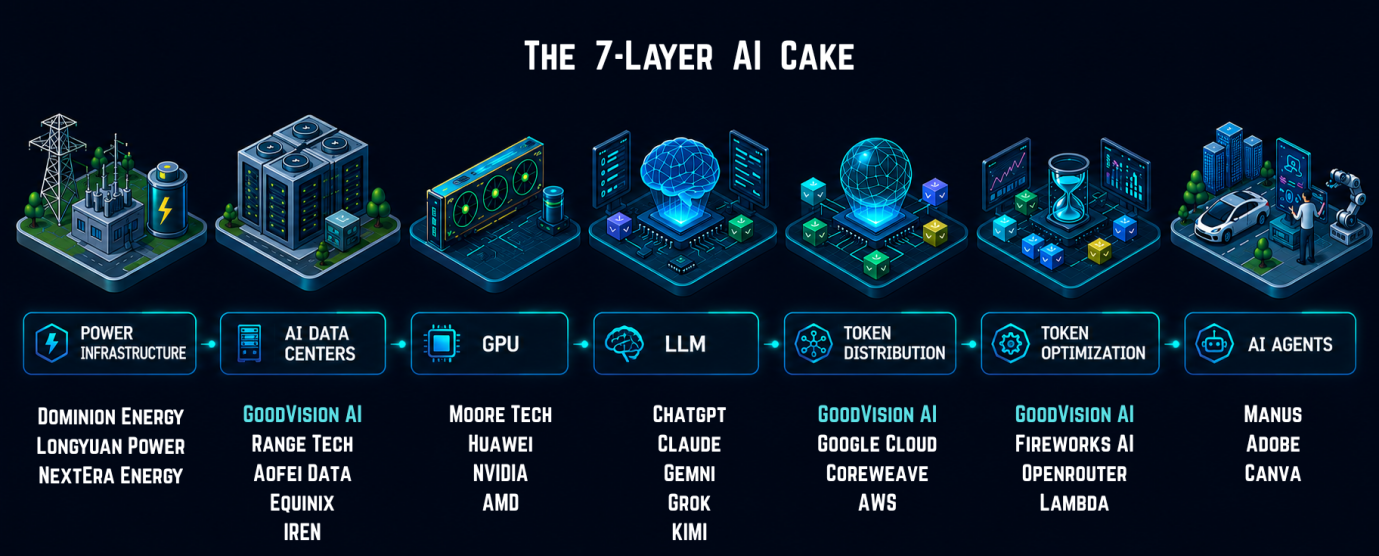
the Overview of 7-Layer AI Cake, Reference: Waterdrip Capital

According to the company, the future AI stack will consist of seven interconnected infrastructure layers:

  • Power Infrastructure
  • AIDC (AI Data Centers)
  • GPUs
  • Large Language Models (LLMs)
  • Token Distribution Networks
  • Intelligent Scheduling Systems
  • AI Agents

GoodVision AI argues that AI is evolving into a large-scale “token industrial system,” where the ability to generate, distribute, orchestrate, and optimize tokens efficiently may become more important than model size alone.

The company said the framework was developed in response to the rapid expansion of AI inference workloads, as AI agents become increasingly embedded across enterprise workflows, consumer applications, robotics, edge devices, and autonomous systems.

Over the past two years, the AI industry has largely been defined by the race to build increasingly powerful foundation models. Parameter counts expanded from hundreds of billions to trillions, while GPU clusters scaled from thousands of chips to tens of thousands. The industry focused heavily on model capability, reasoning performance, and the pursuit of AGI.

But according to GoodVision AI, the next phase of AI may be driven less by model scale itself and more by the infrastructure required to support global token generation, routing, and consumption at scale.

Layer 1: Energy Emerges as the Foundation of AI Infrastructure

As AI infrastructure expands globally, energy is becoming one of the industry’s most important bottlenecks.

Large AI data centers can now consume as much electricity as mid-sized cities, while power grid expansion in many regions is struggling to keep pace with surging AI demand.

According to GoodVision AI, this imbalance is pushing the AI industry further upstream into energy infrastructure.

The company believes stable baseload energy sources, long-term power access, and energy efficiency will become increasingly strategic as inference workloads continue scaling globally.

In the emerging token economy, access to reliable, low-cost energy may become one of the most important competitive advantages in AI infrastructure.

Layer 2: AI Data Centers Become “Token Factories”

The company’s framework positions AI data centers, or AIDCs, as the “token factories” of the AI era.

Rather than relying on individual GPUs, modern AI infrastructure depends on large-scale GPU clustering capable of producing tokens at industrial scale.

But traditional AI data center development cycles can take years, while power grid expansion often takes even longer. As AI inference demand accelerates, many legacy infrastructure models are struggling to keep pace.

At the same time, AI infrastructure is gradually shifting away from purely hyperscale centralized architectures toward more distributed and modular systems.

According to GoodVision AI, inference workloads are increasingly expected to move closer to end users through regional edge-oriented deployment models.

Against this backdrop, the company is pursuing a modular AI Factory strategy centered around lightweight, rapidly deployable inference infrastructure.

Rather than relying solely on hyperscale facilities, GoodVision AI says it is focusing on smaller inference-oriented AI Factory nodes designed for dense regional deployment and faster integration with local energy infrastructure.

The company argues that modular AI Factories are better aligned with the long-term evolution of distributed inference networks.

Layer 3: GPUs Become the Production Equipment of the Token Economy

If electricity represents the energy foundation of AI, GPUs represent the production equipment.

During the first phase of the AI boom, GPU demand was driven primarily by model training. But the next wave of infrastructure growth is increasingly expected to come from inference.

Unlike training workloads, which remain concentrated among a small number of frontier AI companies, inference workloads are expected to expand across nearly every application, device, and endpoint.

Robotics, AI wearables, autonomous systems, and future AI agent collaboration networks all require continuous real-time inference — and therefore continuous token generation and consumption.

According to industry observers, the future of AI infrastructure may ultimately depend on one key metric: how efficiently tokens can be generated per unit of time.

As a result, infrastructure layers surrounding GPUs — including networking, power management, liquid cooling, servers, and optical interconnects — are becoming increasingly critical to AI performance and operational efficiency.

Industry analysts increasingly view this infrastructure layer as the “picks-and-shovels” foundation of the broader AI economy.

Layer 4: LLMs Evolve Into “Token Production Engines”

Large language models are also evolving beyond simple demonstrations of model capability.

According to GoodVision AI, the market is increasingly shifting away from a pure race for parameter scale and toward a broader focus on inference efficiency, deployment cost, orchestration capability, and scalability.

The company argues that models themselves do not directly create value. Instead, value emerges through continuous inference — the repeated generation, routing, and consumption of tokens across real-world applications.

As a result, LLMs are increasingly becoming the “token production engines” of the AI economy.

Competition at the model layer is also evolving rapidly. Rather than focusing solely on parameter counts, the market is increasingly evaluating models based on factors such as inference efficiency, token generation cost, long-context processing, multi-agent collaboration, and integration with distributed infrastructure systems.

According to GoodVision AI, future winners at the model layer may not simply be those building the largest models, but those capable of operating models efficiently at global scale.

The company says it is developing its own optimization strategy by deploying large language models directly within its AI Factory infrastructure, allowing it to evolve from a traditional compute rental provider into a Token-as-a-Service platform.

Layer 5: Token Distribution Emerges as the “Power Grid” of the AI Era

As AI infrastructure scales globally, another major challenge is becoming increasingly important: how compute resources can be distributed and utilized efficiently at scale.

According to GoodVision AI, token distribution networks may ultimately function much like the electrical grids of the industrial era — connecting fragmented GPU resources into unified global infrastructure systems.

As AI adoption expands beyond frontier model developers into enterprises, startups, applications, and AI agent ecosystems, the demand for flexible and scalable compute distribution is rising rapidly.

At the same time, the market is beginning to shift away from purely centralized cloud architectures toward more distributed compute networks optimized specifically for inference workloads.

Lighter deployment models, faster provisioning systems, lower-latency routing, and cost-efficient GPU access are becoming increasingly important as inference workloads continue scaling globally.

According to GoodVision AI, token distribution infrastructure is emerging as one of the key connective layers of the AI economy — linking GPUs, AI models, edge nodes, and inference demand into a scalable global compute network.

Layer 6: Intelligent Scheduling Could Become the “Brain” of the AI Economy

As AI infrastructure becomes more distributed, intelligent scheduling and token orchestration are emerging as critical infrastructure layers for the next phase of AI.

According to GoodVision AI, the future challenge is no longer simply whether sufficient compute exists, but whether compute can be utilized intelligently and efficiently.

The company argues that not every workload should be routed to the most expensive frontier models. Lightweight tasks may be processed locally, privacy-sensitive workloads may remain at the edge, and high-concurrency inference may increasingly rely on hybrid orchestration systems.

As a result, AI infrastructure is evolving toward dynamic scheduling architectures capable of routing workloads across different models, compute environments, and inference layers in real time.

GoodVision AI compares this infrastructure layer to modern intelligent power grid systems, where multiple energy sources can operate simultaneously while efficiency depends on dynamic orchestration systems operating in the middle layer.

The company believes future AI architectures will increasingly rely on a simple principle: “the right model running on the right compute for the right task.”

According to GoodVision AI, this transition could fundamentally reshape the economics of AI infrastructure, shifting the industry away from simply “selling compute” toward “optimizing compute” through orchestration, inference routing, and token scheduling systems.

Layer 7: AI Agents Could Become the Largest Consumers of Tokens

The final layer of the framework focuses on AI agents.

According to GoodVision AI, AI agents may ultimately become the largest drivers of global token consumption.

Unlike traditional AI applications, AI agents can simultaneously call multiple models, tools, APIs, and inference systems while continuously performing reasoning, coordination, planning, and autonomous execution.

As a result, future token consumption could far exceed the scale of today’s human-AI interactions.

The company believes the future AI economy may involve not only billions of humans using AI systems, but potentially tens or even hundreds of billions of AI agents continuously operating and interacting with one another.

At that scale, the primary bottleneck may shift away from model capability itself and toward token orchestration efficiency.

According to the company, AI agents are gradually evolving from simple software applications into continuously operating economic participants within a global intelligent infrastructure network.

The Next Phase of AI May Depend on Fully Integrated Infrastructure

Despite rapid growth across the AI sector, GoodVision AI believes the industry remains structurally fragmented.

Some organizations possess advanced GPU infrastructure but remain constrained by energy supply. Others operate large-scale AI data centers but lack efficient orchestration systems. Some have developed powerful AI models and agents but continue to face high inference costs and latency bottlenecks.

According to the company, the next phase of AI competition will center on connecting these fragmented infrastructure layers into a unified global system.

The company argues that the future AI economy will no longer revolve solely around training increasingly large models. Instead, billions of continuously operating AI agents will require coordinated systems spanning energy, compute, networking, orchestration, and distributed inference infrastructure.

Industry observers increasingly view this transition as a shift away from software-centric infrastructure toward a much broader industrial system spanning semiconductors, cloud computing, energy systems, networking, and intelligent orchestration.

According to GoodVision AI, the most important AI companies of the future may not necessarily be those with the single largest models, but those capable of integrating energy, compute, networking, models, and token flows into one scalable infrastructure system.


About Web3Wire
Web3Wire – Information, news, press releases, events and research articles about Web3, Metaverse, Blockchain, Artificial Intelligence, Cryptocurrencies, Decentralized Finance, NFTs and Gaming.
Visit Web3Wire for Web3 News and Events, Block3Wire for the latest Blockchain news and Meta3Wire to stay updated with Metaverse News.

ShareTweet1ShareSendShare2
Previous Post

Find the Best AI Tool for Every Job

Next Post

UPDATE — Ataccama Named on Inc. Magazine’s Best Workplaces List for 2026

Related Posts

Vadzo Imaging Explains AGV Embedded Vision USB Camera Design for AMR and AGV Navigation: Frame Rate, Latency, and Field of View Tradeoffs

Vadzo Imaging explains the imaging architecture decisions that define autonomous navigation reliability, presenting the FALCON-2020MRS USB camera, FALCON-900MGS USB camera, FALCON-234CGS USB camera, and FALCON-234MGS USB camera as purpose-matched embedded vision AGV camera solutions covering mapping, real-time obstacle detection, and edge AI guidance across AMR and AGV platforms. FORT WORTH,...

Read moreDetails

Vadzo Imaging Launches Falcon-3C10CRS: 2.5MP OmnivisionOX03C10 HDR USB 3.0 Camera with 140dB HDR and LED Flicker Mitigation for Automotive-Grade Embedded Vision

The Falcon-3C10CRS HDR USB camera brings automotive-grade 140dB HDR and best-in-class LED Flicker Mitigation to embedded USB vision systems, purpose-built for dashcams, fleet management, smart city monitoring, kiosks, AGVs, and medical devices operating in high-contrast and LED-lit environments. FORT WORTH, TX / ACCESS Newswire / June 2, 2026 / Vadzo...

Read moreDetails

Salt Security Launches Salt Code, the First Agentic Security Solution to Enforce Security Policies Inside AI Coding Assistants

Tewksbury, MA, June 02, 2026 --(PR.com)-- The first solution that enforces security policy inside every AI coding assistant your developers use. Claude, Cursor, GitHub Copilot, Windsurf, Codex and Gemini CLI now generate policy-compliant code by default, from prompt to production.Salt Security, the leader in API and Agentic Security, today announced the...

Read moreDetails

Ontra Promotes Andy Lujan to Chief Financial Officer

SAN FRANCISCO, June 02, 2026 (GLOBE NEWSWIRE) -- Ontra, the leader in AI-powered solutions for the private markets, today announced the promotion of Andy Lujan to Chief Financial Officer. Lujan joined Ontra in December 2017 as the company’s only finance and administrative employee and has served most recently as SVP...

Read moreDetails

ASUS and Republic of Gamers Announcements From Computex 2026

Fremont, CA, June 02, 2026 (GLOBE NEWSWIRE) -- ASUS and Republic of Gamers today announced an exciting lineup of computer hardware, displays, miniPCs, and AI-based innovations for gaming, content creation, hybrid work, and productivity at Computex 2026. ASUS is making a wave of announcements throughout Computex 2026, ranging from advancements...

Read moreDetails

UPDATE — Ataccama Named on Inc. Magazine’s Best Workplaces List for 2026

BOSTON, June 02, 2026 (GLOBE NEWSWIRE) -- Ataccama, the data trust company, today announced it has been named to Inc. Magazine's Best Workplaces list for 2026. Ataccama ranked among the highest-scoring companies in its category, with nearly 95% of employees classified as highly engaged – people who spend their days...

Read moreDetails

Find the Best AI Tool for Every Job

New York City, June 02, 2026 (GLOBE NEWSWIRE) -- The AI tools market has exploded. Hundreds of new products launch every month, review sites churn out generic listicles, and professionals are left sifting through noise to answer one simple question: what's the best AI tool for my job? bestaitoolfor.com was...

Read moreDetails

Planisware – Share capital decrease by way of treasury shares cancellation

Share capital decrease by way oftreasury shares cancellation Paris, France, June 2, 2026 – Planisware, a leading provider of B2B AI-powered SaaS platforms serving the rapidly growing Project Economy, announces that its Board of Directors, meeting on June 2, 2026, upon authorization of the General Meeting of June 19, 2025,...

Read moreDetails

DAI World Cup Announces Global Digital Culture Campaign Connecting Football Chants and Crypto Community Engagement

DUBAI, United Arab Emirates, June 02, 2026 (GLOBE NEWSWIRE) -- DAI World Cup today announced the public rollout of a global digital culture campaign designed to connect the energy of football fandom with the creativity, humor, and participation of crypto-native communities. The campaign is built around the phrase "DAI DAI,"...

Read moreDetails

Exent AI Beat S&P 500 by 10x Over 8 Years

NEW YORK, June 02, 2026 (GLOBE NEWSWIRE) -- An eight-year performance analysis of Exent AI's proprietary Kambo Score market regime signal shows a roughly 1,400 percentage point outperformance gap versus the S&P 500, translating to approximately 10x the benchmark's total return. Performance analysis data for the Kambo Score, a proprietary...

Read moreDetails
Web3Wire NFTs - The Web3 Collective

Web3Wire, $W3W Token and .w3w tld Whitepaper

Web3Wire, $W3W Token and .w3w tld Whitepaper

Claim your space in Web3 with .w3w Domain!

Web3Wire

Trending on Web3Wire

  • Top Cross-Chain DeFi Solutions to Watch by 2025

    111 shares
    Share 44 Tweet 28
  • Understanding Soulbound Tokens SBT Their Definition and Significance

    62 shares
    Share 25 Tweet 16
  • Top Layer 1 Crypto Projects to Watch in 2025

    11 shares
    Share 4 Tweet 3
  • Unifying Blockchain Ecosystems: 2024 Guide to Cross-Chain Interoperability

    169 shares
    Share 68 Tweet 42
  • Nokia Corporation Financial Report for Q4 2025 and full year 2025

    6 shares
    Share 2 Tweet 2
Join our Web3Wire Community!

Our newsletters are only twice a month, reaching around 10000+ Blockchain Companies, 800 Web3 VCs, 600 Blockchain Journalists and Media Houses.


* We wont pass your details on to anyone else and we hate spam as much as you do. By clicking the signup button you agree to our Terms of Use and Privacy Policy.

Web3Wire Podcasts

Upcoming Events

There are currently no events.

Latest on Web3Wire

  • Vadzo Imaging Explains AGV Embedded Vision USB Camera Design for AMR and AGV Navigation: Frame Rate, Latency, and Field of View Tradeoffs
  • Announces Plans to Repurchase Common Shares
  • Laptop Outlet Expands Business Offering with Everything ICT Supplier Approval
  • Vadzo Imaging Launches Falcon-3C10CRS: 2.5MP OmnivisionOX03C10 HDR USB 3.0 Camera with 140dB HDR and LED Flicker Mitigation for Automotive-Grade Embedded Vision
  • Salt Security Launches Salt Code, the First Agentic Security Solution to Enforce Security Policies Inside AI Coding Assistants

RSS Latest on Block3Wire

  • The Algorithmic Monographs: A Five-Volume Civil Code for the Age of Autonomous Intelligence
  • Ali Sadhik Shaik: Practitioner, Scholar, and Author – Focused on the Governance of Intelligent Systems
  • The Klyrox Protocol: A Decentralized Framework to Close the AI Accountability Gap
  • Covo Finance: Revolutionary Crypto Leverage Trading Platform
  • WorldStrides and HEX Announce Partnership to Offer High School and University Students Innovative Courses Designed to Improve Their Outlook in the Digital Age

RSS Latest on Meta3Wire

  • The Algorithmic Monographs: A Five-Volume Civil Code for the Age of Autonomous Intelligence
  • Ali Sadhik Shaik: Practitioner, Scholar, and Author – Focused on the Governance of Intelligent Systems
  • The Klyrox Protocol: A Decentralized Framework to Close the AI Accountability Gap
  • Thumbtack Honored as a 2023 Transform Awards Winner
  • Accenture Invests in Looking Glass to Accelerate Shift from 2D to 3D
Web3Wire

Web3Wire is your go-to source for the latest insights and updates in Web3, Metaverse, Blockchain, AI, Cryptocurrencies, DeFi, NFTs, and Gaming. We provide comprehensive coverage through news, press releases, event updates, and research articles, keeping you informed about the rapidly evolving digital world.

  • About Web3Wire
  • Founder’s Note
  • Web3Wire NFTs – The Web3 Collective
  • .w3w TLD
  • $W3W Token
  • Web3Wire DAO
  • Event Partners
  • Community Partners
  • Our Media Network
  • Media Kit
  • RSS Feeds
  • Contact Us

Crypto Coins

  • Top 10 Coins
  • Top 50 Coins
  • Top 100 Coins
  • All Coins – Marketcap
  • Crypto Coins Heatmap

Crypto Exchanges

  • Top 10 Exchanges
  • Top 50 Exchanges
  • Top 100 Exchanges
  • All Crypto Exchanges

Crypto Stocks

  • Blockchain Stocks
  • NFT Stocks
  • Metaverse Stocks
  • Artificial Intelligence Stocks

Web3Wire Whitepaper | Tokenomics

Web3 Resources

  • Top Web3 and Crypto Youtube Channels
  • Latest Crypto News
  • Latest DeFi News
  • Latest Web3 News

Blockchain Resources

  • Blockchain and Web3 Resources
  • Decentralized Finance (DeFi) – Research Reports
  • All Crypto Whitepapers

Metaverse Resources

  • AR VR and Metaverse Resources
  • Metaverse Courses
Claim your space in Web3 with .w3w!

The Klyrox Protocol | The Algorithmic Monographs

Top 50 Web3 Blogs and Websites
Web3Wire Podcast on Spotify Web3Wire Podcast on Amazon Music 
Web3Wire - Web3 and Blockchain - News, Events and Press Releases | Product Hunt
Web3Wire on Google News

Media Portfolio: Block3Wire | Meta3Wire

  • Privacy Policy
  • Terms of Use
  • Disclaimer
  • Sitemap
  • For Search Engines
  • Crypto Sitemap
  • Exchanges Sitemap

© 2024 Web3Wire. We strongly recommend our readers to DYOR, before investing in any cryptocurrencies, blockchain projects, or ICOs, particularly those that guarantee profits.

Welcome Back!

Login to your account below

Forgotten Password?

Retrieve your password

Please enter your username or email address to reset your password.

Log In

Add New Playlist

No Result
View All Result
  • Coins
    • Top 10 Cryptocurrencies
    • Top 50 Cryptocurrencies
    • Top 100 Cryptocurrencies
    • All Coins
  • Exchanges
    • Top 10 Cryptocurrency Exchanges
    • Top 50 Cryptocurrency Exchanges
    • Top 100 Cryptocurrency Exchanges
    • All Crypto Exchanges
  • Stocks
    • Blockchain Stocks
    • NFT Stocks
    • Metaverse Stocks
    • Artificial Intelligence Stocks

© 2024 Web3Wire. We strongly recommend our readers to DYOR, before investing in any cryptocurrencies, blockchain projects, or ICOs, particularly those that guarantee profits.

This website uses cookies. By continuing to use this website you are giving consent to cookies being used. Visit our Privacy and Cookie Policy.