UVC USB cameras deliver true plug-and-play imaging, combining OEM flexibility with embedded vision capabilities for seamless system integration. Engineered for performance, these cameras feature HDR imaging, fast autofocus, and industrial-grade 4K quality to meet demanding application needs. Built on USB 3.2 Gen 1 and optimized for Edge AI, they enable high-speed data transfer and intelligent real-time vision processing.
FORT WORTH, TX / ACCESS Newswire / April 20, 2026 / Vadzo Imaging, a world leader of embedded vision, today announced four purpose-built UVC USB camera products from Falcon series the Falcon-821CRH 8.3MP 4K HDR Autofocus Camera, the Falcon-1335CRA 13MP 4K Autofocus Camera, the Falcon-234CGS 2MP Global Shutter Camera and the Falcon-2020MRS 20MP Monochrome Camera each engineered for embedded vision systems that demand driverless integration, consistent image quality and reliable operation across production-grade deployments. Powered by the Onsemi AR0821 HyperLux, Onsemi AR1335, Onsemi AR0234 and Onsemi AR2020 HyperLux LP sensors respectively the four camera combine full UVC compliance, USB 3.2 Gen 1 SuperSpeed connectivity and VISPA ARC SDK support in a lineup designed for OEM teams building industrial automation, robotics, surveillance and edge AI platforms that demand integration speed, cross-platform compatibility and long-term driver stability.
What UVC Compliance Actually Means
UVC stands for USB Video Class. It is a standard defined by the USB Implementers Forum that governs how a USB camera communicates with a host system. A camera that is fully UVC compliant exposes a standardized device descriptor to the operating system which recognizes it as a video capture device and loads its own built-in class driver automatically. No vendor installer. No kernel module. No custom driver required at boot.
The distinction matters because driver development is expensive. It demands engineers with OS-level expertise, a qualification matrix that spans OS versions and hardware platforms and a long-term maintenance commitment that follows the product through its entire deployment lifecycle. Every kernel update, every OS version bump and every new platform the product gets ported to becomes a re-qualification event for a driver-dependent camera. A genuine plug-and-play camera with full UVC compliance eliminates this cycle entirely. What works on the OS version tested at launch continues to work on the next version because Microsoft, the Linux kernel team and Google maintain the UVC stack. The OEM spends engineering resources on application logic instead of driver maintenance.
For teams building industrial camera platforms with deployment lifetimes of ten years or more this stability is not a preference; it is an operational requirement. Vadzo’s UVC camera portfolio is built around this standard from the ground up across all four cameras in this announcement.
Why OEM Teams Care About Driver-Free Integration
For a consumer product plugging in a webcam and watching it work feels unremarkable. For an OEM camera integration team the same outcome represents a significant reduction in program risk.
Driver development is expensive. It requires engineers with OS-level expertise, a test matrix that spans OS versions and hardware configurations and a long-term maintenance commitment. When a vendor updates their driver to address a bug or add a feature the OEM must re-qualify their product. This cycle repeats across the product lifecycle.
A UVC USB camera removes this cycle entirely. Because the camera speaks the OS’s native language the integration is stable by definition. What works on the OS version tested at launch will work on the next version without driver changes because Microsoft, the Linux kernel team and Google maintain the UVC stack. The OEM gets to spend engineering resources on application logic instead of driver maintenance.
This matters even more for teams building industrial camera platforms where the deployment lifetime can stretch to ten years or more and where the cost of a field update to fix a driver incompatibility is measured in logistics and service contracts not just engineering hours.
UVC and the Embedded Vision Reality
Embedded vision deployments add constraints that a desktop webcam never has to handle. The host platform might be a single-board computer running a custom Linux build with a locked kernel version. It might be an Android-based kiosk or an edge AI system running inference with minimal headroom for background processes. In these environments driver stability is not a preference it is a requirement.
Full UVC compliance means the embedded vision camera works on these platforms without any modification. There is no need to port a driver to a new kernel version or negotiate with a vendor to support an embedded Linux distribution that is not in their test matrix. The camera enumerates and streams. That is the contract UVC provides.
For edge AI deployments this also means the camera can feed a frame pipeline directly from a USB port without a software layer between the sensor and the inference engine. Sensor-level controls like ROI windowing and in-pixel binning that are exposed through UVC allow the application to reduce frame size and bandwidth programmatically. This keeps the compute budget focused on the model rather than on data movement.
The Role of Image Quality Within a Plug-and-Play Framework
UVC compliance defines how a camera integrates. It does not define what the camera captures. The two are independent dimensions and both matter for OEM deployments.
A plug-and-play camera that delivers mediocre image quality under real-world conditions forces the OEM to compensate in software. Post-processing pipelines add latency consume compute resources and introduce another layer of engineering to develop and maintain. The better approach is a camera that handles difficult imaging conditions at the sensor level so the application receives clean data from the start.
This is where sensor choice becomes critical. The Falcon-821CRH, built on the Onsemi AR0821 HyperLux sensor delivers embedded HDR beyond 140 dB handling extreme contrast scenes that wash out highlights or crush shadows on standard sensors. The Falcon-1335CRA built on the Onsemi AR1335 sensor delivers 13MP resolution giving OCR engines and AI classifiers significantly more pixel data per capture than 8MP platforms reducing recognition errors at variable working distances. The Falcon-234CGS built on the Onsemi AR0234 sensor eliminates rolling shutter distortion entirely through global shutter architecture delivering geometrically accurate frames on fast-moving platforms where rolling shutter cameras produce skew and smear. The Falcon-2020MRS built on the Onsemi AR2020 HyperLux LP sensor delivers 20MP monochrome imaging with enhanced NIR sensitivity at 850nm and 940nm giving inspection and medical imaging systems the fine feature resolution and spectral range that color sensors at lower megapixel counts cannot match. Each camera addresses a different category of real-world imaging failure and each pairs that sensor-level capability with a genuine UVC interface that requires no driver development to deploy.
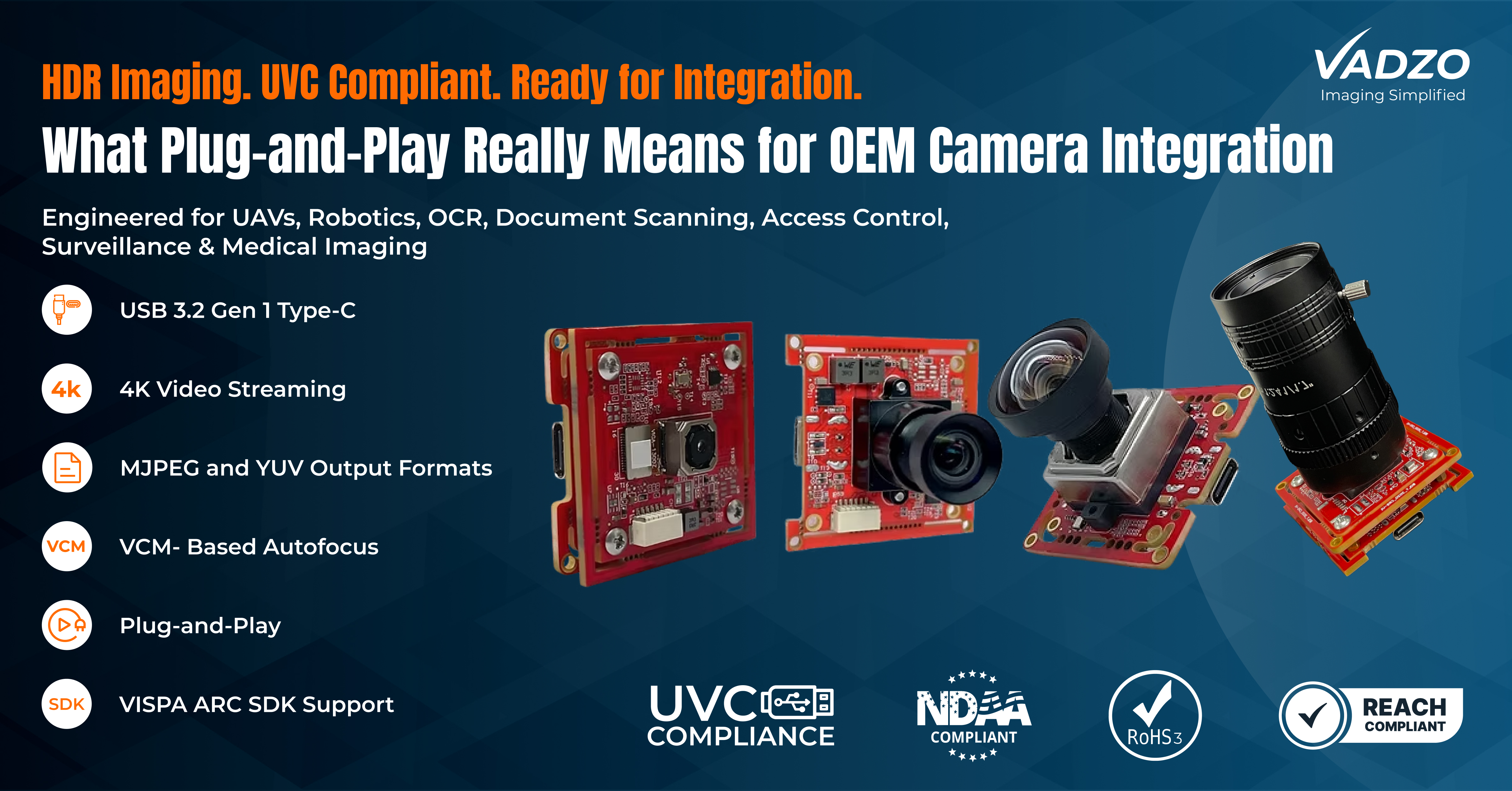
The Falcon UVC USB Camera Lineup
Each camera in this lineup addresses a distinct imaging requirement while sharing the same integration foundation: full UVC compliance, USB 3.2 Gen 1 connectivity, VISPA ARC SDK support and a compact board footprint designed for direct embedded integration. Together they give OEM teams a single supplier and a single SDK across four different sensor architectures and application categories.
Falcon-821CRH: 8.3MP 4K HDR Autofocus USB 3.2 Gen 1 UVC Camera
The Falcon-821CRHM, 8 MP USB camera built on the Onsemi AR0821 HyperLux sensor the Falcon-821CRH delivers 8.3MP 4K resolution at 30fps with embedded HDR exceeding 140 dB and an M12 VCM autofocus system that adapts to varying subject distances through software-controlled focus. In-pixel binning, windowing and flexible ROI give system designers direct control over bandwidth and processing load. It is particularly well suited for UAV imaging, OCR systems, access control and edge AI deployments where both dynamic range and depth variability are system constraints.
Falcon-1335CRA: 13MP 4K Autofocus USB 3.2 Gen 1 UVC Camera
For applications that demand higher resolution than the 8.3MP AR0821 platform the Falcon-1335CRA delivers 13MP USB Camera built on the Onsemi AR1335 sensor with VCM-based autofocus covering 100mm to infinity. ROI-based AE and AF, Digital PTZ and iHDR are supported through a full UVC interface. It is particularly well suited for document scanning kiosks, OCR stations, product label capture and retail AI applications where variable working distance and fine text detail both matter.
Falcon-234CGS: 2MP Global Shutter USB 3.0 UVC Camera
Where the application involves fast-moving subjects or a camera mounted on a moving platform the Falcon-234CGS provides 2MP global shutter camera that captures every pixel at the same instant eliminating the rolling shutter distortion that affects scene accuracy at speed. Built on the AR0234 sensor with USB 3.0 UVC compliance it is used in AGV navigation, drone vision, robotics arms, traffic monitoring and machine inspection conveyor systems where motion fidelity is critical.
Falcon-2020MRS: 20MP Monochrome USB 3.2 Gen 1 UVC Camera
The Falcon-2020MRS, 20MP USB Camera Built on the Onsemi AR2020 HyperLux LP sensor the Falcon-2020MRS delivers 20MP monochrome imaging at 5120 x 3840 with enhanced NIR sensitivity at 850nm and 940nm, LI-HDR, eDR and Wake-on-Motion. Through binning the same camera achieves 4K output serving both ultra-high-resolution and bandwidth-optimized workflows from a single hardware platform. It is particularly well suited for digital pathology, semiconductor inspection, microscopy, night vision surveillance and iris identification where fine feature capture and near-infrared response determine output accuracy.
VISPA ARC SDK: Unified Software Control Across the Lineup
All four cameras are supported by the Vadzo VISPA ARC SDK which provides fine-grained software control over streaming, ROI configuration, exposure, HDR settings, trigger synchronization, binning and windowing beyond what the UVC standard exposes natively. APIs are available for C, C++, C# and Python across Windows, Linux and embedded platforms enabling faster development cycles and straightforward lifecycle management for OEM deployments. For OEM teams that need driverless operation at launch and deeper sensor control as the application matures the SDK provides both paths from a single camera platform.
“OEM teams told us repeatedly that plug-and-play was the starting point not the finish line. They needed cameras that integrate without driver work on day one and then give them full sensor control as the application matures. The four cameras in this lineup are built around that requirement. The UVC interface handles the OS layer and the VISPA ARC SDK handles everything the standard does not expose.” – Alwin Vincent, Product Manager, Vadzo Imaging
Frequently Asked Questions
Q1. What does UVC compliant mean for a USB camera?
A UVC compliant camera follows the USB Video Class standard defined by the USB Implementers Forum. The host operating system recognizes it and drives it using its built-in class driver with no vendor-supplied driver required. All four cameras in this lineup are fully UVC compliant and operate driverlessly on Windows, Linux and Android out of the box.
Q2. Which of the four cameras is best for motion-critical applications like AGV and robotics?
The Falcon-234CGS global shutter camera is the correct choice for motion-critical deployments. It captures every pixel simultaneously eliminating the rolling shutter distortion that causes geometric inaccuracies when subjects or the camera platform are moving. For platforms that additionally need HDR imaging across high-contrast warehouse environments the Falcon-821CRH addresses both requirements in a single compact module.
Q3. What is the difference between the Falcon-821CRH and the Falcon-1335CRA?
Both cameras are UVC compliant autofocus platforms. The Falcon-821CRH delivers 8.3MP 4K HDR imaging with embedded HDR exceeding 140 dB on the Onsemi AR0821 sensor making it the stronger choice for high-contrast scene environments. The Falcon-1335CRA delivers 13MP imaging on the Onsemi AR1335 sensor making it the higher-resolution choice for OCR, document scanning and label capture applications where pixel density at the capture plane determines recognition accuracy.
Q4. Can the Falcon-2020MRS deliver 4K output despite being a 20MP camera?
Yes. The Falcon-2020MRS achieves 4K output through on-sensor binning providing a flexible resolution path that allows the same camera to serve both 20MP ultra-high-resolution workflows and bandwidth-optimized 4K deployments within the same system architecture without swapping hardware.
Q5. Do all four cameras support the VISPA ARC SDK?
Yes. All four cameras are supported by the VISPA ARC SDK which provides APIs for C, C++, C# and Python across Windows, Linux and embedded platforms. The SDK enables fine-grained control over streaming, ROI, exposure, HDR settings, trigger synchronization, binning and windowing beyond what the UVC standard exposes natively.
Availability
The Falcon-821CRH, Falcon-1335CRA, Falcon-234CGS and Falcon-2020MRS are available now for evaluation and pre-production sampling with production quantities available for OEM deployment. Engineering teams can access full technical datasheets, CAD files and SDK documentation through Vadzo’s online store at vadzoimaging.com or contact Vadzo’s sales team directly for volume pricing, customization requirements and integration support.
About Vadzo Imaging
Vadzo Imaging develops embedded and machine vision cameras for OEMs and system integrators building production-ready vision systems across industrial automation, robotics, healthcare and smart infrastructure. The company’s imaging platforms span USB, MIPI, GigE, Wi-Fi and SerDes interfaces covering the full range of embedded deployment architectures from compact edge devices to distributed networked systems. Beyond hardware Vadzo provides end-to-end imaging support including sensor integration, ISP tuning, firmware development and SDK frameworks giving engineering teams a single partner from initial evaluation through production lifecycle management.
Media Contact
Alwin Vincent
Vadzo Imaging
Email: [email protected]
LinkedIn: Vadzo Imaging
YouTube: Vadzo Imaging
X: Vadzo Imaging
SOURCE: Vadzo Imaging