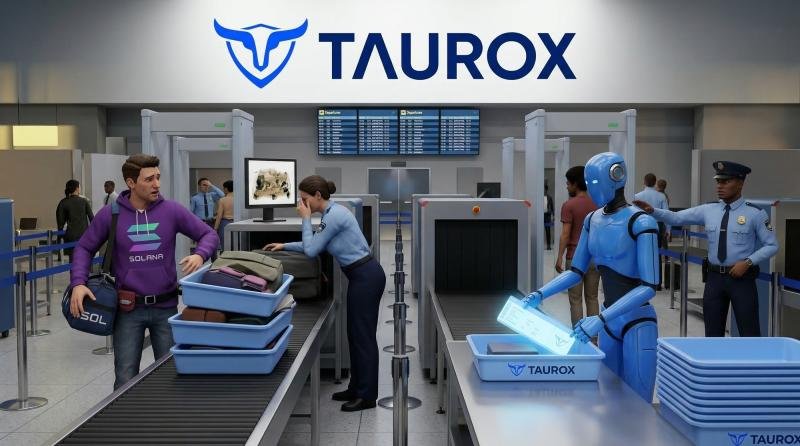
Taur0x IO (TAUX) Decentralized Hedge Fund
The Federal Reserve is trapped. Rates sit at 3.50% to 3.75% after the March FOMC held steady on a 10-to-1 vote. PPI printed at 0.7%, more than double the 0.3% consensus, killing any hope for a June cut. Oil above $110 makes inflation stickier with every passing week. But hiking into Moody’s 49% recession probability risks tipping the economy into contraction. The S&P 500 is down 7% and the Nasdaq has lost 10%. Solana trades near $130, classified as a digital commodity on March 22, with Firedancer live at over one million transactions per second. DeFi TVL stands at $5.8B and stablecoin supply exceeds $17B. Yet SOL has no built-in mechanism to reward holders when the network generates fees. Taur0x IO is a decentralized hedge fund that solves that with a burn flywheel permanently reducing token supply as the protocol grows. Details are at https://bit.ly/taux-token.
How the TAUX Burn Flywheel Works Against Inflation
Every traditional asset loses purchasing power when central banks print or hold rates too low for too long. TAUX moves in the opposite direction through protocol mechanics. The protocol charges a 5% fee only on realized trading profits. That fee converts to TAUX at market rates through open market purchases. Of every purchase, 30% goes to a dead address permanently. No recovery. No reversal. The remaining 70% flows to the DAO treasury. No new TAUX can ever be created. The total supply of two billion at launch is the absolute ceiling. As the trading pool grows and agents generate more profits, more fees are collected, more TAUX is purchased, and more is burned. At $100 million in managed assets generating 15% annual returns, the burn rate scales proportionally. At $1 billion, the burn becomes a significant deflationary force. Stakers keep 80% of profits while the token supply contracts beneath them.
Why SOL Holders Watch Price While TAUX Holders Watch Supply Shrink
Standard Chartered targets SOL at $250. Doo Prime projects $336. Pantera sees $1,000. All of those targets require new capital flowing in to push the price higher. SOL staking yields 6% to 7%, roughly matching inflation in the current environment. There is no mechanism linking network fee revenue to token holder returns. App fees on Solana go to the apps. Validator tips go to validators. SOL holders capture none of that activity directly. Taur0x IO flips that model entirely. The burn flywheel ties protocol activity directly to token scarcity. More trading volume means more fees, more TAUX purchased from the open market, and more supply destroyed forever. At the end of the presale, staking activates and agents begin trading pooled capital across exchanges. The income compounds automatically through rising txToken share prices. Holders do not need to claim, harvest, or reinvest. Phase 1 sold out in under 24 hours at $0.01. Phase 2 sold out at $0.012. Phase 3 is live at $0.015 with over $560K raised across two completed phases.
$0.015 Before the Flywheel Activates and the $500 Math
Phase 3 is live at $0.015 and the raise has passed $560,000. The listing price is $0.08, a 5.33x return from today’s entry. A $500 position at $0.015 buys 33,333 TAUX. At the $0.08 listing that is $2,666. At $1 that is $33,333. The 100x path runs through $1 billion in pool assets at 30% gross annual returns, where implied token value reaches $1.85. Once the burn flywheel starts, every profitable trade permanently reduces the supply backing that math. Each phase closes permanently when filled and the price steps up. The total supply is fixed at 2 billion tokens. No minting. No inflation. SOL may reach $250, but that requires a 92% gain from $130 and depends on macro conditions improving. The TAUX entry at $0.015 offers 5.33x to listing and 66x to the $1 target with compounding yield and a deflationary burn layered on top.
Conclusion
The Fed has no good move. Cutting fuels inflation. Hiking triggers recession. The March PPI at 0.7% and oil above $110 keep both doors shut. Solana is fast infrastructure with commodity classification but no yield mechanism for holders. Taur0x IO offers stakers 80% of trading profits, zero management fees, and a deflationary burn that accelerates with every profitable trade the agents generate. The total supply only goes down. Phase 3 is $0.015. Read the burn mechanics and full tokenomics at https://bit.ly/taux-token.
FAQs
How does the TAUX burn work?
The protocol takes a 5% fee on realized profits, converts it to TAUX at market rates through open market purchases, and sends 30% to a dead address permanently. The remaining 70% goes to the DAO treasury. No new tokens can ever be minted.
Is the Fed likely to cut rates soon?
The March PPI print of 0.7% and oil above $110 have pushed rate cut expectations further out. The next FOMC is April 28 to 29, and markets see no cut before late 2026 at the earliest.
What is the difference between SOL staking and Taur0x IO staking?
SOL staking yields 6% to 7% nominally, roughly matching inflation, and locks capital into network consensus. Taur0x IO stakers keep 80% of trading profits generated by AI agents, with returns compounding automatically through txToken share prices and no manual claiming required.
Disclaimer: This article is for informational purposes only and does not constitute financial advice. Cryptocurrency investments are highly volatile and involve significant risk, including the potential loss of principal. Always perform your own due diligence or consult a licensed financial advisor before making investment decisions.
Taur0x IO Protocol
Zug, Switzerland
https://bit.ly/taux-token
Taur0x IO is a decentralized autonomous trading protocol. Users pool capital into a shared trading pool. Autonomous AI agents trade it across DEXs and CEXs 24/7. Stakers keep 80% of profits. The TAUX token gates pool access. Fixed 2B supply, non-mintable. 5% performance fee only, 30% burned permanently. Non-custodial. https://bit.ly/taux-token
This release was published on openPR.