Market Overview
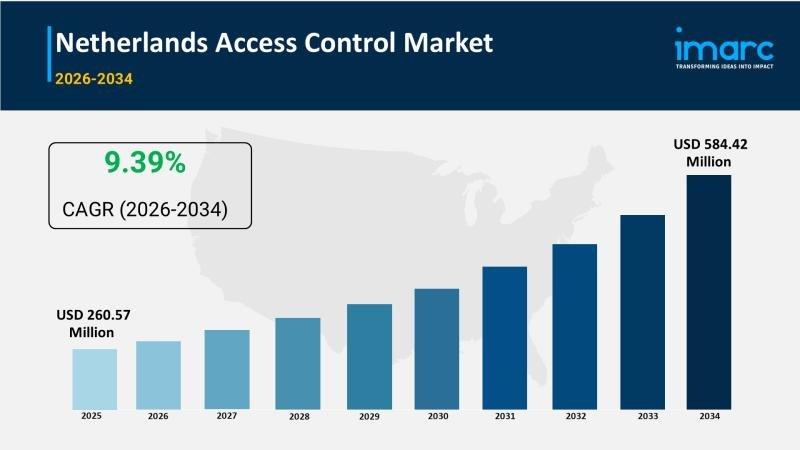
The Netherlands access control market size reached USD 260.57 Million in 2025 and is projected to reach USD 584.42 Million by 2034, exhibiting a growth rate (CAGR) of 9.39% during 2026-2034. The market is primarily driven by increasing security concerns across commercial, residential, and government sectors, coupled with rising adoption of advanced technologies such as biometric systems, cloud-based solutions, and Internet of Things (IoT) integration. Regulatory compliance requirements, including data protection laws, are pushing organizations to implement robust access management. Additionally, smart city initiatives and the growing need for seamless, contactless, and remote access solutions are fueling demand, while digital transformation trends in enterprises and public infrastructure further accelerate Netherlands access control market share.
The Netherlands access control market is gaining strong momentum due to rising demand for advanced security solutions across commercial, residential, and critical infrastructure sectors. Increasing adoption of cloud-based access control and “Access Control as a Service” models is enabling scalable and flexible security systems. Additionally, integration of AI, biometrics, and IoT technologies, along with growing smart city initiatives and strict data protection regulations, is driving innovation and positioning the market for sustained growth.
Request for a sample report PDF: https://www.imarcgroup.com/netherlands-access-control-market/requestsample
Netherlands Access Control Market Summary
• Strong market growth is being driven by escalating security threats including cyberattacks, unauthorized access, and physical intrusions, compelling organizations across all sectors to invest in modern, scalable access control solutions
• Rising adoption of advanced technologies including biometric authentication, smart cards, cloud-based management, and multi-factor verification is transforming the Netherlands access control landscape across commercial, government, and residential segments
• Growing IoT integration is enabling smart building ecosystems where access control systems communicate seamlessly with lighting, HVAC, and surveillance platforms for comprehensive security management
• Market segmentation includes component (controller, reader, locks, and software), type (card-based and biometric-based), end user (government, commercial, healthcare, manufacturing and industrial, transport, education, residential, and others), and region
• Stringent regulatory compliance requirements including GDPR and sector-specific mandates are compelling organizations in healthcare, banking, critical infrastructure, and government to deploy sophisticated access management systems
• Smart city initiatives and digital transformation programs across Dutch public infrastructure are accelerating demand for seamless, contactless, and remotely managed access solutions
• Competitive landscape includes global access control hardware manufacturers, cloud security software providers, IoT solution integrators, and biometric technology specialists
• In February 2025, the Netherlands recorded over 550 million log-ins via its national digital ID system DigiD – a 15% increase from 2023 – signaling strong and growing national momentum toward secure digital identity and access management
• The Netherlands access control market exhibits strong growth potential driven by the country’s advanced digital infrastructure, high regulatory standards, and broad enterprise and public sector adoption across key provinces
How AI is Reshaping the Netherlands Access Control Market
Artificial intelligence is increasingly central to the Netherlands access control market, enabling security solution providers, enterprises, and public institutions to enhance threat detection, automate access management, and deliver more intelligent, adaptive security ecosystems across physical and digital environments.
• Intelligent Threat Detection and Anomaly Identification: AI-powered analytics continuously monitor access patterns and flag anomalous behavior – such as repeated failed authentication attempts, unusual access timing, or unauthorized zone entries – enabling real-time threat identification and faster security response across commercial and government facilities.
• Facial Recognition and Biometric Optimization: Machine learning algorithms enhance the accuracy and speed of facial recognition and other biometric authentication systems, reducing false acceptance and rejection rates while enabling reliable contactless access in high-traffic environments such as transport hubs, hospitals, and corporate campuses.
• Predictive Access Management: AI platforms analyze historical access data and personnel movement patterns to predict access requirements, automate permission adjustments, and optimize security protocols – reducing administrative overhead while maintaining compliance with GDPR and sector-specific regulatory frameworks.
• Integrated Video Surveillance Analytics: AI-driven video analytics integrated with access control systems deliver real-time monitoring, automated intrusion detection, and intelligent alerting – enhancing situational awareness and enabling security teams to respond proactively to physical security incidents.
• Cloud-Based AI Security Operations: Cloud-deployed AI platforms enable centralized, remote management of access control systems across multiple sites, providing organizations with unified dashboards, automated compliance reporting, and AI-assisted audit trail analysis for regulatory accountability.
• Smart Building Automation: AI facilitates seamless interoperability between access control systems and building management platforms – including lighting, HVAC, and energy systems – enabling intelligent automation that responds dynamically to occupancy patterns and security events across Dutch commercial and public buildings.
• Digital Identity Verification and eIDAS Compliance: AI-powered identity verification tools support the Netherlands’ national digital identity infrastructure – including DigiD and eHerkenning – by automating identity validation workflows, detecting fraudulent access attempts, and ensuring compliance with EU eIDAS digital identity regulations.
Key Trends Shaping the Netherlands Access Control Market
Rising Security Concerns Across Sectors: Growing security threats and incidents, such as cyberattacks, unauthorized access, and physical intrusions, are a principal driver of the Netherlands access control market. Companies, residential buildings, schools, and government buildings are focusing on the necessity of effective security solutions to safeguard critical data, assets, and human resources. Growth in urbanization and greater concentration of key infrastructure further compels the demand for managed access systems. Organizations are embracing advanced technologies like biometric authentication, smart cards, and multi-factor verification to counter risks. Additionally, the merging of surveillance with access control systems boosts monitoring capabilities, offering real-time alerts and improved response time in emergency situations. These increased security needs are forcing institutions to invest in contemporary, scalable access control solutions to secure physical and digital assets effectively.
Technological Advancements and IoT Integration: The access control market in the Netherlands is being highly influenced by rapid technological advances and IoT device integration. Contemporary access control systems now provide capabilities including cloud-based management, mobile credentials, AI analytics, and seamless IoT connectivity, enabling centralized monitoring and improved automation. These technologies make it possible for organizations to monitor, control, and limit access in real time, bolstering operational efficiency and security management. IoT integration allows for smart buildings, with access control able to communicate with lighting, HVAC, and surveillance systems to deliver a complete security ecosystem. Further development in biometric technologies, facial recognition, and mobile access applications is resulting in more convenient, contactless solutions – particularly relevant in a post-pandemic environment. Such technological advancement fosters mass adoption across commercial, industrial, and residential segments, driving Netherlands access control market growth.
Regulatory Compliance and Data Protection Requirements: Compliance with regulations is a key driver for the Netherlands access control market. Companies are required to adhere to stringent privacy and data protection laws, such as GDPR, which calls for secure management of personal and sensitive data. Non-compliance carries serious consequences, compelling organizations to deploy effective access control systems to protect both physical sites and digital resources. Compliance extends to sectors such as critical infrastructure, healthcare, banking, and government, where restricted access is necessary to comply with legal and safety mandates. Access control systems provide valid authorization, audit trails, and accountability required for regulatory reporting purposes. Industry standards and certifications also prompt organizations to embrace sophisticated technologies such as biometric authentication, cloud-based authentication, and multi-factor access, improving security and compliance. This regulatory environment continues to fuel investment in dependable, secure access control systems nationwide.
Browse the full report with TOC and list of figures: https://www.imarcgroup.com/netherlands-access-control-market?utm_source=openpr&utm_medium=referral&utm_campaign=imarc_ref&utm_term= netherlands access control market +t…
Market Growth Drivers
Escalating Security Threats, Smart City Development, and Digital Transformation Imperatives
The Netherlands access control market growth is anchored in the persistent escalation of physical and cyber security threats across commercial, government, healthcare, and residential sectors, creating sustained demand for advanced, multi-layered access management solutions that protect critical assets, personnel, and sensitive data. The Netherlands’ ambitious smart city development agenda – encompassing intelligent building infrastructure, connected public facilities, and integrated urban security systems – is driving the deployment of IoT-enabled access control platforms that deliver centralized, real-time management across geographically distributed sites. The country’s advanced digital infrastructure and high rate of enterprise digital transformation are accelerating the migration from legacy physical access systems to cloud-based, mobile-credential, and AI-powered solutions that offer superior scalability, operational efficiency, and integration with broader enterprise security ecosystems. The rapid growth of contactless and remote access requirements – accelerated by post-pandemic workplace transformation and hybrid working models – is further expanding the addressable market for biometric and mobile-based access technologies throughout the 2026-2034 forecast period.
Regulatory Compliance, National Digital Identity Expansion, and Biometric Innovation
The Netherlands’ stringent regulatory environment – encompassing GDPR, sector-specific data protection mandates, and the EU’s eIDAS digital identity framework – is structurally compelling organizations across all major end-user verticals to invest in robust, auditable, and compliant access control infrastructure that meets the country’s high legal and security standards. The ongoing expansion of the Netherlands’ national digital identity ecosystem – with DigiD recording over 550 million log-ins in February 2025, representing a 15% year-on-year increase – signals accelerating societal adoption of secure digital identity and access frameworks that are driving broader access control modernization across both public and private sectors. Rapid innovation in biometric technologies including facial recognition, iris scanning, and fingerprint authentication is continuously improving authentication accuracy, speed, and user convenience – broadening the appeal of biometric-based access systems beyond high-security government and financial sector applications to mainstream commercial, educational, and residential deployments. These converging dynamics of regulatory necessity, national digital identity momentum, and biometric technology advancement collectively underpin the Netherlands access control market’s robust growth trajectory across the forecast period.
Market Segmentation
IMARC Group’s research categorizes the Netherlands access control market as follows:
By Component:
• Controller
• Reader
• Locks
• Software
By Type:
• Card-Based
o Contact
o Contactless
• Biometric-Based
o Fingerprint
o Face Recognition
o Face Recognition and Fingerprint
o Iris Recognition
o Others
By End User:
• Government
• Commercial
• Healthcare
• Manufacturing and Industrial
• Transport
• Education
• Residential
• Others
By Region:
• Noord-Holland
• Zuid-Holland
• Noord-Brabant
• Gelderland
• Utrecht
• Others
Key Players
The Netherlands access control market features competition among global access control hardware manufacturers, cloud-based security software providers, IoT solution integrators, biometric technology specialists, and system integrators delivering end-to-end physical and digital security solutions across commercial, government, and industrial end-user segments. The market research report provides a comprehensive analysis of the competitive landscape including key player positioning, market structure, top winning strategies, competitive dashboards, and detailed company profiles.
Key Aspects Required for Netherlands Access Control Market
• Demand is driven primarily by escalating physical and cyber security threats compelling organizations across all sectors to deploy modern, scalable, and compliant access management infrastructure
• Strong linkage between the Netherlands’ advanced digital transformation agenda and the accelerating adoption of cloud-based, IoT-integrated, and AI-powered access control solutions
• Product segmentation includes hardware components (controller, reader, locks), software platforms, and access type technologies spanning card-based and biometric-based systems
• Distribution channels include direct enterprise sales, system integrator partnerships, cloud subscription models, and government procurement programs
• Expansion of smart building and smart city projects driving large-scale, multi-site access control deployments across Dutch commercial real estate, public infrastructure, and transport networks
• Rising investment in national digital identity infrastructure including DigiD and eHerkenning supporting broader secure access adoption across public and private service sectors
• Supply chain includes hardware component manufacturers, software developers, cloud infrastructure providers, biometric sensor suppliers, installation specialists, and maintenance service providers
• Increasing role of EU regulatory frameworks including GDPR and eIDAS in shaping access control technology standards and compliance requirements across Dutch organizations
• Growing adoption in high-density commercial and government regions including Noord-Holland, Zuid-Holland, and Utrecht driven by concentration of enterprise, financial, and public sector facilities
• Integration of access control systems with HR management platforms, visitor management solutions, and enterprise resource planning systems for unified identity and access governance
• Rising demand for scalable, remotely managed access control solutions supporting hybrid work environments and multi-site corporate security management
• Expansion of biometric access applications beyond traditional high-security sectors into healthcare, education, residential, and transport end-user segments
• Increasing focus on cybersecurity resilience within access control system architecture to protect against digital intrusion, credential theft, and system manipulation
Recent News and Developments
February 2025: The Netherlands recorded over 550 million log-ins using its national digital ID system DigiD, representing a 15% increase from 2023. The government announced plans to expand digital ID options by allowing private-sector log-ins alongside DigiD and eHerkenning, as mandated by the Digital Government Act. The expansion introduces legal digital representation for minors under 12 via the ToegangVerleningService, supporting compliance with the EU’s eIDAS regulation and promoting secure access to both public and private services.
Speak to an analyst for a customized sample report: https://www.imarcgroup.com/request?type=report&id=41711&flag=C
Contact Us
IMARC Group,
134 N 4th St. Brooklyn, NY 11249, USA,
Email: sales@imarcgroup.com
Tel No: (D) +91 120 433 0800,
United States: +1-201-971-6302
About Us
IMARC Group is a global management consulting firm that helps the world’s most ambitious changemakers to create a lasting impact. The company provides a comprehensive suite of market entry and expansion services. IMARC offerings include thorough market assessment, feasibility studies, company incorporation assistance, factory setup support, regulatory approvals and licensing navigation, branding, marketing and sales strategies, competitive landscape and benchmarking analyses, pricing and cost research, and procurement research.
This release was published on openPR.