Market Overview
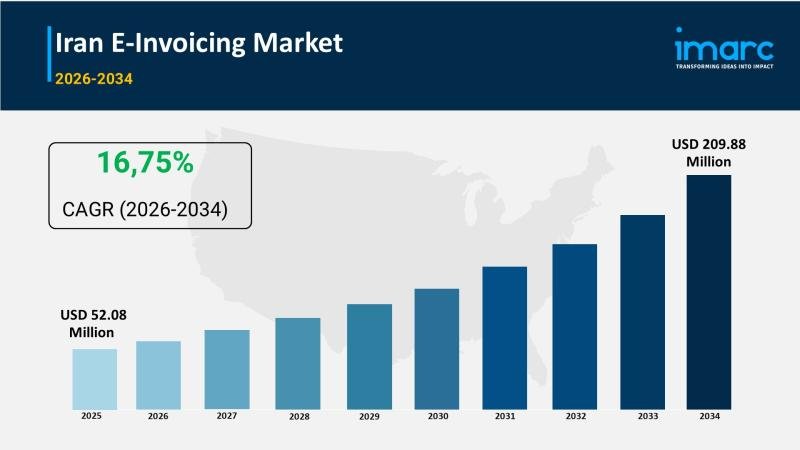
The Iran e-invoicing market size reached USD 52.08 Million in 2025 and is projected to reach USD 209.88 Million by 2034, exhibiting a growth rate (CAGR) of 16.75% during 2026-2034. The market is growing steadily due to increasing digital adoption and government initiatives promoting electronic billing. Both small and large businesses across various industries are shifting towards efficient, real-time invoicing systems to improve accuracy and reduce paperwork. Cloud-based solutions and regulatory support play key roles in accelerating this trend.
The Iran e-invoicing market is gaining traction as part of the country’s broader digital tax transformation and efforts to improve financial transparency. Government initiatives to formalize the economy and reduce tax evasion are encouraging adoption of electronic invoicing systems. Additionally, the rapid expansion of Iran’s e-commerce sector and increasing digital transactions are creating strong demand for automated invoicing solutions, positioning the market for steady growth and regulatory-driven adoption.
Request for a sample report PDF: https://www.imarcgroup.com/iran-e-invoicing-market/requestsample
Iran E-Invoicing Market Summary
• Strong market growth is being driven by government mandates requiring businesses – particularly large-scale and high-turnover entities – to adopt compliant digital invoicing formats in place of traditional paper-based systems
• Increasing digital adoption across Iranian businesses of all sizes is accelerating the transition toward real-time, automated invoicing solutions that improve accuracy and reduce administrative overhead
• Cloud-based deployment models and regulatory frameworks are playing key roles in lowering the barriers to e-invoicing adoption across multiple industries
• Market segmentation includes channel (B2B, B2C, and others), deployment type (cloud-based and on-premises), and application (energy and utilities, FMCG, e-commerce, BFSI, government, and others)
• Iran’s tax authority is advancing real-time invoice validation systems integrated with national payment networks to enhance tax compliance and curb invoice-related fraud
• Adoption of internationally recognized structured invoice formats such as UBL and XML is supporting regional trade integration and cross-border electronic documentation
• Competitive landscape includes domestic fintech solution providers, ERP platform developers, cloud software vendors, and government-backed digital infrastructure operators
• Approximately 65% of major corporations have implemented compliant e-invoice systems, while around 70% of invoices from manufacturing and wholesale sectors are now processed digitally
• E-invoicing penetration among small and medium-sized enterprises remains an area of significant growth opportunity as regulatory mandates progressively expand to cover additional business categories
How AI is Reshaping the Iran E-Invoicing Market
Artificial intelligence is increasingly central to the Iran e-invoicing market, enabling tax authorities, software developers, and businesses to enhance compliance automation, fraud detection, and operational efficiency across the country’s rapidly evolving digital invoicing ecosystem.
• Automated Invoice Validation: AI-powered systems automatically validate e-invoice data against tax authority requirements in real time, reducing manual review burdens and ensuring regulatory compliance across B2B and B2C transactions.
• Fraud Detection and Anomaly Identification: Machine learning models analyze invoice patterns to detect duplicate submissions, inflated amounts, and other fraudulent activities – enhancing the integrity of Iran’s digital tax infrastructure and reducing revenue leakage.
• Intelligent Data Extraction: AI-driven optical character recognition and natural language processing tools extract structured data from diverse invoice formats, enabling seamless integration with ERP platforms and reducing manual data entry errors.
• Predictive Compliance Monitoring: AI platforms continuously monitor regulatory changes and automatically update invoicing templates and workflows to ensure ongoing compliance with evolving government mandates and tax authority requirements.
• Smart ERP Integration: AI facilitates seamless interoperability between e-invoicing systems and enterprise resource planning platforms, automating the end-to-end flow of invoice data from generation through to tax authority submission without manual interference.
• Cross-Border Invoice Standardization: AI tools assist businesses in automatically converting invoice formats to internationally recognized standards such as UBL and XML, supporting Iran’s regional trade integration and cross-border e-documentation pilot programs.
• Analytics and Reporting for Tax Authorities: AI-powered analytics dashboards provide Iran’s tax authorities with real-time visibility into transaction flows, sector-level compliance rates, and audit risk indicators – supporting more targeted and efficient regulatory oversight.
Key Trends Shaping the Iran E-Invoicing Market
Broad Mandates Extend E-Invoicing Coverage: Iran is actively broadening its e-invoicing regulations to encompass additional sectors, responding to the demand for transparency and efficiency in tax administration. The Ministry of Economic Affairs and Finance has been encouraging businesses – especially large-scale and high-turnover entities – to adopt digital invoicing formats and move away from traditional paper invoicing systems. Approximately 65% of major corporations have implemented compliant e-invoice systems, reflecting substantial migration toward nationwide digital invoicing. The expansion reduces paperwork for government audits and helps curb invoice-related fraud. New mandates specify uniform e-invoice templates, secure digital signatures, and mandatory archiving. These regulations also drive system upgrades in small and medium-sized enterprises. Integrating invoicing with existing financial software is becoming essential, as it facilitates automated compliance and reduces administrative burdens – enabling smoother tax operations and setting the stage for a more robust digital financial ecosystem.
Real-Time Invoice Processing Strengthens Controls: In 2025, Iran’s tax authority launched a pilot program for a real-time e-invoice validation system designed to enhance tax compliance and reduce fraud. This advanced system cross-references digital invoice data with national payment records through the Shetab interbank network, enabling near-instant verification of transactions. Currently, around 70% of invoices from sectors like manufacturing and wholesale are processed digitally, minimizing the potential for hidden revenue and boosting transparency. Mandatory digital signatures and encrypted QR codes ensure document authenticity and facilitate efficient audit processes. The system integrates with enterprise resource planning platforms, allowing seamless flow of invoice data from generation to tax authority submission without manual interference. These initiatives align with Iran’s broader strategy to modernize treasury and tax functions through centralized digital gateways, reducing administrative burdens for compliant businesses while improving regulatory oversight.
Interoperability and Regional Alignment Accelerate Adoption: Iran is progressing towards e-invoicing interoperability by adopting internationally recognized structured invoice formats like UBL and XML, facilitating regional trade integration. In early 2025, Iran initiated pilot programs with neighboring countries to test cross-border electronic tax documentation. These pilots focus on utilizing standardized digital invoice templates to streamline customs clearance and regulatory compliance in international trade. Over 50% of export-related invoices are already formatted to be compatible with such regional systems. This harmonization strategy reduces the cost and complexity of system upgrades for businesses, easing their transition toward compliant invoicing practices. Regional alignment supports increased export transparency, fostering smoother trade flows and better regulatory cooperation – positioning Iran to integrate more fully with larger regional economies and support efficient commercial infrastructure.
Browse the full report with TOC and list of figures:
https://www.imarcgroup.com/iran-e-invoicing-market?utm_source=openpr&utm_medium=referral&utm_campaign=imarc_ref&utm_term= Iran e-invoicing market +t…
Market Growth Drivers
Government Mandates, Digital Transformation, and Tax Modernization Imperatives
The Iran e-invoicing market growth is anchored in the Iranian government’s strategic commitment to modernizing its tax administration infrastructure through mandatory digital invoicing adoption – creating a compliance-driven demand pull that is progressively extending across business sizes and industry sectors. The Ministry of Economic Affairs and Finance’s regulatory framework, which enforces uniform e-invoice templates, mandatory digital signatures, and secure archiving requirements, is compelling businesses to invest in compliant invoicing systems and driving widespread platform adoption beyond early technology adopters. Iran’s broader digital transformation agenda – encompassing centralized digital gateways, electronic payment network integration through the Shetab interbank system, and real-time invoice validation infrastructure – is fundamentally reshaping the operational landscape for both businesses and tax authorities. The combination of compliance necessity and efficiency gains from automated invoicing is generating sustained demand for cloud-based and on-premises e-invoicing solutions throughout the 2026-2034 forecast period.
Cloud Adoption, ERP Integration, and Regional Trade Interoperability
Rapid adoption of cloud-based deployment models is democratizing access to e-invoicing solutions across Iranian businesses of all sizes, enabling cost-effective compliance without the need for significant on-premises IT infrastructure investment – particularly benefiting small and medium-sized enterprises that represent a large untapped segment of the addressable market. The integration of e-invoicing platforms with enterprise resource planning systems is automating end-to-end financial workflows, reducing manual data entry, improving accuracy, and delivering measurable operational efficiency gains that create compelling business cases for adoption beyond regulatory compliance alone. Iran’s strategic initiative to adopt internationally recognized invoice standards such as UBL and XML – supported by cross-border pilot programs with neighboring countries – is positioning the country’s digital invoicing infrastructure for regional trade integration, expanding the commercial value proposition of e-invoicing beyond domestic tax compliance to encompass international trade facilitation and export documentation efficiency.
Market Segmentation
IMARC Group’s research categorizes the Iran e-invoicing market as follows:
By Channel:
• B2B
• B2C
• Others
By Deployment Type:
• Cloud-based
• On-premises
By Application:
• Energy and Utilities
• FMCG
• E-Commerce
• BFSI
• Government
• Others
By Province:
• Tehran
• Khuzestan
• Bushehr
• Esfahan
• Khorasan
• Others
Key Players
The Iran e-invoicing market features competition among domestic fintech solution providers, enterprise resource planning platform developers, cloud software vendors, and government-backed digital infrastructure operators supporting Iran’s national e-invoicing mandate and tax modernization agenda. The market research report provides a comprehensive analysis of the competitive landscape including key player positioning, market structure, top winning strategies, competitive dashboards, and detailed company profiles.
Key Aspects Required for Iran E-Invoicing Market
• Demand is driven primarily by government compliance mandates requiring businesses to adopt standardized digital invoicing formats across multiple sectors
• Strong linkage between Iran’s tax modernization agenda and the accelerating adoption of real-time e-invoicing validation systems integrated with national payment infrastructure
• Product segmentation includes cloud-based and on-premises deployment models across B2B, B2C, and government application channels
• Increasing preference for cloud-based solutions among small and medium-sized enterprises due to lower upfront costs and easier regulatory compliance management
• Businesses prioritize seamless ERP integration, automated compliance workflows, and secure digital signature capabilities
• Growing demand for AI-powered fraud detection and anomaly identification tools embedded within e-invoicing platforms
• Competitive landscape includes domestic software developers, cloud platform vendors, ERP integrators, and government technology partners
• Distribution channels include direct software licensing, cloud subscription models, and government-mandated platform onboarding programs
• Expansion of mandatory e-invoicing coverage progressively extending from large corporations to small and medium-sized enterprises
• Rising investment in real-time invoice validation infrastructure and national digital payment network integration
• Supply chain includes software developers, cloud infrastructure providers, ERP vendors, digital signature certificate authorities, and tax authority technology partners
• Increasing role of government regulatory frameworks in driving platform standardization and uniform invoice template adoption
• Growing adoption in major commercial and industrial provinces including Tehran, Esfahan, Khuzestan, and Khorasan
• Integration of internationally recognized invoice formats supporting cross-border trade documentation and regional interoperability
• Rising demand for transparent, auditable, and tamper-proof invoicing systems to support Iran’s broader anti-fraud and tax revenue enhancement objectives
• Expansion of sector-specific e-invoicing mandates across energy and utilities, FMCG, e-commerce, and BFSI verticals
• Increasing focus on interoperability standards and regional trade alignment as Iran pursues deeper integration with neighboring economies
Recent News and Developments
• 2025: Iran’s tax authority launched a pilot program for a real-time e-invoice validation system that cross-references digital invoice data with national payment records through the Shetab interbank network, enabling near-instant transaction verification and strengthening tax compliance across manufacturing and wholesale sectors.
• Early 2025: Iran initiated cross-border electronic tax documentation pilot programs with neighboring countries, testing standardized digital invoice templates based on internationally recognized UBL and XML formats to streamline customs clearance, improve regulatory compliance in international trade, and accelerate regional e-invoicing interoperability.
Speak to an analyst for a customized sample report: https://www.imarcgroup.com/request?type=report&id=38030&flag=C
Contact Us
IMARC Group,
134 N 4th St. Brooklyn, NY 11249, USA,
Email: sales@imarcgroup.com
Tel No: (D) +91 120 433 0800,
United States: +1-201-971-6302
About Us
IMARC Group is a global management consulting firm that helps the world’s most ambitious changemakers to create a lasting impact. The company provides a comprehensive suite of market entry and expansion services. IMARC offerings include thorough market assessment, feasibility studies, company incorporation assistance, factory setup support, regulatory approvals and licensing navigation, branding, marketing and sales strategies, competitive landscape and benchmarking analyses, pricing and cost research, and procurement research.
This release was published on openPR.