Vadzo Imaging highlights the Falcon-900MGS, Falcon-234CGS, and Falcon-234MGS – three USB 3.0 global shutter camera built on Sony IMX900 and ON Semiconductor AR0234 sensors, addressing the motion distortion and synchronization challenges that make rolling shutter sensors unsuitable for high-speed robot vision, AGV guidance, and precision robotic inspection.
FORT WORTH, TX / ACCESS Newswire / May 14, 2026 / Vadzo Imaging, a provider of embedded vision camera, is addressing one of the most persistent design bottlenecks in robotic vision system development: what happens to image quality when a rolling shutter camera captures a fast-moving target. For engineers building AGV systems, robotic pick-and-place platforms, surgical robotics, and high-speed inspection lines, rolling shutter distortion produces skewed, smeared, or geometrically inconsistent frames the moment the subject or camera itself is in motion. When downstream algorithms depend on accurate edge detection, dimensional measurement, or target localization, that distortion translates directly to system failures.
Vadzo’s answer is the Falcon series three USB 3.0 global shutter camera, purpose-built for these environments, powered by Sony IMX900 and ON Semiconductor AR0234 sensors, covering monochrome precision inspection, color AGV guidance, and low-light structured-light applications across a single, consistent USB 3.0 platform.
Why Global Shutter Camera Is the Right Sensor Architecture for Robot Vision
Rolling shutter vs global shutter is the defining sensor decision in robot vision design. Rolling shutter sensors read pixel rows sequentially; at the speeds typical of robotic arms, conveyor inspection lines, and AGV platforms, this produces rolling shutter distortion: diagonal edges on vertical objects, deformed circular features, and dimensional measurement errors that post-processing cannot reliably correct. A global shutter imaging camera exposes all pixels simultaneously. There is no skew, no smear, and no geometric inconsistency regardless of subject velocity or camera motion. For any high-speed robot vision camera used in dimensional gauging, barcode reading, or motion-critical inspection, this is not optional it is the baseline requirement.
Across AGV navigation, robotic pick-and-place, surgical imaging, and conveyor inspection, systems built on rolling shutter sensors accumulate image quality failures as throughput increases. Replacing a rolling shutter sensor with a global shutter camera is consistently the single hardware change that closes the accuracy gap and enables the system to meet its specification.
“Robotic vision systems at production throughput cannot tolerate rolling shutter distortion. Every pixel must reflect the same moment in time. Vadzo’s Falcon global shutter cameras are engineered around that requirement from the sensor up, with the OEM flexibility to integrate into any robotic platform our customers are building.” – Alwin Vincent, Product Manager, Vadzo Imaging.
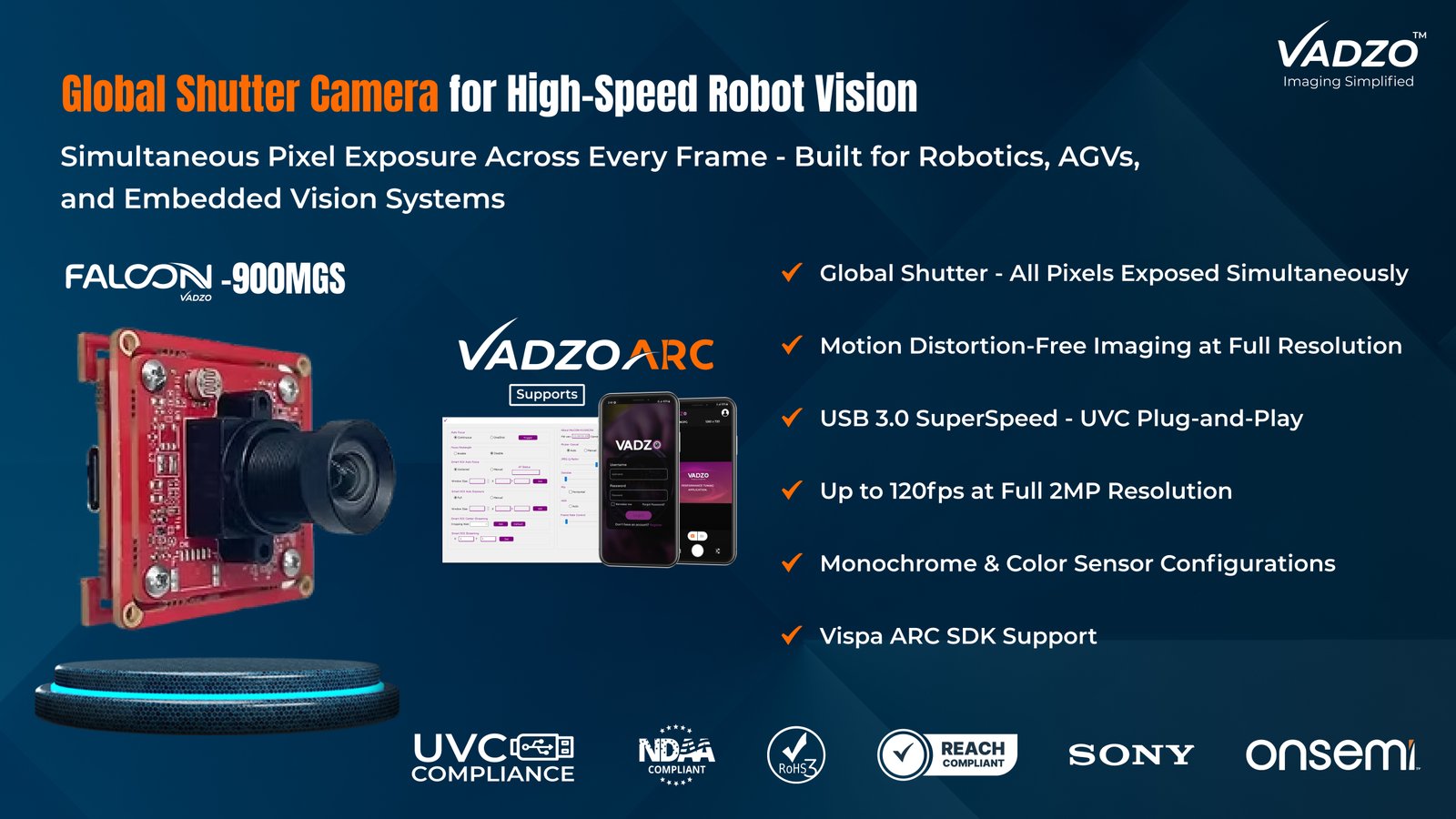
High-resolution robotic inspection and NIR-dependent machine vision tasks expose a gap that most 2MP global shutter camera cannot bridge: insufficient spatial resolution at typical robotic working distances, and reduced NIR sensitivity in color sensor configurations. The Falcon-900MGS IMX900 USB Camera closes both gaps as a 3MP Global Shutter USB 3.0 Camera built on the Sony Pregius S IMX900 sensor. At 3.2MP (2064×1552) with a 2.25μm BSI pixel architecture, this Sony IMX900 Monochrome Global Shutter USB Camera delivers higher resolution than 2MP alternatives while its monochrome configuration maximizes photon sensitivity across visible and near-infrared wavelengths. For systems using structured light, laser line profiling, or IR-based robotic guidance, the Sony IMX900 sensor’s BSI design captures NIR illumination with measurably greater efficiency than front-illuminated sensor architectures. The 3MP IMX900 Mono USB 3.0 Camera integrates directly into standard USB 3.0 host platforms, reducing development overhead in embedded OEM designs.
Robotic systems relying on color-based classification, label inspection, or AGV navigation with color-coded markers need a global shutter camera that preserves both motion integrity and color fidelity simultaneously. A rolling shutter color sensor distorts color boundaries and undermines the spatial consistency that color-dependent vision algorithms require. The Falcon-234CGS is Vadzo’s AR0234 Color Global Shutter USB 3.0 Camera, delivering 2MP (1920×1080) full-HD at up to 120fps with zero rolling shutter distortion regardless of whether the subject, end-effector, or AGV platform itself is in motion. For engineers building AGV camera systems, collaborative robot interfaces, and real-time color inspection platforms, the combination of 120fps and global shutter architecture provides the temporal resolution and motion accuracy that robot vision accuracy camera applications demand. The 2MP AR0234 USB Camera is available as an OEM module, supporting integration into custom enclosures, carrier boards, and robotic vision heads.
When lighting is controlled, and spectral efficiency matters more than color output, a monochrome global shutter camera delivers measurably better sensitivity and contrast than a color configuration. In structured-light 3D profiling, laser triangulation, barcode and QR code reading, and binary-feature-based robot guidance, color information is irrelevant photon sensitivity and spatial acuity determine system performance, and a monochrome sensor delivers both without the quantum efficiency loss of a Bayer color filter array. The Falcon-234MGS is Vadzo’s AR0234 Monochrome Global Shutter USB Camera, providing 2MP (1920×1080) at up to 120fps. As a 2MP Mono Global Shutter Camera, it delivers the same motion distortion-free imaging camera performance as the Falcon-234CGS while maximizing NIR sensitivity for structured-light and low-light robotic inspection. This 1080p AR0234 USB Camera is equally suited to medical device camera applications requiring motion-artifact-free imaging and to NIR camera systems operating under near-infrared illumination.
Key specs: 2MP (1920×1200) | Onsemi AR0234 | Global Shutter | 1/2.6″ 3.0μm Pixel | USB 3.0 | NIR | S-Mount (M12) | −40°C to 85°C
Vispa ARC: Camera Control SDK for Embedded Vision Developers
All three Falcon USB global shutter camera are supported by Vadzo’s Vispa ARC SDK, providing programmatic control over streaming, exposure, gain, white balance, Region of Interest configuration, and firmware updates. The SDK supports C, C++, and Python across Windows, Linux, and Android platforms, enabling robotics engineers, OEM product developers, and edge AI system architects to build and deploy custom vision applications with full control over imaging performance. For teams that prefer standard driver frameworks, all three cameras operate natively under UVC, V4L2, and DirectShow without any proprietary driver dependency.
Robotic Applications for the Falcon Global Shutter Camera Lineup
Precision Inspection and Structured-Light 3D Profiling: Falcon-900MGS
Robotic inspection cells, laser line profilers, and pick-and-place systems that require fine feature resolution at arm working distances need a global shutter camera with both spatial resolution and NIR capability. The Falcon-900MGS IMX900 Global Shutter USB Camera delivers 3.2MP global shutter imaging with Sony IMX900 BSI pixel architecture, capturing crisp, motion-artifact-free frames at the resolution and NIR sensitivity that structured-light and dimensional gauging workflows require.
AGV Navigation and Color Robot Vision: Falcon-234CGS
AGV guidance, collaborative robot interfaces, and color-label inspection platforms require motion-accurate color imaging at throughput speeds where rolling shutter distortion makes color boundaries unreliable. The Falcon-234CGS AR0234 Color Global Shutter USB 3.0 Camera delivers 120fps global shutter color imaging, enabling consistent color-based feature detection, lane tracking, and obstacle classification regardless of platform motion speed.
Barcode Reading, Medical Robotics, and NIR-Based Robot Vision: Falcon-234MGS
Barcode verification, QR code reading, surgical imaging, and near-infrared robotic guidance all share a common requirement: motion-distortion-free imaging under controlled or NIR illumination. The Falcon-234MGS AR0234 Mono Global Shutter USB Camera provides 120fps monochrome global shutter capture with enhanced NIR sensitivity, making it the reliable choice for medical device camera platforms and NIR camera robot vision applications where color output is unnecessary, and quantum efficiency is the deciding factor.
What the Falcon Series Shares: Vadzo’s OEM Commitment to Robotics Engineers
Across all three Falcon global shutter cameras, Vadzo provides a consistent set of OEM services that embedded vision engineers and robotics product teams rely on beyond the camera hardware itself. Full OEM customization covers board redesigns, firmware modifications, lens holder and filter changes, and enclosure design. ISP tuning is calibrated for specific robotic inspection environments across Sony IMX900 and ON Semiconductor AR0234 sensors. Volume pricing, production support, and direct applications engineering support for design-in assistance and production ramp are available on request from Vadzo Imaging.
Frequently Asked Questions (FAQs)
1) Is a global shutter camera necessary for all robotic vision systems, or only for high-speed applications?
Any robotic vision system where the camera or subject moves during exposure benefits from a global shutter camera. At production throughput velocities, rolling shutter distortion is not manageable in post it must be eliminated at the sensor. Both the Falcon-234CGS and Falcon-234MGS, 1080p AR0234 USB 3.0 camera, deliver up to 120fps global shutter capture, covering even the most demanding high-speed robot vision scenarios.
2) What frame rate do the Falcon-234CGS and Falcon-234MGS achieve at full 1080p resolution?
3) Which Falcon global shutter camera is best suited for NIR robotic guidance or structured-light profiling?
The Falcon-900MGS, a 3MP IMX900 Mono USB 3.0 Camera built on the Sony IMX900 Pregius S BSI sensor, is the recommended choice. Its back-illuminated pixel architecture delivers superior NIR sensitivity compared to front-illuminated alternatives, making it purpose-built for laser line profiling and IR-based robotic localization.
4) Can Vadzo customize the Falcon series global shutter camera for a specific OEM form factor?
Yes. Vadzo supports full OEM customization across all three Falcon global shutter cameras board redesigns, firmware modifications, lens and filter changes, and volume production ramp. Design-in assistance and engineering samples are available directly from Vadzo Imaging.
5) Does the Falcon-234CGS function reliably as an AGV camera in both navigation and color-feature detection tasks?
Yes. The Falcon-234CGS AR0234 Color Global Shutter USB 3.0 Camera delivers 120fps with full global shutter architecture at 2MP. It handles color marker detection, lane tracking, and obstacle classification in AGV camera deployments where motion-accurate color imaging at speed is a hard system requirement.
Availability
The Falcon-900MGS IMX900 USB 3.0 Camera, Falcon-234CGS 2MP AR0234 USB 3.0 Camera, and Falcon-234MGS AR0234 Monochrome USB 3.0 Camera are available for OEM evaluation. Engineering samples, technical documentation, and integration support are available directly from Vadzo Imaging. Volume pricing, firmware customization, optics, and enclosure design services are available upon request. For inquiries, contact the Vadzo Imaging sales team at [email protected].
About Vadzo Imaging
Vadzo Imaging develops high-performance embedded and machine vision camera for OEMs and system integrators building next-generation intelligent systems. The company delivers imaging platforms across USB, MIPI, GigE, Wi-Fi, and SerDes interfaces, supporting applications in industrial automation, robotics, smart surveillance, smart city infrastructure, and edge AI. Beyond hardware, Vadzo provides end-to-end imaging expertise, including sensor integration, ISP tuning, firmware development, and OEM customization services that accelerate development and deployment at scale.