Vadzo Imaging expands its ONVIF GigE camera and ONVIF WiFi camera portfolio, supported by a comprehensive ONVIF IP camera guide covering protocol architecture, device discovery, and multi-vendor interoperability for scalable IP surveillance deployments.
FORT WORTH, TX / ACCESS Newswire / April 15, 2026 / Vadzo Imaging, a global leader in embedded vision cameras and imaging platforms, today announced the release of a comprehensive ONVIF IP camera guide, “What Is an ONVIF Camera: Protocol, Compliance, and Benefits,” developed to define how ONVIF-based interoperability is implemented across modern IP surveillance systems eliminating the need for proprietary integrations, fragmented protocol handling, and vendor-specific workflows in multi-camera deployments.
As surveillance and industrial monitoring systems continue to transition toward IP-based architectures, interoperability across multi-vendor camera systems has moved from a convenience to a baseline requirement. In practice, this interoperability has historically depended on custom integrations, vendor-specific SDKs, and inconsistent protocol implementations that increase development complexity, slow deployment timelines, and limit system scalability particularly in large-scale or distributed surveillance infrastructure.
“IP camera interoperability has historically required custom integrations, proprietary SDKs, and vendor-specific workflows,” said Alwin Vincent, Product Manager at Vadzo Imaging. “ONVIF removes that complexity by standardizing discovery, control, and streaming across devices. This guide defines how the ONVIF protocol actually works in deployment, giving engineers a clear path to building scalable, multi-vendor surveillance systems without reinventing integration from scratch on every project.”
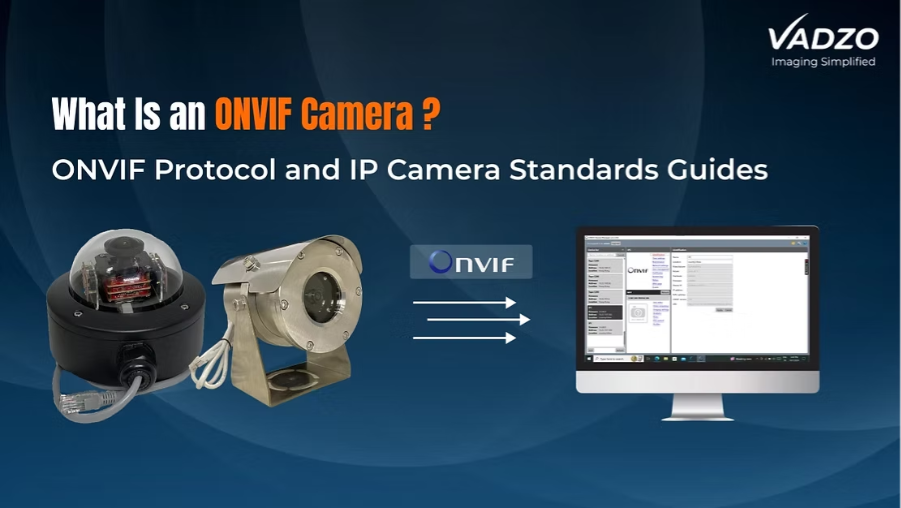
ONVIF Cameras and Protocol Architecture
ONVIF IP camera is an IP-based imaging device that complies with the Open Network Video Interface Forum standard, enabling automatic device discovery, configuration, and video streaming across compatible systems without requiring application-specific drivers or proprietary middleware layers.
The ONVIF protocol is built on standardized web services, combining SOAP/XML-based communication for device control with RTSP for media streaming. This unified framework governs how compliant cameras are discovered on a network, remotely configured, and integrated into downstream video management systems. The core service layers defined by ONVIF include:
Device Discovery: Automatic detection of ONVIF devices on a network via WS-Discovery, eliminating manual URL entry and reducing commissioning time in large deployments
Device Management: Remote configuration of network settings, system time, user access, and firmware updates across all connected cameras from a central interface
Media Services: Standardized negotiation of video stream parameters including resolution, codec selection (MJPEG, H.264, H.265), and frame rate, ensuring consistent stream handling across multi-vendor environments
PTZ Control: Unified pan, tilt, and zoom commands across motorized camera models from any manufacturer, removing the need for model-specific control logic
Event Handling: Motion detection alerts, tampering notifications, and digital I/O triggers integrated directly into VMS platforms through a standardized event model
Together, these service layers define a complete device interaction model that allows ONVIF-compliant cameras to be deployed, managed, and replaced without modifying the surrounding system architecture.
ONVIF vs. RTSP: Understanding the Difference
A common point of confusion for developers and integrators is the distinction between ONVIF and RTSP, and when each is the right choice.
RTSP (Real Time Streaming Protocol) is a lower-level protocol for initiating and controlling media streams. It handles video transport effectively but provides no mechanism for device discovery, remote configuration, PTZ standardization, or event-driven control. For basic single-viewer streaming to a known endpoint, RTSP is lightweight and sufficient.
ONVIF extends well beyond streaming. It introduces a complete device interaction model built on top of RTSP, adding the system-level capabilities that make cameras manageable at scale with automatic discovery, standardized configuration APIs, unified PTZ commands, and VMS-integrated event handling. In multi-camera or multi-site deployments, this makes ONVIF a foundational requirement rather than an optional enhancement.
ONVIF Compliant Camera | ||
Device Discovery | Manual URL entry required | Automatic via WS-Discovery |
Device Configuration | None or proprietary | Standardized API |
PTZ Control | Not defined | Standardized commands |
Event Alerts | Not supported | Motion detection, I/O triggers, tampering |
Multi-Vendor VMS Support | Full interoperability |
The guide advises developers that for simple, single-viewer streaming, RTSP may be sufficient. For professional surveillance or any deployment that will grow across vendors, sites, or management systems, an ONVIF-compliant camera is the correct foundation.
ONVIF Compliance: What to Look for When Selecting a Camera
Not all cameras that claim ONVIF support implement it with equal depth or consistency. The guide provides practical criteria for evaluating ONVIF compliance before committing to a platform:
Profile support: ONVIF defines distinct profiles for different deployment scenarios. Profile S covers live streaming and basic configuration. Profile G adds on-device recording and edge storage. Profile T extends streaming with advanced video analytics metadata. Profile M covers metadata for object classification and event-driven analytics. Selecting the right profile for your use case is as important as confirming compliance itself
Implementation quality: Older firmware versions may have incomplete or inconsistent ONVIF implementations. Always verify compliance against the specific firmware version shipping on the device
Tested interoperability: Compliance claims should be backed by testing against common VMS platforms. Cameras certified through the official ONVIF testing program offer stronger guarantees than self-declared compliance
Firmware update availability: ONVIF implementations improve over time. Cameras with an active firmware update policy are more likely to maintain interoperability as VMS platforms evolve
ONVIF-Compliant Camera Portfolio from Vadzo Imaging
Vadzo Imaging’s ONVIF-compliant camera portfolio includes GigE camera products and WIFI camera products designed for smart surveillance, industrial monitoring, and edge AI deployments. Each model is optimized for specific imaging requirements such as low-light sensitivity, high dynamic range, motion accuracy, and network-based integration across multi-vendor video management systems.
Innova-662CRS: IMX662 ONVIF IP Camera for Low-Light Surveillance
Built on the Sony IMX662 STARVIS 2 ONVIF Camera sensor with 2.9 µm pixel pitch, the Innova-662CRS delivers reliable low-light performance for outdoor surveillance environments where consistent night-time imaging is critical. The integrated Auto IR-Cut filter maintains color accuracy in mixed-light conditions and switches automatically for night-mode operation. Designed for perimeter security, parking infrastructure, and critical outdoor monitoring zones. Supports ONVIF Profile S and Profile T for advanced streaming, metadata handling, and broad VMS compatibility.
Key specs: 2MP (1920×1080) | Sony IMX662 STARVIS 2 | 2.9 µm pixel pitch | Rolling Shutter | 200° DFOV | S-Mount (M12) + Auto IR-Cut | GigE + PoE (802.3af) | Windows, Linux, Android, iOS | ONVIF Profile S/T | MJPEG, H.264, H.265
Innova-678CRS: IMX678 ONVIF 4K HDR IP camera for Industrial Monitoring
Built on the Sony IMX678 STARVIS 2 sensor with 2.0 µm pixel pitch, the Innova-678CRS is engineered as an IMX678 ONVIF 4K HDR camera for industrial and outdoor environments where lighting variability and harsh operating conditions are continuous challenges. Its ruggedized enclosure provides resilience against dust, vibration, moisture, and temperature fluctuations. Wide dynamic range (WDR) imaging maintains contrast retention and recovers detail in scenes containing simultaneous bright and dark regions, a common challenge in industrial and infrastructure monitoring. Supports ONVIF Profile G for on-device recording and edge storage management in distributed deployments.
Key specs: 8.4MP 4K (3856×2180) | Sony IMX678 STARVIS 2 | 2.0 µm pixel pitch | Rolling Shutter | 105° DFOV | S-Mount (M12) + Auto IR-Cut | GigE (100/1000Base-T) + PoE (802.3af) | Windows, Linux, Android | ONVIF Profile G | MJPEG, H.264, H.265
Innova-234CGS: AR0234 global shutter ONVIF camera for Motion-Critical Applications
Built on the Onsemi AR0234 global shutter sensor with 3.0 µm pixel pitch, the Innova-234CGS ONVIF camera eliminates rolling shutter distortion by capturing all pixels simultaneously ensuring geometrically accurate imaging in fast-moving scenarios where motion artifacts would compromise recognition accuracy. Its compact form factor allows flexible, discreet installation in space-constrained environments. Designed as a onsemi AR0234 ONVIF GigE camera for license plate recognition (LPR), access control, and industrial automation. Supports ONVIF Profile M for metadata integration with third-party analytics and surveillance platforms.
Key specs: 2MP (1920×1200) | Onsemi AR0234 | 3.0 µm pixel pitch | Global Shutter | 105° DFOV | S-Mount (M12) | GigE + PoE (802.3af) | Windows, Linux, Android | ONVIF Profile M | MJPEG, H.264, H.265
Wave-662CRS: IMX662 WiFi ONVIF IP camera for Flexible Deployment
Built on the Sony IMX662 STARVIS 2 sensor, the Wave-662CRS extends IMX662 WiFi ONVIF camera functionality to wireless surveillance deployments where cabling constraints limit installation flexibility. A motorized varifocal lens enables remote zoom and focus adjustment without physical access to the camera reducing maintenance overhead in ceiling-mounted or hard-to-reach installations. Designed for retail, hospitality, and enterprise environments where deployment flexibility and architectural integration both matter. Supports full ONVIF PTZ control and event handling for seamless integration into existing video management systems.
Key specs: 2MP (1920×1080) | Sony IMX662 STARVIS 2 | 2.9 µm pixel pitch | Rolling Shutter | 105° DFOV | S-Mount (M12) | WiFi (RTSP / ONVIF) | Windows, Linux, Android | MJPEG, H.264, H.265
Frequently Asked Questions
I’m building a multi-site surveillance system with cameras from different vendors. How do I avoid integration headaches down the line?
The most reliable way to future-proof a multi-vendor deployment is to standardize ONVIF-compliant cameras from the start. ONVIF’s device discovery, configuration, and event handling APIs work consistently regardless of manufacturer, which means you’re not locked into any single vendor’s SDK or driver ecosystem as the system grows. Vadzo’s Innova-662CRS IMX662 ONVIF GigE camera and Innova-678CRS IMX678 ONVIF GigE camera are built for exactly this scenario both integrate directly into any ONVIF-compatible VMS without custom middleware or proprietary integration work.
My application involves fast-moving subjects like vehicles, machinery, people at speed. Will a standard ONVIF camera handle that accurately?
Most standard IP cameras use rolling shutter sensors, which read pixels sequentially and can introduce geometric distortion when imaging fast-moving subjects. For motion-critical applications like license plate recognition, access control gates, or industrial automation lines, a global shutter sensor is required in global shutter ONVIF camera deployments. It captures all pixels simultaneously, eliminating motion artifacts entirely. The Innova-234CGS is Vadzo’s AR0234 global shutter ONVIF camera, built on the Onsemi AR0234, and supports ONVIF Profile M for metadata integration with downstream analytics platforms.
My deployment site has extreme lighting (direct sunlight, dim corridors, or both in the same frame). What should I evaluate?
You’re dealing with a wide dynamic range (WDR) scenario, where both very bright and very dark areas need to be captured clearly in the same frame. When evaluating a camera, focus on real HDR performance (not just specs), the ability to retain detail in highlights and shadows, motion handling in HDR mode, and low-light performance if your environment includes dim areas. These factors directly impact analytics accuracy and system reliability. Sensors like the Sony IMX678 STARVIS 2 sensor are designed for such conditions, offering strong HDR and low-light performance, making them well-suited for high-contrast, real-world deployments.
Where can i buy day-night OEM camera for Smart Surveillance Solution Development?
The Innova-662CRS is an IMX662 ONVIF low light camera built on the Sony IMX662 STARVIS 2 sensor with a 2.9 µm pixel pitch, optimized for low-light ONVIF IP surveillance applications. The integrated Auto IR-Cut filter maintains accurate color imaging in mixed-light conditions and switches automatically to night mode when ambient light drops. It is the right choice for perimeter security, parking areas, and outdoor critical infrastructure where consistent imaging after dark is non-negotiable. ONVIF Profile S and T support ensures direct integration with your existing VMS without additional configuration.
My installation site makes cabling difficult or impossible. Is there a wireless ONVIF option?
Yes. The Wave-662CRS is Vadzo’s IMX662 WiFi ONVIF camera, designed for wireless ONVIF IP surveillance environments where running Ethernet cabling is impractical. It supports full ONVIF PTZ control and event handling over WIFI, and its motorized varifocal lens enables remote zoom and focus adjustment without physically accessing the installed camera useful for ceiling-mounted deployments in retail, hospitality, or enterprise spaces where ongoing access is difficult.
We’re evaluating cameras for an OEM product. How quickly can we go from evaluation to production?
Vadzo’s ONVIF-compliant cameras ship ready for deployment, eliminating driver development in ONVIF IP camera systems. The portfolio supports OEM customization including firmware, ISP tuning, lens, and form factor changes for industrial ONVIF GigE camera solutions. Engineering teams can access datasheets, CAD files, and integration support at vadzoimaging.com or request evaluation units and production support.
Availability
The guide, “What Is an ONVIF Camera: Protocol, Compliance, and Benefits,” is available now on the Vadzo Imaging website. Engineering teams can access technical datasheets, product CAD files, and integration documentation directly on the site. For evaluation units, OEM customization requirements, volume pricing, and integration support, contact Vadzo’s team through vadzoimaging.com.
About Vadzo Imaging
Vadzo Imaging develops embedded vision and ONVIF-compliant camera systems for OEMs and system integrators building production-ready solutions across industrial automation, robotics, UAV platforms, surveillance, and edge AI. The company’s imaging platforms span MIPI CSI-2, USB, GigE, WiFi, and SerDes interfaces, covering the full range of embedded deployment architectures from compact edge devices to distributed networked systems. Beyond hardware, Vadzo provides end-to-end support including sensor integration, ISP tuning, firmware development, and SDK frameworks giving engineering teams a single partner from initial evaluation through production lifecycle management.
Media Contact
Alwin Vincent
Vadzo Imaging
Phone: +1 817-678-2139
Email: [email protected]
LinkedIn: Vadzo Imaging
YouTube: Vadzo Imaging
X: Vadzo Imaging
SOURCE: Vadzo Imaging