Gaming Console Market
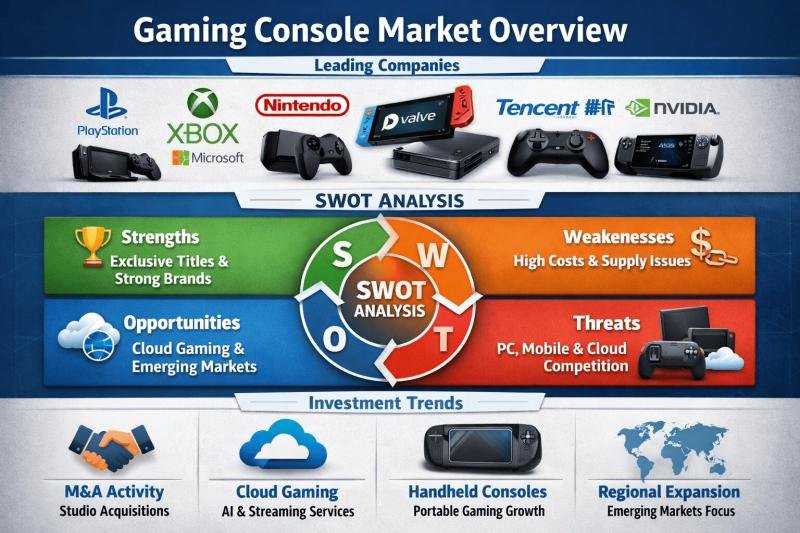
The Gaming Console Market continues to evolve as major technology companies compete to deliver immersive gaming experiences, powerful hardware architectures, and integrated digital ecosystems. With rapid advances in graphics processing, cloud connectivity, and subscription-based services, gaming consoles are no longer limited to traditional living-room entertainment devices. They now function as integrated entertainment hubs that combine gaming, streaming, digital marketplaces, and social connectivity.
Competition in the Gaming Console Market is largely driven by innovation in hardware performance, exclusive game content, and digital distribution platforms. Established industry leaders and emerging players are reshaping the competitive landscape through strategic investments, platform ecosystems, and partnerships with developers. This article explores the top companies shaping the Gaming Console Market, analyzes their strategic strengths through a SWOT framework, and highlights key investment opportunities and trends influencing the industry.
➤ Request Free Sample PDF Report @ https://www.researchnester.com/sample-request-6730
Top Companies & Their Strategies
1. Sony Group Corporation
Sony remains one of the most influential players in the Gaming Console Market through its PlayStation ecosystem. The company’s success is driven by its strong portfolio of exclusive game titles, advanced hardware development, and a loyal global gaming community. Sony’s vertically integrated approach-combining hardware, software development studios, and digital distribution through PlayStation Network-creates a powerful competitive advantage.
Sony’s strategy also focuses on strengthening subscription-based services and expanding digital content offerings. Investments in first-party game studios and exclusive intellectual property ensure a consistent flow of premium titles that attract gamers and sustain platform loyalty.
2. Microsoft Corporation
Microsoft has transformed its gaming business through the Xbox ecosystem. Rather than focusing solely on hardware sales, the company has built a broader gaming platform integrating consoles, PC gaming, and cloud-based services. Xbox Game Pass has emerged as a cornerstone strategy, offering subscription-based access to a large game library.
Microsoft has also strengthened its position through acquisitions of game development studios and technology integration. By leveraging cloud infrastructure through Azure, the company is expanding gaming accessibility across devices while positioning Xbox as a service-oriented gaming platform.
3. Nintendo Co., Ltd.
Nintendo holds a unique position in the Gaming Console Market by prioritizing innovation in gameplay experiences rather than competing purely on hardware power. Its hybrid console design and family-friendly game franchises differentiate the company from competitors.
Nintendo’s strategy revolves around exclusive intellectual property such as iconic game characters and franchises. The company consistently focuses on creative gameplay concepts, appealing to both casual gamers and long-time fans. This distinct approach enables Nintendo to maintain strong brand loyalty across generations.
4. Valve Corporation
Valve has entered the Gaming Console Market through its portable gaming ecosystem and the Steam digital distribution platform. By combining PC gaming performance with handheld portability, the company targets a niche segment of gamers seeking flexibility and access to a vast PC game library.
Valve’s strategic strength lies in its established digital marketplace and strong developer relationships. The integration of hardware with Steam services creates a seamless ecosystem for gamers and developers alike.
➤ Explore detailed profiles of top players and new entrants in this space – access your free sample report → https://www.researchnester.com/sample-request-6730
5. Tencent Holdings Limited
Tencent is increasingly influencing the Gaming Console Market through investments in game development studios and strategic partnerships with global gaming companies. While Tencent is traditionally known for mobile and online gaming, its financial influence and global investment strategy allow it to shape the broader gaming ecosystem.
Tencent’s approach focuses on expanding content ownership and strengthening distribution channels across multiple gaming platforms, including consoles. By supporting developers and acquiring stakes in studios, the company indirectly strengthens its presence in the console gaming industry.
6. NVIDIA Corporation
NVIDIA plays an important supporting role in the Gaming Console Market through advanced graphics processing technology and AI-driven gaming infrastructure. The company’s GPU innovations influence the performance capabilities of gaming hardware and cloud gaming services.
NVIDIA’s strategic focus includes developing high-performance chips and expanding cloud gaming solutions. By enabling realistic graphics and advanced rendering technologies, NVIDIA contributes to the technological advancement of next-generation gaming platforms.
7. ASUS
ASUS has recently entered the portable gaming segment, reflecting the growing demand for handheld gaming consoles. The company leverages its expertise in PC hardware and gaming laptops to develop high-performance portable gaming devices.
ASUS’s strategy centers on integrating powerful processors and customizable gaming features that appeal to performance-focused gamers. Its ability to combine hardware engineering expertise with strong gaming brand recognition provides competitive potential within the evolving Gaming Console Market.
➤ View our Gaming Console Market Report Overview here: https://www.researchnester.com/reports/gaming-console-market/6730
SWOT Analysis
Strengths
Leading companies in the Gaming Console Market possess strong technological capabilities and global brand recognition. Established ecosystems such as PlayStation, Xbox, and Nintendo platforms benefit from extensive developer networks and exclusive game libraries. These ecosystems create high switching costs for users and foster long-term customer loyalty.
Additionally, companies in this sector have the financial resources to invest in research, game development, and advanced hardware technologies. Integration with digital distribution platforms and subscription services further strengthens their market presence by generating recurring revenue streams.
Weaknesses
Despite their strong positions, gaming console manufacturers face several structural challenges. Hardware development cycles are long and capital intensive, making it difficult for companies to rapidly respond to changing consumer preferences. Production costs for advanced consoles can also be high, reducing profit margins in early product launch phases.
Another weakness is heavy reliance on blockbuster game releases to drive console adoption. Delays or underperformance of major titles can significantly affect platform engagement and hardware demand. Supply chain constraints and semiconductor shortages have also highlighted vulnerabilities in manufacturing and distribution processes.
Opportunities
The Gaming Console Market offers multiple opportunities driven by technological advancements and expanding gaming audiences. Cloud gaming integration allows console platforms to reach users across different devices, increasing accessibility and engagement. Subscription services and digital game distribution models are also creating new revenue streams for platform operators.
Emerging markets present additional growth opportunities as internet infrastructure improves and gaming adoption increases. Investments in virtual reality, augmented reality, and artificial intelligence could further enhance immersive gaming experiences, opening new avenues for innovation within the console ecosystem.
Threats
Competition from alternative gaming platforms poses a major threat to console manufacturers. High-performance gaming PCs, mobile gaming platforms, and cloud-based streaming services are expanding rapidly and attracting diverse gamer demographics.
Regulatory challenges, cybersecurity concerns, and intellectual property disputes also represent potential risks. Additionally, the rising costs of game development and the increasing expectations for high-quality graphics and gameplay could place financial pressure on developers and console manufacturers alike.
➤ Access a complete SWOT breakdown with company-specific scorecards: Claim your sample report → https://www.researchnester.com/sample-request-6730
Investment Opportunities & Emerging Trends
The Gaming Console Market is attracting strong investor interest due to technological innovation and the increasing popularity of interactive entertainment. Several strategic investment themes are shaping the industry’s future direction.
1. Expansion of Gaming Ecosystems
One of the most significant investment trends involves building comprehensive gaming ecosystems that integrate hardware, software, and digital services. Companies are investing heavily in subscription platforms, digital game libraries, and cloud infrastructure to create long-term engagement with users. This ecosystem approach generates recurring revenue while strengthening brand loyalty.
2. Mergers and Acquisitions in Game Development
In the past year, the industry has witnessed increased consolidation as large technology companies acquire game development studios to secure exclusive content. Owning intellectual property has become a critical competitive advantage because exclusive titles often drive console sales and platform adoption.
Major platform operators are investing in development studios to ensure a steady pipeline of high-quality games. This trend also enables companies to control production timelines and maintain consistent content quality across their platforms.
3. Growth of Handheld and Hybrid Consoles
The popularity of portable gaming devices has sparked renewed interest in handheld and hybrid consoles. Companies are investing in compact hardware capable of delivering high-performance gaming while maintaining mobility. This trend reflects the changing gaming habits of consumers who want flexibility between home gaming and on-the-go entertainment.
Handheld gaming platforms are attracting investment from both established console manufacturers and PC hardware companies, indicating growing confidence in this segment of the Gaming Console Market.
4. Integration of Cloud and AI Technologies
Cloud gaming infrastructure is becoming a major area of technological investment. Companies are deploying cloud-based platforms that allow gamers to access console-quality games without relying solely on physical hardware. Artificial intelligence is also being integrated into gaming platforms to improve graphics rendering, player matchmaking, and personalized gaming experiences.
These innovations are reshaping the technological foundation of the Gaming Console Market and creating opportunities for companies specializing in cloud computing, semiconductors, and gaming software.
5. Regional Expansion and Digital Distribution
Companies are increasingly targeting emerging gaming markets in Asia-Pacific, Latin America, and parts of the Middle East. Improvements in internet connectivity and digital payment systems are enabling wider access to gaming content. Digital distribution platforms allow companies to reach these markets without extensive physical retail infrastructure.
As a result, investors are paying close attention to companies expanding their regional footprint through localized content, partnerships with regional developers, and digital storefronts.
➤ Request Free Sample PDF Report @ https://www.researchnester.com/sample-request-6730
➤ Related news:
https://www.linkedin.com/pulse/cyber-threat-intelligence-market-navigating-next-phase-rida-patel-zx1yc/
https://www.linkedin.com/pulse/what-driving-global-application-programming-interface-rida-patel-quluf/
Contact Data
AJ Daniel
Corporate Sales, USA
Research Nester
77 Water Street 8th Floor, New York, 10005
Email: info@researchnester.com
USA Phone: +1 646 586 9123
Europe Phone: +44 203 608 5919
About Research Nester
Research Nester is a one-stop service provider with a client base in more than 50 countries, leading in strategic market research and consulting with an unbiased and unparalleled approach towards helping global industrial players, conglomerates and executives for their future investment while avoiding forthcoming uncertainties. With an out-of-the-box mindset to produce statistical and analytical market research reports, we provide strategic consulting so that our clients can make wise business decisions with clarity while strategizing and planning for their forthcoming needs and succeed in achieving their future endeavors. We believe every business can expand to its new horizon, provided a right guidance at a right time is available through strategic minds.
This release was published on openPR.