Disinfection Robots Market
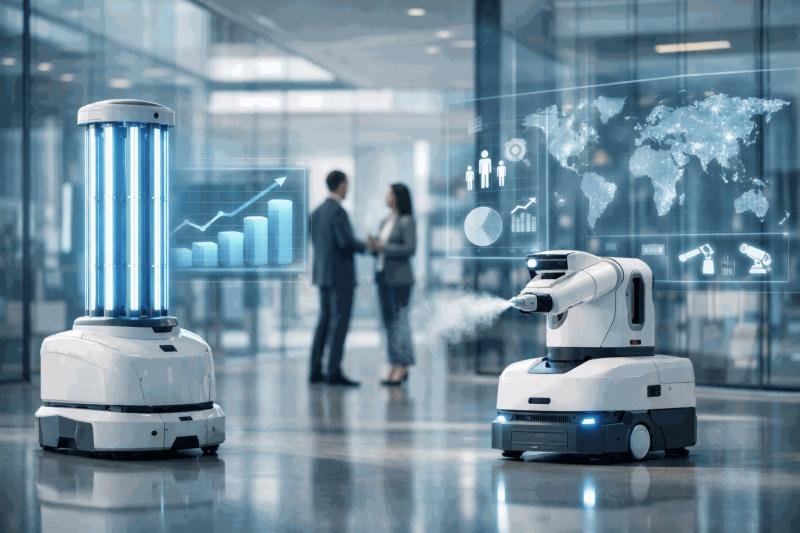
The Disinfection Robots Market has transitioned from a niche healthcare solution to a strategic component of global hygiene infrastructure. Initially accelerated by pandemic-driven demand, disinfection robots are now embedded in long-term infection control strategies across hospitals, airports, commercial buildings, hospitality venues, manufacturing plants, and public transportation systems. The market is increasingly shaped by advances in ultraviolet (UV-C) technology, autonomous navigation, AI-driven mapping systems, and robotics-as-a-service (RaaS) business models.
As global standards for hygiene and workplace safety continue to evolve, the Disinfection Robots Market is becoming a convergence point for robotics, artificial intelligence, healthcare compliance, and smart building integration. The competitive landscape includes specialized robotics manufacturers, medical device innovators, and large automation companies diversifying into sanitation technologies. Strategic positioning depends on technological differentiation, regulatory certifications, and regional service networks.
➤ Request Free Sample PDF Report @ https://www.researchnester.com/sample-request-8305
Top Companies & Their Strategies
1. Xenex Disinfection Services
Xenex is a recognized leader in the Disinfection Robots Market, particularly within healthcare environments. Its UV-C light-based robots are widely deployed in hospitals for reducing healthcare-associated infections (HAIs). Xenex differentiates itself through clinical validation studies and strong regulatory positioning.
The company’s strategy focuses on scientific credibility and outcome-based results, emphasizing peer-reviewed data to secure long-term healthcare contracts. Its strength lies in its reputation for safety, reliability, and measurable infection reduction performance.
2. UVD Robots (Blue Ocean Robotics)
Denmark-based UVD Robots has built a strong global footprint with autonomous UV disinfection systems deployed in hospitals, airports, and corporate offices. The company leverages advanced LiDAR navigation and cloud connectivity for efficient room mapping and data reporting.
Its strategy emphasizes international partnerships and rapid scalability. By integrating remote monitoring and fleet management capabilities, UVD Robots strengthens its position in multi-site facility deployments.
3. Tru-D SmartUVC (PDI Healthcare)
Tru-D SmartUVC focuses on precision-based UV disinfection technology designed for healthcare facilities. The company differentiates itself with sensor-driven dosage systems that calculate exact UV exposure levels for optimal pathogen elimination.
Its competitive strength lies in compliance-driven solutions and integration with infection prevention protocols. Tru-D’s focus on data-driven validation makes it a trusted partner for clinical environments.
4. TMiRob (Time Medical International)
TMiRob offers autonomous disinfection robots that combine UV-C technology with intelligent navigation systems. The company has expanded beyond healthcare into hospitality and public transport sectors.
Its strategy centers on cost-effective design and rapid deployment capabilities, making it attractive to emerging markets seeking scalable hygiene solutions.
➤ Explore detailed profiles of top players and new entrants in this space – access your free sample report → https://www.researchnester.com/sample-request-8305
5. Finsen Technologies
Finsen Technologies, known for its THOR UVC system, specializes in high-intensity pulsed xenon UV disinfection. The company emphasizes superior pathogen inactivation rates and compliance with healthcare safety standards.
Its strength lies in technological innovation and niche positioning within critical-care facilities, where stringent sterilization requirements demand advanced solutions.
6. OTSAW Digital
OTSAW Digital integrates robotics with AI-driven analytics, offering multi-functional robots capable of disinfection, surveillance, and delivery tasks. This multifunctionality differentiates OTSAW within the Disinfection Robots Market.
The company’s strategic focus is on smart building ecosystems, positioning its robots as part of a broader automation strategy rather than standalone sanitation tools.
7. Nevoa (formerly Akara Robotics)
Nevoa develops AI-powered autonomous disinfection robots designed for operational efficiency and minimal human supervision. The company focuses on robotics-as-a-service models to reduce upfront capital expenditure for clients.
Its strength lies in adaptive software systems that allow continuous updates and integration with building management systems (BMS), enhancing long-term scalability.
➤ View our Disinfection Robots Market Report Overview here: https://www.researchnester.com/reports/disinfection-robots-market/8305
SWOT Analysis
Strengths
Leading companies in the Disinfection Robots Market benefit from strong technological innovation, including advanced UV-C systems, AI-powered navigation, and autonomous operation. Clinical validation and regulatory approvals strengthen credibility, particularly in healthcare settings. Many firms offer integrated software dashboards for monitoring and compliance reporting, enhancing customer value. Additionally, robotics-as-a-service models provide flexible adoption pathways for institutions.
Weaknesses
High upfront costs remain a barrier to widespread adoption, particularly in smaller facilities or developing regions. Dependence on UV-C technology may limit flexibility compared to chemical-based disinfection systems. Maintenance requirements and the need for trained personnel can add operational complexity. Furthermore, limited awareness in non-healthcare sectors can restrict broader market penetration.
Opportunities
Growing global emphasis on infection prevention, workplace safety, and hygiene automation presents long-term growth opportunities. Expansion into airports, schools, retail spaces, and industrial facilities offers untapped potential. Integration with IoT-enabled smart building systems and AI-based data analytics opens new service-based revenue models. Emerging markets with rising healthcare infrastructure investments represent attractive expansion territories.
Threats
Competition from traditional disinfection methods and manual cleaning services poses pricing challenges. Regulatory changes concerning UV safety standards may increase compliance costs. Rapid technological advancements could render existing models obsolete if companies fail to innovate. Economic downturns or budget constraints in public institutions may delay procurement cycles.
➤ Access a complete SWOT breakdown with company-specific scorecards: Claim your sample report → https://www.researchnester.com/sample-request-8305
Investment Opportunities & Trends
The Disinfection Robots Market continues to attract investor attention due to its intersection with robotics, healthcare, and smart infrastructure development. Several key investment themes are shaping capital allocation decisions.
1. Robotics-as-a-Service (RaaS) Models
Investors are increasingly supporting subscription-based deployment models that reduce capital expenditure barriers. RaaS allows facilities to access advanced disinfection robots through monthly service agreements, ensuring predictable revenue streams for manufacturers. Startups adopting flexible leasing models are gaining traction, particularly in hospitality and commercial real estate sectors.
2. AI and Autonomous Navigation Integration
Capital is flowing into companies that integrate AI, machine learning, and LiDAR-based navigation into disinfection robots. These technologies enhance route optimization, obstacle avoidance, and real-time reporting. Investors view AI-driven automation as a differentiator in competitive tenders for large-scale facility contracts.
3. Healthcare Infrastructure and Emerging Markets
Asia Pacific and the Middle East are attracting significant investment due to expanding hospital infrastructure and government-backed health modernization initiatives. In North America and Europe, funding is focused on upgrading infection control systems in existing healthcare facilities and public institutions.
4. M&A and Strategic Partnerships
The past 12 months have witnessed strategic collaborations between robotics firms and healthcare service providers to expand deployment networks. Technology companies have entered partnerships with facility management firms to integrate disinfection robots into broader building automation platforms. Several robotics startups have secured venture capital funding to enhance product development and scale production capacity.
5. Notable developments include the launch of multifunctional robots combining disinfection with air purification capabilities, strategic investments in AI software upgrades, and cross-border distribution agreements aimed at expanding regional reach. Additionally, policy initiatives promoting infection control standards in public facilities have indirectly supported procurement activities.
➤ Request Free Sample PDF Report @ https://www.researchnester.com/sample-request-8305
Related News –
https://www.linkedin.com/pulse/what-powering-rise-ai-iot-market-adinath-ahuja-drwpf/
Contact Data
AJ Daniel
Corporate Sales, USA
Research Nester
77 Water Street 8th Floor, New York, 10005
Email: info@researchnester.com
USA Phone: +1 646 586 9123
Europe Phone: +44 203 608 5919
About Research Nester
Research Nester is a one-stop service provider with a client base in more than 50 countries, leading in strategic market research and consulting with an unbiased and unparalleled approach towards helping global industrial players, conglomerates and executives for their future investment while avoiding forthcoming uncertainties. With an out-of-the-box mindset to produce statistical and analytical market research reports, we provide strategic consulting so that our clients can make wise business decisions with clarity while strategizing and planning for their forthcoming needs and succeed in achieving their future endeavors. We believe every business can expand to its new horizon, provided a right guidance at a right time is available through strategic minds.
This release was published on openPR.