Thursday, January 22, 2026
  • About Web3Wire
  • Web3Wire NFTs
  • .w3w TLD
  • $W3W Token
  • Web3Wire DAO
  • Media Network
  • RSS Feed
  • Contact Us
Web3Wire
No Result
View All Result
  • Home
  • Web3
    • Latest
    • AI
    • Business
    • Blockchain
    • Cryptocurrencies
    • Decentralized Finance
    • Metaverse
    • Non-Fungible Token
    • Press Release
  • Technology
    • Consumer Tech
    • Digital Fashion
    • Editor’s Choice
    • Guides
    • Stories
  • Coins
    • Top 10 Coins
    • Top 50 Coins
    • Top 100 Coins
    • All Coins
  • Exchanges
    • Top 10 Crypto Exchanges
    • Top 50 Crypto Exchanges
    • Top 100 Crypto Exchanges
    • All Crypto Exchanges
  • Stocks
    • Blockchain Stocks
    • NFT Stocks
    • Metaverse Stocks
    • Artificial Intelligence Stocks
  • Events
  • News
    • Latest Crypto News
    • Latest DeFi News
    • Latest Web3 News
  • Home
  • Web3
    • Latest
    • AI
    • Business
    • Blockchain
    • Cryptocurrencies
    • Decentralized Finance
    • Metaverse
    • Non-Fungible Token
    • Press Release
  • Technology
    • Consumer Tech
    • Digital Fashion
    • Editor’s Choice
    • Guides
    • Stories
  • Coins
    • Top 10 Coins
    • Top 50 Coins
    • Top 100 Coins
    • All Coins
  • Exchanges
    • Top 10 Crypto Exchanges
    • Top 50 Crypto Exchanges
    • Top 100 Crypto Exchanges
    • All Crypto Exchanges
  • Stocks
    • Blockchain Stocks
    • NFT Stocks
    • Metaverse Stocks
    • Artificial Intelligence Stocks
  • Events
  • News
    • Latest Crypto News
    • Latest DeFi News
    • Latest Web3 News
No Result
View All Result
Web3Wire
No Result
View All Result
Home Artificial Intelligence

The Rise of AI-Driven Product Design: What 2026 Holds

December 23, 2025
in Artificial Intelligence, OpenPR, Web3
Reading Time: 10 mins read
5
SHARES
246
VIEWS
Share on TwitterShare on LinkedInShare on Facebook

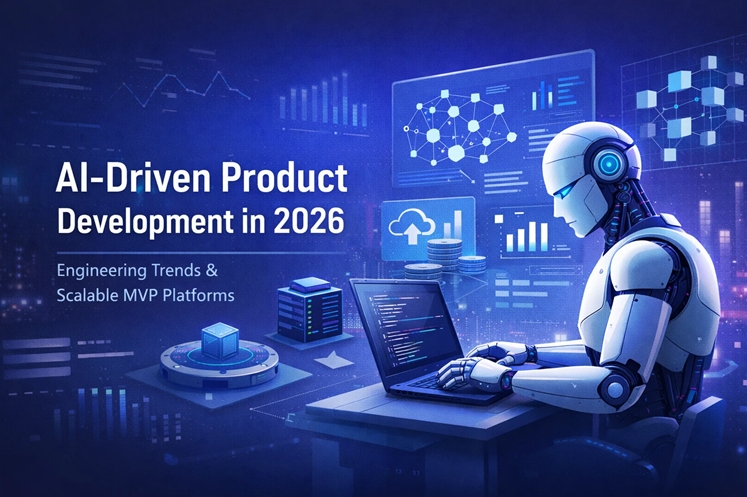
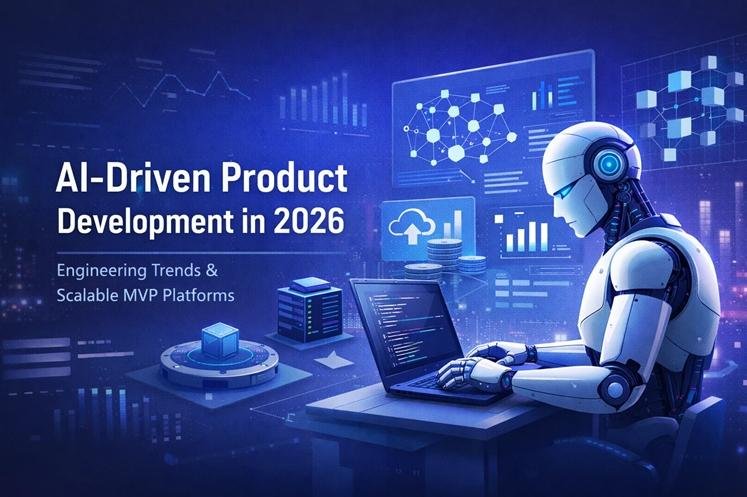
Image: https://www.abnewswire.com/upload/2025/12/c305107e5bd5d5d18da50cb7b7a79cca.jpg

Engineering Trends and Platform Choices for Building Scalable MVPs

By 2026, artificial intelligence has become a standard part of modern software systems – but not in the way many early predictions suggested. AI has not replaced traditional software engineering, nor has it eliminated the need for solid backend architecture, data modeling, or operational discipline. Instead, AI has evolved into an internal system capability that, when applied deliberately, enhances how products operate, automate workflows, and support decision-making.

This shift has fundamentally changed how MVPs are built. A modern MVP is no longer a disposable prototype designed solely to test UI concepts or collect early feedback. It is a production-aware system that must validate business assumptions using real data, real workflows, and real operational constraints. AI can accelerate this validation – but only when it is embedded into the product architecture intentionally and governed by the same engineering standards as the rest of the system.

AI MVP development, in this context, is not about assembling features around a model API. It is about building real software products in which AI operates as an internal part of the system. This requires experienced engineering teams capable of designing scalable architectures, writing production code, and integrating AI components alongside deterministic logic, data pipelines, and operational tooling.

Kavita Systems represents this engineering-first approach to AI MVP development [https://kavitasystems.com/our-services/ai-enhanced-mvp-development]. As a software engineering company, Kavita Systems builds MVPs as complete, production-ready systems and integrates AI into the codebase where it provides measurable value – such as workflow automation, decision support, data processing, and operational intelligence. AI is treated not as a shortcut, but as a managed subsystem that evolves with the product.

This article explores the key engineering trends shaping AI-driven product development in 2026 and examines the platforms, cloud services, and engineering approaches used to build scalable MVPs. A critical distinction is made between AI platforms that provide tools and engineering organizations like Kavita Systems that build software and integrate AI internally as part of the product itself.

1. How MVP Development Has Changed in the AI Era

1.1 From AI Features to AI as an Internal Capability

In earlier product generations, AI was typically introduced as an isolated feature. Teams added chatbots, recommendation widgets, automated tagging, or basic analytics modules that operated alongside the core system. These components were often loosely coupled, stateless, and easy to remove if they failed to deliver value.

By 2026, this approach has proven insufficient. When AI is used in modern products, it often participates directly in workflows, prioritization logic, data interpretation, and user interaction flows. This requires AI to be embedded into the product as an internal capability rather than attached as an external service.

Importantly, this does not mean that every product must be AI-native. In many successful systems, deterministic logic remains dominant, with AI augmenting specific areas such as automation, insights, quality control, or decision support. The architectural shift lies not in how aggressively AI is applied, but in how deliberately and structurally it is integrated.

1.2 Why MVPs Must Be Production-Aware from the Start

One of the strongest lessons from 2024-2025 is that AI-enabled MVPs are expensive to refactor after launch. Once data pipelines, embeddings, inference logic, and feedback loops are integrated into business workflows, architectural shortcuts become difficult – and often impossible – to undo.

MVPs that treated AI as experimental or disposable in 2025 frequently encountered problems within the first months of real usage: unpredictable behavior, scaling bottlenecks, governance gaps, or runaway inference costs. These issues rarely stemmed from AI models themselves, but from weak system architecture and lack of operational discipline.

As a result, MVPs in 2026 must account early for observability, versioning, access control, and cost predictability. This does not imply heavy enterprise overhead. It implies intentional minimalism: building only what is necessary, but building it correctly.

2. Market Reality: MVP Launch and Failure Statistics (2025)

Despite unprecedented acceleration in development tooling, the overall success rate of MVPs in 2025 remained low. Across global startup ecosystems, an estimated 65-75% of MVPs failed to progress beyond early validation stages within the first 12-18 months.

AI did reduce time-to-launch. Many teams shipped MVPs 30-50% faster than in pre-AI years. However, faster launches did not translate into higher success rates. In many cases, AI simply exposed flawed assumptions earlier.

Post-mortem analysis of failed MVPs in 2025 reveals consistent patterns. Roughly 40% of failed MVPs were technically functional but failed to integrate into real user workflows or decision-making processes. Another 25-30% failed due to architectural limitations that surfaced only under real usage, such as inability to evolve core logic, weak data models, or fragile AI integrations.

Notably, 20-25% of AI-enabled MVP failures were directly linked to poor AI integration practices. Common issues included treating AI as a black box, embedding prompts directly into UI flows, lack of observability, and absence of cost or behavior controls. These MVPs did not fail because AI was ineffective – they failed because AI was not engineered as part of the system.

Conversely, MVPs that survived beyond the first 18 months shared clear characteristics. They treated AI as an internal capability, focused on automating internal workflows before exposing AI to users, and invested early in production-grade foundations. These products used AI to generate insights, validate assumptions, and support operations – not to impress users with novelty.

This data explains why engineering-first approaches to AI MVP development are becoming dominant in 2026.

3. Core Engineering Trends in AI-Driven Development3.1 AI-Aware Architecture Design

Modern systems increasingly adopt AI-aware architectures, even when AI is optional rather than central. Data models, service boundaries, and APIs are designed so that intelligent components can be introduced without destabilizing the rest of the system.

A common pattern is the separation of inference logic from orchestration and presentation layers. AI outputs are treated as structured signals rather than free-form text. This allows deterministic code to validate, constrain, or override probabilistic behavior and preserves system reliability.

3.2 Controlled Use of Agents and Semi-Autonomous Components

By 2026, agent-based components are used pragmatically rather than experimentally. Agents handle well-defined tasks such as routing, enrichment, summarization, monitoring, or workflow execution. They operate within strict boundaries enforced by the surrounding system.

Mature teams treat agents as internal subsystems, not independent decision-makers. Scope limitation, validation layers, observability, and reversibility are essential to prevent non-deterministic behavior from undermining system trust.

3.3 Orchestration Over Algorithm Complexity

Competitive advantage increasingly comes from orchestration rather than raw algorithmic sophistication. Systems succeed when they reliably coordinate deterministic logic, AI inference, retrieval pipelines, and user interaction.

This elevates architecture and governance above model choice. Prompts, retrieval strategies, inference routing, and evaluation loops must be versioned, tested, and monitored just like application code. MVPs that skip this discipline rarely survive contact with real users.

3.4 Adaptive UX as a System Behavior

When AI is embedded internally, user experience becomes adaptive by necessity. Interfaces must handle uncertainty, partial confidence, and alternative outcomes gracefully.

Adaptive UX is not a visual feature. It is a system behavior that emerges from coordination between frontend, backend, and AI components. Without this coordination, AI-driven products quickly lose user trust.

4. Evaluating Foundations for AI-Enabled MVPs

Choosing how to build an MVP in 2026 is less about selecting the “best AI tool” and more about aligning architectural control with product goals. Teams must decide how much flexibility they need, how tightly AI should be integrated, and how much operational responsibility they can realistically manage.

The most common mistake is confusing platforms with engineering. Platforms provide capabilities within predefined constraints. Engineering teams build systems and integrate AI into those systems deliberately.

5. Kavita Systems: Engineering-First AI MVP Development

Kavita Systems is a software engineering company [https://kavitasystems.com/] that designs and builds custom digital products using conventional and modern development practices. Its core strength lies in writing production code, designing scalable architectures, and delivering reliable backend systems.

Artificial intelligence is integrated deliberately and only where it provides measurable value. When AI is used, it is embedded directly into the codebase and system architecture as an internal capability. AI components interact with domain logic, data models, and workflows under the same constraints as deterministic code.

This approach allows MVPs to start with a stable, deterministic core and evolve incrementally. AI can be introduced to automate workflows, generate insights, validate data, or support decision-making without forcing architectural rewrites. There is no platform lock-in, and technology choices remain flexible as the product matures.

In practice, this engineering-first model aligns directly with the market realities observed in 2025. Products survive not because they use more AI, but because they integrate intelligence coherently into systems that can operate, measure, and evolve.

AI-driven product development in 2026 is not about maximizing AI usage. It is about integrating intelligence into software systems without sacrificing architectural clarity, operational control, or long-term flexibility.

The market data is clear: MVPs fail when AI is treated as a shortcut, and they succeed when AI is engineered as an internal capability. Kavita Systems represents this approach by focusing on software engineering first and integrating AI where it strengthens the product rather than distorting it.

In an environment where tools change rapidly, engineering discipline remains the most reliable competitive advantage.

Media Contact
Company Name: Kavita Systems
Email:Send Email [https://www.abnewswire.com/email_contact_us.php?pr=the-rise-of-aidriven-product-design-what-2026-holds]
Country: Romania
Website: https://kavitasystems.com/

Legal Disclaimer: Information contained on this page is provided by an independent third-party content provider. ABNewswire makes no warranties or responsibility or liability for the accuracy, content, images, videos, licenses, completeness, legality, or reliability of the information contained in this article. If you are affiliated with this article or have any complaints or copyright issues related to this article and would like it to be removed, please contact retract@swscontact.com

This release was published on openPR.

About Web3Wire
Web3Wire – Information, news, press releases, events and research articles about Web3, Metaverse, Blockchain, Artificial Intelligence, Cryptocurrencies, Decentralized Finance, NFTs and Gaming.
Visit Web3Wire for Web3 News and Events, Block3Wire for the latest Blockchain news and Meta3Wire to stay updated with Metaverse News.

ShareTweet1ShareSendShare2
Previous Post

Canada’s Roads Get Safer with the Rise of Smart Traffic Cameras

Next Post

PetFriendly Launches Expert Guide to Booking Cabins That Welcome Pets

Related Posts

Ramp Network Goes Live as EU-Licensed Crypto Asset Service Provider

Dublin, Ireland, 22nd January 2026, Chainwire

Read moreDetails

Guest Wi-Fi Providers Market Forecast to Grow at 9.6% CAGR Through 2033: Cisco Meraki, Purple WiFi, Ruckus Networks, Fortinet, and Aislelabs Transform Customer Connectivity into Marketing Intelligence

Guest Wi-Fi Providers Market According to a new study by DataHorizzon Research, the "Guest Wi-Fi Providers Market" is projected to grow at a CAGR of 9.6% from 2025 to 2033, driven by increasing consumer expectations for seamless internet connectivity across public venues, rising adoption of location-based marketing strategies by retailers...

Read moreDetails

translators-fusion.com revolutionizes terminology management: glossary# as the key to quality

Cross-system management and maintenance of company terminology ( (C) uebersetzungen Hanns Schiefele) With the introduction of glossary#, the translation company translators-fusion.com (R) is setting new standards in terminology management. This innovative tool enables companies to manage their terminology centrally and easily and to use it independently of translation service providers....

Read moreDetails

Cloud Data Platform Market Set to Achieve 15.3% CAGR by 2033: Snowflake, Databricks, Google BigQuery, Amazon Web Services, and Microsoft Azure Synapse Revolutionize Enterprise Data Infrastructure

Cloud Data Platform Market According to a new study by DataHorizzon Research, the "Cloud Data Platform Market" is projected to grow at a CAGR of 15.3% from 2025 to 2033, driven by exponential data volume growth across industries, accelerating digital transformation initiatives requiring scalable analytics infrastructure, increasing adoption of artificial...

Read moreDetails

United States Content Delivery Network Market Outlook: 12% CAGR Driven by Edge Computing and Low-Latency Streaming (2024-2031)

Content Delivery Network Market The Global Content Delivery Network (CDN) Market is expected to grow at a CAGR of 12% from 2024 to 2031., according to DataM Intelligence.United States: Recent Industry Developments✅ In October 2025, Cloudflare expanded its U.S. edge network with new Points of Presence (PoPs) and AI-optimized traffic...

Read moreDetails

Hybrid Printing Equipment Market is expected to reach US$ 15.1 Billion by 2031 | Major Companies – Electronics For lmaging, Seiko Epson Corporation, Koenig & Bauer Durst GmbH.

Hybrid Printing Equipment Market Market Size and Growth:The Global Hybrid Printing Equipment Market size reached US$ 5.5 Billion in 2023 and is expected to reach US$ 15.1 Billion by 2031, growing with a CAGR of 13.7% during the forecast period 2024-2031.The Hybrid Printing Equipment Market report, published by DataM Intelligence,...

Read moreDetails

Global Li6 And Li7 Market Expected to Record 8.4% CAGR Through 2033: Jiangxi Ganfeng Lithium, Tianqi Lithium, Albemarle Corporation, SQM, and China National Nuclear Corporation Advance Isotope Separation Technology

Global Li6 And Li7 Market According to a new study by DataHorizzon Research, the "Global Li6 And Li7 Market" is projected to grow at a CAGR of 8.4% from 2025 to 2033, driven by accelerating nuclear fusion reactor development requiring lithium-6 for tritium breeding blankets, expanding demand for enriched lithium-7...

Read moreDetails

Robotic Lawn Mower Market Projected to Expand at 10.8% CAGR Through 2033: Husqvarna, WORX, Robomow, STIHL, and EGO Power+ Drive Autonomous Landscape Maintenance Revolution

Robotic Lawn Mower Market According to a new study by DataHorizzon Research, the "Robotic Lawn Mower Market" is projected to grow at a CAGR of 10.8% from 2025 to 2033, driven by increasing labor costs and time constraints among homeowners, rising adoption of smart home automation ecosystems, growing environmental consciousness...

Read moreDetails

United States Hyperspectral Imaging System Market 2025: Size, CAGR, Defense Adoption, and Industry Outlook

Hyperspectral Imaging System Market According to DataM Intelligence has published a new research report on "Hyperspectral Imaging System Market Size 2025". The report explores comprehensive and insightful Information about various key factors like Regional Growth, Segmentation, CAGR, Business Revenue Status of Top Key Players and Drivers. The purpose of this...

Read moreDetails

Automotive cybersecurity Market is set to reach US$ 12,601.67 million by 2032, growing at a strong CAGR of 18.3%. Asia Pacific leads the market with 41% market share.

Automotive Cybersecurity The Automotive cybersecurity Market reached US$ 3,370.00 million in 2024 and is expected to reach US$ 12,601.67 million by 2032, growing with a CAGR of 18.3% during the forecast period 2025-2032.Automotive cybersecurity protects vehicles' electronic systems, networks, and data from cyber threats, ensuring safety, privacy, and operational integrity.The...

Read moreDetails
Web3Wire NFTs - The Web3 Collective

Web3Wire, $W3W Token and .w3w tld Whitepaper

Web3Wire, $W3W Token and .w3w tld Whitepaper

Claim your space in Web3 with .w3w Domain!

Web3Wire

Trending on Web3Wire

  • Top Cross-Chain DeFi Solutions to Watch by 2025

    76 shares
    Share 30 Tweet 19
  • Unifying Blockchain Ecosystems: 2024 Guide to Cross-Chain Interoperability

    147 shares
    Share 59 Tweet 37
  • Top 5 Wallets for Seamless Multi-Chain Trading in 2025

    75 shares
    Share 30 Tweet 19
  • Discover 2025’s Top 5 Promising Low-Cap Crypto Gems

    88 shares
    Share 35 Tweet 22
  • Understanding Soulbound Tokens SBT Their Definition and Significance

    45 shares
    Share 18 Tweet 11
Join our Web3Wire Community!

Our newsletters are only twice a month, reaching around 10000+ Blockchain Companies, 800 Web3 VCs, 600 Blockchain Journalists and Media Houses.


* We wont pass your details on to anyone else and we hate spam as much as you do. By clicking the signup button you agree to our Terms of Use and Privacy Policy.

Web3Wire Podcasts

Upcoming Events

There are currently no events.

Latest on Web3Wire

  • Ramp Network Goes Live as EU-Licensed Crypto Asset Service Provider
  • Guest Wi-Fi Providers Market Forecast to Grow at 9.6% CAGR Through 2033: Cisco Meraki, Purple WiFi, Ruckus Networks, Fortinet, and Aislelabs Transform Customer Connectivity into Marketing Intelligence
  • translators-fusion.com revolutionizes terminology management: glossary# as the key to quality
  • Cloud Data Platform Market Set to Achieve 15.3% CAGR by 2033: Snowflake, Databricks, Google BigQuery, Amazon Web Services, and Microsoft Azure Synapse Revolutionize Enterprise Data Infrastructure
  • United States Content Delivery Network Market Outlook: 12% CAGR Driven by Edge Computing and Low-Latency Streaming (2024-2031)

RSS Latest on Block3Wire

  • Covo Finance: Revolutionary Crypto Leverage Trading Platform
  • WorldStrides and HEX Announce Partnership to Offer High School and University Students Innovative Courses Designed to Improve Their Outlook in the Digital Age
  • Cathedra Bitcoin Announces Leasing of 2.5-MW Bitcoin Mining Facility
  • Global Web3 Payments Leader, Banxa, Announces Integration With Metis to Usher In Next Wave of Cryptocurrency Users
  • Dexalot Launches First Hybrid DeFi Subnet on Avalanche

RSS Latest on Meta3Wire

  • Thumbtack Honored as a 2023 Transform Awards Winner
  • Accenture Invests in Looking Glass to Accelerate Shift from 2D to 3D
  • MetatronAI.com Unveils Revolutionary AI-Chat Features and Interface Upgrades
  • Purely.website – Disruptive new platform combats rising web hosting costs
  • WEMADE and Metagravity Sign Strategic Alliance MOU to Collaborate on Blockchain Games for the Metaverse
Web3Wire

Web3Wire is your go-to source for the latest insights and updates in Web3, Metaverse, Blockchain, AI, Cryptocurrencies, DeFi, NFTs, and Gaming. We provide comprehensive coverage through news, press releases, event updates, and research articles, keeping you informed about the rapidly evolving digital world.

  • About Web3Wire
  • Web3Wire NFTs – The Web3 Collective
  • .w3w TLD
  • $W3W Token
  • Web3Wire DAO
  • Event Partners
  • Community Partners
  • Our Media Network
  • Media Kit
  • RSS Feeds
  • Contact Us

Whitepaper | Tokenomics

Crypto Coins

  • Top 10 Coins
  • Top 50 Coins
  • Top 100 Coins
  • All Coins – Marketcap
  • Crypto Coins Heatmap

Crypto Exchanges

  • Top 10 Exchanges
  • Top 50 Exchanges
  • Top 100 Exchanges
  • All Crypto Exchanges

Crypto Stocks

  • Blockchain Stocks
  • NFT Stocks
  • Metaverse Stocks
  • Artificial Intelligence Stocks

Media Portfolio: Block3Wire | Meta3Wire

Web3 Resources

  • Top Web3 and Crypto Youtube Channels
  • Latest Crypto News
  • Latest DeFi News
  • Latest Web3 News

Blockchain Resources

  • Blockchain and Web3 Resources
  • Decentralized Finance (DeFi) – Research Reports
  • All Crypto Whitepapers

Metaverse Resources

  • AR VR and Metaverse Resources
  • Metaverse Courses
Claim your space in Web3 with .w3w!
Top 50 Web3 Blogs and Websites
Web3Wire Podcast on Spotify Web3Wire Podcast on Amazon Music 
Web3Wire - Web3 and Blockchain - News, Events and Press Releases | Product Hunt
Web3Wire on Google News
  • Privacy Policy
  • Terms of Use
  • Disclaimer
  • Sitemap
  • For Search Engines
  • Crypto Sitemap
  • Exchanges Sitemap

© 2024 Web3Wire. We strongly recommend our readers to DYOR, before investing in any cryptocurrencies, blockchain projects, or ICOs, particularly those that guarantee profits.

Welcome Back!

Login to your account below

Forgotten Password?

Retrieve your password

Please enter your username or email address to reset your password.

Log In

Add New Playlist

No Result
View All Result
  • Coins
    • Top 10 Cryptocurrencies
    • Top 50 Cryptocurrencies
    • Top 100 Cryptocurrencies
    • All Coins
  • Exchanges
    • Top 10 Cryptocurrency Exchanges
    • Top 50 Cryptocurrency Exchanges
    • Top 100 Cryptocurrency Exchanges
    • All Crypto Exchanges
  • Stocks
    • Blockchain Stocks
    • NFT Stocks
    • Metaverse Stocks
    • Artificial Intelligence Stocks

© 2024 Web3Wire. We strongly recommend our readers to DYOR, before investing in any cryptocurrencies, blockchain projects, or ICOs, particularly those that guarantee profits.

This website uses cookies. By continuing to use this website you are giving consent to cookies being used. Visit our Privacy and Cookie Policy.