As transmission capacity demand grows in communication networks, the capacity of traditional single-mode fiber (SMF) has reached the Shannon limit, around 100 Tbit/s. This limit is mainly determined by signal-to-noise ratio (SNR) and bandwidth. Although advanced coding techniques can help to push the boundaries further, the physical constraints of SMF are ultimately unavoidable. Solid-core optical fibers are increasingly unable to meet the needs for low-latency services, have severe nonlinearity, and face challenges in further enhancing maximum transmission capacity. Therefore, the industry urgently needs new fiber technologies to break through this bottleneck. The introduction of Multi-core Fiber (MCF) and Hollow-core Fiber (HCF) is being intensively studied to overcome the capacity limit.
What is Multi-core Fiber(MCF)?
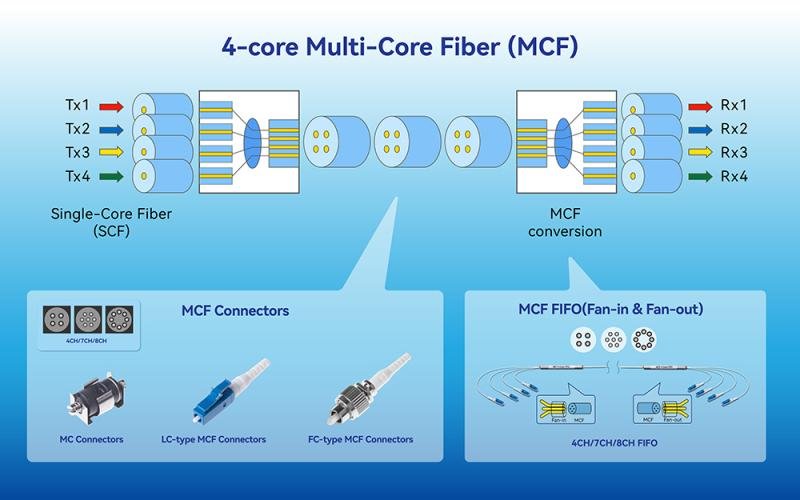
MCF incorporates multiple independent cores within a single fiber, with each core capable of transmitting signals separately. This architecture enables a significant increase in transmission capacity, allowing a single cable to provide several times the bandwidth of traditional fibers without a major increase in physical size.
(Single-core fiber vs multi-core fiber)
MCF’s multi-channel capability significantly increases bandwidth, meeting the growing demands of data centers, backbone networks, and other high-capacity environments. Moreover, MCF reduces the need for additional fiber deployment, which helps to save on fiber resources and installation space.
MCF is typically categorized into Uncoupled Core MCF (UC-MCF) and Coupled Core MCF (CC-MCF). The main difference between them lies in the core pitch. UC-MCF has a core spacing above 30 µm, allowing each core to transmit independently, while CC-MCF, with core spacing under 30 µm, requires multi-input multi-output (MIMO) digital signal processing (DSP) to handle inter-core interference.
(Uncoupled-core and coupled-core multicore fiber)
Mode coupling between signals causes them to become intertwined at the receiving end, making it difficult to differentiate the individual signals. To resolve this, MIMO-DSP technology is employed, enabling the decoding and recovery of the received signals. This process separates and reconstructs the original signals from each core, ensuring that all signals are accurately received and decoded. Since the economic efficiency of the MIMO processing at the practical operation is still under consideration, it is desirable to use the uncoupled MCF that does not require the MIMO processing in terms of cost reduction. When the uncoupled MCF is used for long-distance transmission, it is necessary to reduce inter-core crosstalk (XT). XT is a crucial parameter for MCF transmission, which caused by the coupling between modes propagating in one core and modes propagating in another core.
Commercial Deployment of Multi-core Fiber
In March 2024, NTT and NEC successfully completed the first transoceanic transmission trial over 7,280 kilometers using 12-core MCF technology, increasing network bandwidth by 12 times.
In March 2024, Google has announced plans to collaboration with NEC to implement MCF in its Taiwan-Philippines-U.S. undersea cable system, which is expected to be completed by 2025.
In 2023, FiberHome achieved a record transmission capacity of 3.61 Pbit/s using 19-core SMF in 2023.
Despite these advancements, MCF still faces challenges in areas such as Fan-In/Fan-Out (FIFO), splicing, and amplification, which is related to MCF-to-MCF connections, MCF-to-SCF connections, FIFO, MC-EDFA, etc. Currently, there are no unified global standards for MCF design, with manufacturers’ products varying in core count, structure, size, and core pitch, making splicing between different types of MCF more challenging. Establishing unified standards and implementing this new technology while ensuring compatibility and alignment with existing systems is essential for seamless integration and broader adoption.
MCF-to-SCF with Fan-in & Fan-out (FIFO) devices
For MCF commercialization, it’s essential to address challenges in connecting MCF with traditional single-core fibers. Spatial multiplexers/demultiplexers, known as Fan-In/Fan-Out (FIFO) devices, are used to effectively couple light from a single-core fiber into a multi-core fiber, or vice versa, enabling the connection between MCF and standard single-core fibers. The key technical challenges involve maintaining low inter-core crosstalk, minimizing insertion loss, and ensuring precise alignment during coupling. Several methods have been proposed for implementing FIFO devices, with the most prevalent approaches being: 1) Fused tapering, 2) 3D waveguide technology, and 3) Space optics technology.
Each of the mentioned methods has its own advantages, but achieving low crosstalk in high-density MCF with small core spacing remains a significant challenge. In the fused tapering method, FIFO is achieved by gradually tapering a bundle of single-core fibers. However, this process also increases the mode field diameter (MFD) of each core, which results in greater crosstalk and negatively affects device performance. With 3D waveguide technology, achieving low crosstalk (XT) is challenging, but it allows for the coupling of a greater number of cores. Free-space optics technology minimizes insertion loss (IL) and crosstalk (XT), though it requires precise component alignment and careful optical path design.
Based on advanced free-space optical design capabilities and mature precision coupling capabilities, HYC has launched a compact and low crosstalk four-core MCF fan-in/fan-out (FIFO) devices. Optical components such as lens and prisms are precisely designed to adjust and optimize the coupling between MCF and SCF to achieve compact structure and excellent indicators. This FIFO device with a 43um core-to-core spacing has low average coupling loss (45dB), and return loss (>55dB).
MCF-to-MCF Connections
How to connect multi-core optical fibers? The common fiber connectors in the industry are primarily designed for traditional single-core fibers, and MCFs are often connected by fusion splicing. Fusion splicing on-site is challenging due to varying core spacing between MCF fibers, complicating accurate alignment. The first functional optical connector for MCF, the MU-type MCF connector, was introduced in Japan in 2012. It utilizes Oldham’s coupling mechanism to ensure precise positioning, including accurate rotational alignment. A key feature is that the connection loss remains stable, even when tensile forces are exerted on the cable. In 2019, the SC-type MCF connector was created, offering a more streamlined design while maintaining the same functionality. The practical use of optical connectors in optical communication networks incorporating MCF continues to advance steadily.
HYC has developed LC-type/FC-type optical fiber connectors specifically for MCF connections. It is modified and redesigned based on the traditional LC/FC connector, optimized the positioning and maintaining functions, and improved the grinding and coupling process to ensure that the small insertion loss variation after many times couplings.
MCF Hybrid subassemblies used for MC-EDFA system
To achieve high-capacity, high-speed, and long-distance transmission in spatial division multiplexing (SDM) systems, optical amplifiers are crucial for compensating transmission losses. SDM fiber amplifiers are crucial for the practical application of SDM technology, and multi-core erbium-doped fiber amplifiers (MC-EDFA) are key components of SDM transmission systems.
There are two kinds of MC-EDFA pumping schemes, cladding-pumped type and core-pumped type. In the cladding-pumped scheme, the pumping light source launched to the entire cladding. The pump light propagating along the fiber core’s outer cladding, not directly through the core. For core-pumped MC-EDFA, the pump lights launched into a specific erbium-doped cores to amplify the signal.
HYC offers collaborative development of EDFA systems for multi-core fibers (MCF), providing ODM/JDM services throughout the customer’s design-in stage. The customized subassemblies include: MCF Isolator + TAP; MCF 980/1550 WDM; MCF GFF, etc.
Multi-Core Fiber Market Size
According to Businessresearchinsights’ , the global multi-core fiber (MCF) market size reached $1.836 billion in 2022, and it is expected to grow to $21.63265 billion by 2031, with a compound annual growth rate (CAGR) of 32.3% over the forecast period. The major players in this market include Furukawa Electric (Japan), Yangtze Optical Fibre and Cable (China), Fiberhome (China), iXblue (France), Humanetics (USA), Fujikura (Japan), and Sumitomo Electric (Japan). The top three companies hold over 70% of the market share. The Asia-Pacific region is the largest market by size, with a share exceeding 65%, followed by North America and Europe, with approximately 20% and 10%, respectively. In terms of product type, four-core fiber is the largest segment, accounting for about 60% of the market. For product applications, the communications sector holds more than 55% of the market share.
(Global multi-core fibers market size, 2031)
(Global multi-core fibers market share by type)
What is Hollow-core Fibers(HCF)?
Hollow-core fiber (HCF) differs from traditional solid glass or plastic-core fibers in that its core is hollow and can be filled with air, inert gas, or a vacuum. This unique structural design significantly alters the fiber’s light propagation characteristics, providing various performance advantages over traditional solid glass-core fibers. Since light travels faster in air than in glass, HCF offers lower latency and reduced signal loss compared to conventional fibers. Microsoft’s Lumenisity claims that light travels 47% faster in its hollow-core fibers than in standard silica glass fibers. Additionally, HCF is adaptable to multiple wavelengths, easily supporting bands such as O, S, E, C, L, and U.
Like traditional glass-core fibers, hollow-core fibers (HCF) consist of three parts: the core, cladding, and coating. However, the primary difference lies in the core and cladding. HCF uses a proprietary design where light propagates in an air core, and the cladding is designed with microstructure air holes as like honeycomb pattern. When the light enters the space between the core and cladding, it will undergo strongly scattering due to the periodically arranged air holes. This strongly and repeated scattering reflects the coherent phenomena, allowing light signal of a specific wavelength and angle to return to the core and continue to propagate. The role of this microstructure air hole is to confine the light signal within the core, and the performance of hollow core fibers also depends on this microstructure design.
(How hollow-core fiber works)
Hollow-core fiber, where light propagates through air, significantly reduces the refraction of light by the transmission medium, thereby greatly lowering transmission latency. Its signal loss is substantially lower than that of traditional optical fiber, making it well-suited for ultra-long-distance transmission with reduced demand for signal amplification. In high-power optical transmission, nonlinear effects (such as self-phase modulation within the optical fiber) are significantly reduced, which makes it have broad application prospects in high-power laser transmission and quantum communications.
Hollow core fibers can be simply divided into the following two categories according to their microstructure design and working principle: Photonic Bandgap Hollow-Core Fiber (PBG-HCF) and Anti-Resonant Hollow-Core Fiber (AR-HCF). The development of HCF has primarily progressed from photonic bandgap fiber to anti-resonant fiber.
(Photonic bandgap HCF, Anti-resonant HCF)
Photonic Bandgap Hollow-Core Fiber (PBG-HCF) relies on a photonic crystal structure in the fiber cladding that forms a photonic bandgap to limit the propagation of light within the hollow core. The refractive index difference of the photonic crystal ensures that light propagate only in the core and preventing leakage into the cladding. However, this structure is prone to loss, with predicted attenuation around 4dB per kilometer, which limits its use in long-haul networks.
Anti-Resonant Hollow-Core Fiber (AR-HCF) confines light through coherent reflection between tubular glass membranes within the fiber, guiding the light along the core’s axis. The anti-resonance principle is more complex, often likened to thin-film interference. This fiber type employs anti-resonant reflection, where a specially designed structure-such as a multi-layered, precisely arranged capillary system forming an intricate microstructure-prevents total internal reflection during transmission. The nested capillary structure significantly reduces attenuation, enhancing the fiber’s performance over longer distances.
Commercial of Hollow-core Fiber
In June 2024, Yangtze Optical Fibre and Cable (YOFC) supported China Mobile and China Telecom in establishing the world’s first 800G hollow-core fiber (HCF) transmission technology test network (between Shenzhen and Dongguan, Guangdong) and the world’s first single-wavelength 1.2T, unidirectional 100T+ HCF transmission system demonstration.
In February 2024, Lyntia, Nokia, Furukawa, and Interxion jointly tested HCF, achieving over 30% lower latency compared to single-mode fiber, nearly 46% faster optical transmission, and significantly reduced nonlinear effects. The demonstration achieved transmission rates of 800Gbps and 1.2Tbps, indicating potential to surpass the Shannon capacity limit.
In 2022, Lumenisity Limited, a spin-off from the University of Southampton and now a Microsoft acquisition, introduced the next-generation DNANF® hollow-core fiber. The company claims it has the lowest reported attenuation of any hollow-core fiber to date, outperforming traditional germanium-doped single-mode fiber (SMF) in the O- and C-bands.
Also in 2022, Comcast, in collaboration with Lumenisity, deployed a 40-kilometer hybrid link of hollow-core and traditional fiber in Philadelphia.
In June 2021, BT began testing Lumenisity’s HCF technology for mobile network deployments and, in September, further explored quantum key distribution over HCF for enhanced security.
To achieve broader application, HCF still faces challenges such as improving fiber and cable manufacturing processes, reducing cable loss and costs, and increasing capacity for mass production.
Hollow-Core Fiber Market Size
According to the by Businessresearchinsights, the global hollow-core fiber (HCF) market size was $13 million in 2022, with projections indicating it will reach $19 million by 2029, reflecting a compound annual growth rate (CAGR) of 6.6% during the forecast period. Key manufacturers in this market include NKT Photonics from Denmark and Lumenisity from the United Kingdom.
(Global hollow core fiber market size)
(Global hollow core fiber market share by application)
Multi-core fiber (MCF) and Hollow-core fiber (HCF) represent the future trajectory of optical communication technology. MCF enhances transmission capacity within a single fiber cable, overcoming the physical limitations of traditional fibers, while HCF offers an innovative hollow structure that supports high-speed, low-latency transmission. Although these two technologies differ in terms of market readiness and application scenarios, they share a common goal: creating more efficient and faster optical communication networks. In the future, MCF and HCF are expected to see widespread global adoption, propelling the optical communication industry to new heights.
https://www.hyc-system.com
No.38, Baijia Street, High-tech Industry Development Zone, Qingyuan, Guangdong, China
About HYC Co., Ltd
Founded in 2000, HYC is a leading global manufacturer of innovative and reliable passive optical components. HYC designs, develops, manufactures, and sells a comprehensive line of passive optical devices that enables 5G/6G, data center, data communication, FTTH, aeronautical communication networks.
This release was published on openPR.