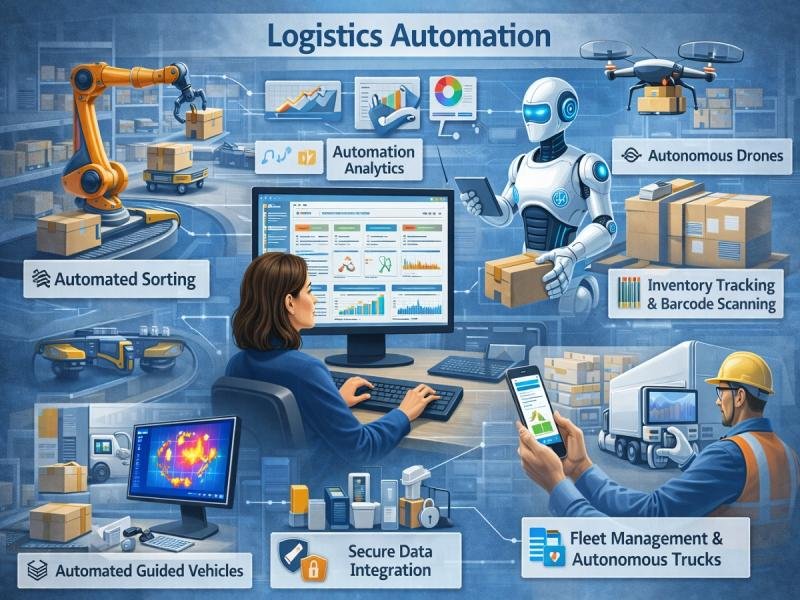
Logistics Automation market
The global Logistics Automation market was valued at US$ 68.4 billion in 2024 and is projected to reach US$ 193.9 billion by 2033, growing at a CAGR of 15.5% during the forecast period 2025-2033. Market growth is driven by increasing demand for faster delivery times, rising e-commerce volumes, labor shortages, and the need to improve operational efficiency and accuracy in warehouses, distribution centers, and transportation networks. Solutions such as automated guided vehicles (AGVs), autonomous mobile robots (AMRs), conveyor systems, sortation technologies, and warehouse management software are being widely adopted to streamline end-to-end logistics operations.
The market is gaining strong momentum from investments in robotics, AI-enabled route optimization, and integrated automation platforms that enhance visibility and reduce manual handling. Logistics service providers and retailers are modernizing infrastructure to support real-time tracking, predictive maintenance, and seamless order fulfillment. North America holds the largest market share, backed by advanced supply chain technology adoption and high e-commerce penetration, while Asia-Pacific is the fastest-growing region, fueled by rapid industrialization, expanding e-commerce markets, and government support for smart manufacturing and digital logistics transformation. Europe continues to grow steadily with strong demand for automation in manufacturing and retail logistics.
Get a Free Sample PDF Of This Report (Get Higher Priority for Corporate Email ID):- https://www.datamintelligence.com/download-sample/logistics-automation-market?sai-v
The Logistics Automation market refers to the sector of technologies and solutions that automate and optimize logistics operations, including warehousing, transportation, and supply chain processes.
Key Developments
✅ January 2026: In North America, adoption of autonomous mobile robots (AMRs), automated guided vehicles (AGVs), and warehouse execution systems expanded among major logistics and e-commerce companies such as Amazon Robotics, DHL Supply Chain, XPO Logistics, and FedEx Logistics to improve throughput, reduce labor costs, and enhance order fulfillment speed.
✅ January 2026: In Europe, port operators and freight forwarders including DP World, Maersk Logistics, DB Schenker, and Kuehne + Nagel accelerated implementation of AI-driven yard management, automated container handling, and real-time asset tracking to optimize terminal operations and reduce dwell times.
✅ December 2025: In Asia-Pacific, demand for end-to-end logistics automation increased among manufacturing and retail supply chains, with JD Logistics, Cainiao Network, Tata Group Logistics, and Yusen Logistics deploying robotics, automated sortation, and predictive analytics to handle rising e-commerce volumes.
✅ December 2025: Globally, integration of machine learning and digital twin technologies advanced dynamic route optimization, predictive maintenance, and real-time supply chain visibility, driven by providers such as IBM, Oracle, SAP, and Manhattan Associates to improve resilience and reduce disruption risk.
✅ November 2025: In the Middle East and Africa, logistics hubs and airport cargo terminals including DP World UAE, Qatar Airways Cargo, and Ethiopian Airlines Logistics adopted automated cargo handling, smart conveyors, and IoT sensors to enhance throughput and regulatory compliance.
✅ October 2025: Worldwide, collaborative robotics and vision-guided picking systems from RightHand Robotics, Fetch Robotics, ABB Robotics, and KION Group gained traction among 3PLs to improve picking accuracy and adapt to flexible fulfillment requirements.
Mergers & Acquisitions
✅ January 2026: Siemens Logistics acquired Autonomous Robotics Co., a developer of AI-driven mobile robotic solutions for warehouses, to expand its intralogistics automation offerings and strengthen autonomous operations capabilities.
✅ December 2025: Honeywell Intelligrated acquired SortTech Innovations, a provider of advanced automated sortation and conveyor analytics, to enhance its material handling solutions and speed up warehouse processing.
✅ November 2025: Zebra Technologies acquired TrackSense AI, a real-time tracking and sensor analytics provider, to integrate advanced visibility and predictive insights into its logistics automation product portfolio.
Key Players
AG | TGW Logistics Group GmbH | Toshiba Logistics | Dematic Corp | WiseTech Global | Others
Key Highlights
Dematic Corp holds 26% share, driven by its advanced warehouse automation systems, strong global presence, and large-scale deployments across retail, e-commerce, and manufacturing supply chains.
WiseTech Global holds 22% share, supported by its leading logistics execution software, strong cloud-based platforms, and widespread adoption among freight forwarders and logistics service providers.
TGW Logistics Group GmbH holds 18% share, leveraging its expertise in automated material handling, robotics, and high-throughput warehouse solutions for complex logistics environments.
Toshiba Logistics holds 14% share, driven by its integrated logistics services, automation technologies, and strong presence in Asia-Pacific supply chain operations.
AG holds 10% share, focusing on industrial automation and intralogistics solutions with growing adoption in manufacturing and distribution centers.
Others hold 2-5% share, comprising regional logistics automation providers and emerging digital supply chain solution vendors expanding intelligent warehousing and logistics capabilities.
Buy Now & Unlock 360° Market Intelligence: https://www.datamintelligence.com/buy-now-page?report=logistics-automation-market?sai-v
(Single User Report: USD 4350 & One Year Database Subscription: USD 12K)
Market Drivers
– Rising demand for faster order fulfillment, accuracy, and cost efficiency across e-commerce, retail, manufacturing, and third-party logistics driving adoption of logistics automation solutions.
– Growing labor shortages and increasing workforce costs accelerating the shift toward automated warehouses, sorting systems, and material handling technologies.
– Rapid growth of e-commerce and omnichannel retail requiring high-throughput, scalable, and flexible logistics operations.
– Advancements in robotics, AI, machine vision, and autonomous systems improving picking, sorting, packaging, and inventory management processes.
– Increasing focus on supply chain visibility, resilience, and real-time decision-making supporting investment in automated logistics platforms.
Industry Developments
– Deployment of autonomous mobile robots (AMRs), automated guided vehicles (AGVs), and robotic picking systems in warehouses and distribution centers.
– Integration of AI-driven warehouse management systems (WMS) and warehouse execution systems (WES) for optimized workflow orchestration.
– Adoption of automated storage and retrieval systems (AS/RS) to maximize space utilization and throughput.
– Strategic partnerships between logistics providers, e-commerce companies, and automation technology vendors to scale automated fulfillment capabilities.
– Growing use of data analytics, digital twins, and IoT-enabled systems for predictive maintenance and performance optimization.
Regional Insights
North America – 37% share: “Driven by strong e-commerce penetration, advanced warehouse infrastructure, high labor costs, and early adoption of automation technologies.”
Europe – 29% share: “Supported by mature logistics networks, focus on efficiency and sustainability, and widespread adoption of warehouse automation.”
Asia Pacific – 26% share: “Fueled by rapid e-commerce growth, manufacturing expansion, and significant investments in smart logistics infrastructure.”
Latin America – 5% share: “Driven by gradual modernization of logistics facilities and increasing e-commerce activity.”
Middle East & Africa – 3% share: “Supported by expanding trade hubs, logistics infrastructure investments, and adoption of automated warehousing solutions.”
Speak to Our Analyst and Get Customization in the report as per your requirements: https://www.datamintelligence.com/customize/logistics-automation-market?sai-v
Key Segments
By Organization Size
Large enterprises account for the dominant share of the market due to their complex supply chain networks, high transaction volumes, and strong investment capacity in advanced logistics and management systems. Small and medium-sized enterprises are a fast-growing segment, driven by increasing digitalization, adoption of cloud-based solutions, and the need to improve operational efficiency and cost control.
By Component
Storage and warehouse management represents a major component segment, supported by the rising demand for inventory optimization, real-time tracking, and automated warehouse operations. Transportation management also holds a significant share, driven by the need to optimize routing, reduce fuel costs, enhance delivery visibility, and improve overall logistics efficiency.
By Vertical
Food and beverage lead the vertical segmentation, driven by strict quality, safety, and traceability requirements. Defense and aerospace maintain a strong share due to complex logistics, high-value inventory, and stringent regulatory compliance. Healthcare and pharmaceuticals are rapidly adopting these solutions to ensure cold chain integrity and regulatory adherence. Automotive and manufacturing sectors contribute substantially, supported by just-in-time production models and global supply chains. Oil, gas, and energy, along with other industries, are steadily increasing adoption to manage large-scale operations and asset-intensive logistics environments.
Unlock 360° Market Intelligence with DataM Subscription Services: https://www.datamintelligence.com/reports-subscription
Power your decisions with real-time competitor tracking, strategic forecasts, and global investment insights all in one place.
✅ Competitive Landscape
✅ Sustainability Impact Analysis
✅ KOL / Stakeholder Insights
✅ Unmet Needs & Positioning, Pricing & Market Access Snapshots
✅ Market Volatility & Emerging Risks Analysis
✅ Quarterly Industry Report Updated
✅ Live Market & Pricing Trends
✅ Import-Export Data Monitoring
Have a look at our Subscription Dashboard: https://www.youtube.com/watch?v=x5oEiqEqTWg
Contact Us –
Company Name: DataM Intelligence
Contact Person: Sai Kiran
Email: Sai.k@datamintelligence.com
Phone: +1 877 441 4866
Website: https://www.datamintelligence.com
About Us –
DataM Intelligence is a Market Research and Consulting firm that provides end-to-end business solutions to organizations from Research to Consulting. We, at DataM Intelligence, leverage our top trademark trends, insights and developments to emancipate swift and astute solutions to clients like you. We encompass a multitude of syndicate reports and customized reports with a robust methodology.
Our research database features countless statistics and in-depth analyses across a wide range of 6300+ reports in 40+ domains creating business solutions for more than 200+ companies across 50+ countries; catering to the key business research needs that influence the growth trajectory of our vast clientele.
This release was published on openPR.