Intelligent Traffic Systems Market Size
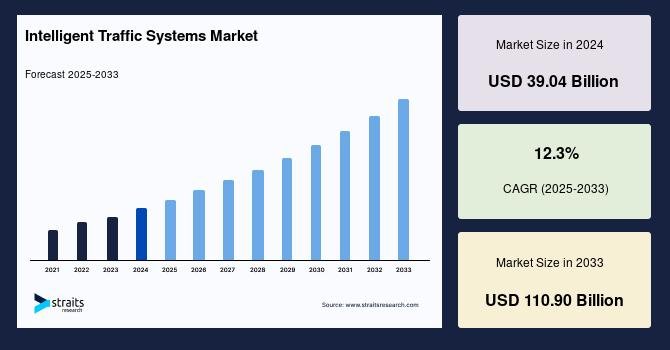
The global market for intelligent traffic systems (ITS) is on a steep growth trajectory, with the market is estimated at USD 43.84 billion in 2025, and is projected to reach USD 110.90 billion by 2033, representing aCompound Annual Growth Rate (CAGR) of 12.3% between 2025 and 2033.
“Traffic management” encompasses organising, directing and controlling moving and stationary traffic including vehicles (motorised & non-motorised), cyclists and pedestrians with the objective of ensuring safe, orderly and effective movement of people and goods, whilst improving the quality of the surrounding environment where possible.
As urbanisation accelerates globally, particularly in developing regions, traffic congestion, ageing road infrastructure and increasing vehicle parcels are prompting governments and municipalities to invest heavily in intelligent traffic systems. Real-time monitoring, adaptive signal control, connected vehicle (V2V and V2I) communications and corridor management solutions are becoming core components of future-proof urban mobility infrastructure.
View the full report for complete insights and forecasts: https://straitsresearch.com/report/intelligent-traffic-systems-market
Market Growth Drivers:
Growing awareness of congestion and road-safety issues
Rapid urbanisation, rising vehicle ownership and constrained infrastructure in cities are adding to traffic bottlenecks, higher fuel consumption and road-safety risks. The increased focus on reducing travel time, carbon emissions and enhancing road safety is catalysing the adoption of ITS.
Technological advancements and connectivity
Advances in sensors, RFID, beacon-sensing technologies, communications and telematics are enabling smarter traffic systems. Meanwhile, regulatory mandates encouraging vehicle telematics and stability/driver assistance systems in developed economies are supporting the deployment of ITS.
Smart city initiative & infrastructure upgrades
Cities globally are striving to make their mobility systems “smart”, resilient and future-ready. Upgrading legacy infrastructure, deploying adaptive traffic controls and integrating real-time mobility data are key trends. While this ups the cost and complexity (see restraints section), it also opens large opportunities.
Market Restraints & Challenges:
Existing infrastructure upgrade requirements
Deploying the latest ITS technologies often requires major overhaul of current infrastructure intersections, sensors, communications, roadside units and control systems need to be upgraded or replaced. This raises cap-ex, implementation complexity and time-to-value.
High cost and organisational readiness
Beyond hardware/software costs, municipalities must plan for integration, training, operations and maintenance over time. Budget constraints, skill gaps and coordination among multiple agencies can slow down deployments.
Market Opportunities:
Smart & connected vehicle platforms
The rise of cooperative, connected and automated mobility (CCAM) is a major opportunity. Vehicle-to‐vehicle and vehicle‐to‐infrastructure communications, part of the broader “C-ITS” (Cooperative-Intelligent Transport Systems) concept being promoted in the EU and elsewhere, will drive uptake of ITS solutions that enable real-time decision making, improved road safety and traffic efficiency.
Urban mobility & corridor management
Integrated corridor management (ICM) systems which optimise the movement of vehicles across detailed road-network corridors (freeways + arterials) with coordinated signals, incident detection and real-time controls are a fast-growing segment and present significant growth potential.
Download a free sample to explore key drivers and segment data: https://straitsresearch.com/report/intelligent-traffic-systems-market/request-sample
Regional Outlook:
North America – Leading market
North America is expected to dominate the intelligent traffic systems market, with a share of USD 9,337 million and a projected CAGR of 10.7% during the forecast period. The region benefits from mature infrastructure, early technology adoption and strong government initiative in transportation research and smart city programmes.
Europe – Growth via regulation and integration
Europe is expected to grow at approximately 11% CAGR, supported by transportation sector initiatives, smart city strategies and regulatory frameworks promoting ITS integration across EU member states.
Asia-Pacific – Fastest growth region
Asia-Pacific is anticipated to register the highest growth rate, ~16.2% CAGR, driven by rapid urbanisation in China, India, Japan and Southeast Asia, rising vehicle ownership and major infrastructure investments in traffic and mobility systems.
Market Segmentation:
By Product Type: Integrated Urban Traffic Control System, Freeway Management System, Electronic Toll Collection (ETC), Advanced Public Transportation System, Others.
By Component: Hardware, Software, Services, Integration & Implementation, Support & Maintenance.
By Solution: Traffic Monitoring Systems, Traffic Signal Control Systems, Traffic Enforcement Cameras, Integrated Corridor Management (ICM), Intelligent Driver Information Systems, Others.
By End-Use: Urban Traffic, Inter-Urban, Parking Management, Info-Mobility, Public Transport, Freeway.
By Region: North America, Europe, Asia-Pacific, Middle East & Africa, Latin America.
Within these segments, the Traffic Monitoring System solution leads in market share (USD 6,140 million; ~CAGR 12.2%) and the Integrated Corridor Management segment holds strong potential (~USD 4,930 million; CAGR 12.7%). The Intelligent Driver Information System is projected to grow fastest (~CAGR 13.3%) due to increasing demand for collision warnings, adaptive cruise control and vehicle-driver assistance technologies.
Competitive Landscape:
Key players operating globally within the intelligent traffic systems market include:
Cubic Corporation
SNC-Lavalin Group
Thales Group
IBM Corporation
General Electric Company (GE)
Siemens AG
Kapsch TrafficCom
TomTom International BV
These companies are actively investing in R&D, participating in smart-city partnerships, rolling out integrated corridor and adaptive traffic control solutions, and expanding their geographic footprint.
Get the full report to access detailed datasets and strategies: https://straitsresearch.com/buy-now/intelligent-traffic-systems-market
Recent Industry Developments:
In 2022, SNC-Lavalin Group announced a joint initiative with MBC Group to strengthen building and infrastructure resilience in the wake of climate change and extreme weather events an indicator of the expanding role of ITS in infrastructure resilience.
Also in 2022, Kapsch TrafficCom launched an “Intelligent Corridor” deployment at Nicholson Street in Melbourne showcasing real-world ICM implementation and smart infrastructure in action.
Outlook & Future Trends:
The intelligent traffic systems market is poised to be transformed by emerging technologies such as artificial intelligence (AI), the Internet of Things (IoT), connected vehicle systems and data analytics. Adaptive signal control, cloud-based traffic analytics, edge computing for real-time decision making, and integrated mobility platforms are increasingly becoming standard features.
As cities transition toward “mobility as a service” (MaaS) models, ITS solutions that offer flexible, scalable, data-driven and interoperable platforms will become high priority. Vendors offering open-platform architectures, sensor-to-cloud connectivity, and strong security/compliance frameworks will hold competitive advantage.
Contact Us :
+1 646 905 0080 (U.S.)
+91 8087085354 (India)
+44 203 695 0070 (U.K.)
sales@straitsresearch.com
About Us :
Straits Research is a market intelligence company providing global business information reports and services. Our exclusive blend of quantitative forecasting and trends analysis provides forward-looking insight for thousands of decision-makers. Straits Research Pvt. Ltd. provides actionable market research data, especially designed and presented for decision making and ROI.
This release was published on openPR.