Additive Manufacturing Generative AI Copilots Market
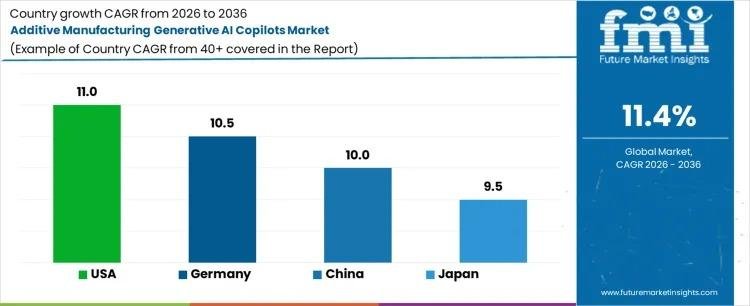
The global additive manufacturing generative AI copilots market is poised for strong expansion as artificial intelligence begins to play a central role in industrial design and production processes. According to new industry analysis, the market is expected to grow from USD 199.4 million in 2026 to USD 587.7 million by 2036, reflecting a compound annual growth rate (CAGR) of 11.4% during the forecast period.
The rapid integration of AI-driven design assistants within additive manufacturing platforms is transforming how engineers create, optimize, and validate components for industrial 3D printing. These generative AI copilots are increasingly being deployed to automate design iterations, optimize materials, and accelerate product development cycles across sectors such as aerospace, automotive, industrial manufacturing, and medical technology.
Get Access of Report Sample:
https://www.futuremarketinsights.com/reports/sample/rep-gb-30798
As manufacturers pursue faster innovation and improved operational efficiency, generative AI copilots are emerging as critical tools that enhance design intelligence and streamline additive manufacturing workflows.
Rising Demand for AI-Driven Design Optimization
Traditional product design workflows often involve lengthy cycles of simulation, prototyping, and manual iteration. Generative AI copilots are dramatically reducing this complexity by enabling engineers to automatically generate optimized geometries, simulate performance outcomes, and detect potential design flaws in real time.
Several structural factors are driving market growth:
• Increasing adoption of industrial additive manufacturing technologies
• Demand for lightweight, high-performance components in aerospace and automotive sectors
• Rising focus on material efficiency and waste reduction
• Accelerated product development cycles in advanced manufacturing industries
• Integration of AI capabilities with CAD, PLM, and simulation software platforms
Manufacturers are leveraging AI copilots not only for design automation but also for predictive process optimization, build preparation, and quality validation, improving the reliability and scalability of additive manufacturing operations.
Generative Design Leads Functional Adoption
Among the various functions offered by AI copilots, generative design has emerged as the most widely adopted capability, accounting for approximately 34% of total market demand.
Generative design systems enable engineers to input performance requirements-such as load conditions, materials, and manufacturing constraints-while the AI platform generates multiple optimized design alternatives that meet those criteria.
This approach delivers several advantages:
• Reduced material consumption
• Faster prototyping cycles
• Improved structural performance
• Increased design innovation through automated geometry generation
Integration with advanced simulation platforms further ensures that generated designs remain manufacturable and compliant with engineering standards.
Aerospace Sector Leads End-Use Adoption
The aerospace industry represents the largest end-use segment, capturing approximately 32% of global demand for additive manufacturing generative AI copilots.
Aircraft and spacecraft manufacturers increasingly rely on AI-assisted generative design to create lightweight, structurally optimized components that meet strict safety and certification requirements. By leveraging AI-driven design tools, aerospace engineers can reduce component weight, improve fuel efficiency, and simplify complex assemblies.
Beyond aerospace, several industries are rapidly embracing AI-assisted additive manufacturing:
• Automotive manufacturing
• Industrial machinery production
• Medical device engineering
• Defense and advanced materials development
These sectors benefit from the ability to produce complex geometries and customized components that would be difficult or impossible to manufacture using conventional techniques.
Regional Adoption Led by Advanced Manufacturing Economies
Geographically, adoption of generative AI copilots for additive manufacturing remains concentrated in regions with advanced industrial ecosystems, strong digital infrastructure, and high R&D investment.
Key growth regions include the United States, Germany, China, and Japan, where manufacturers are increasingly integrating AI-driven design technologies into production environments.
Country-level growth projections highlight the global momentum:
• United States: 11.0% CAGR – driven by aerospace and industrial innovation hubs
• Germany: 10.5% CAGR – supported by Industry 4.0 initiatives and advanced manufacturing infrastructure
• China: 10.0% CAGR – fueled by expanding additive manufacturing capabilities
• Japan: 9.5% CAGR – driven by high-precision manufacturing and automation
These regions benefit from strong ecosystems that combine AI software development, additive manufacturing hardware innovation, and skilled engineering talent.
Exhaustive Market Report: A Complete Study
https://www.futuremarketinsights.com/reports/additive-manufacturing-generative-ai-copilots-market
Competitive Landscape: AI Platforms Integrated with Manufacturing Workflows
Competition in the additive manufacturing generative AI copilots market is centered on AI algorithm sophistication, platform integration capabilities, and simulation accuracy.
Leading technology providers are focusing on developing scalable platforms that seamlessly integrate with existing CAD, PLM, and additive manufacturing systems, enabling engineers to incorporate AI-assisted design into established workflows.
Key companies operating in the market include:
Autodesk, Siemens Digital Industries, Dassault Systèmes, PTC, Ansys, Hexagon
These companies are investing heavily in generative design technologies, simulation engines, and digital twin capabilities to strengthen their position in the rapidly evolving AI-driven manufacturing ecosystem.
Market differentiation increasingly depends on:
• AI model accuracy and training data quality
• Multi-material design optimization capabilities
• Integration with industrial additive manufacturing platforms
• Simulation and validation reliability
Strategic Outlook: AI Copilots Becoming Core Tools for Industrial Design
Industry analysts anticipate that generative AI copilots will soon become standard components of digital manufacturing toolchains, fundamentally changing how engineers approach design and production.
By combining machine learning, simulation intelligence, and automated design generation, AI copilots enable manufacturers to accelerate product development while improving performance and reducing material waste.
As industrial companies pursue greater digitalization and manufacturing agility, adoption of AI-assisted additive design tools is expected to accelerate across sectors ranging from aerospace to consumer products.
The next phase of market development will likely focus on multi-material optimization, predictive defect detection, and automated build preparation, expanding the role of AI across the entire additive manufacturing lifecycle.
Brows More Industry Reports
Paint Additive Market
https://www.futuremarketinsights.com/reports/paint-additives-market
Additive Manufacturing With Metal Powders Market
https://www.futuremarketinsights.com/reports/additive-manufacturing-with-metal-powders-market
Additive Manufacturing and Material Market
https://www.futuremarketinsights.com/reports/additive-manufacturing-material-market
Future Market Insights Inc.
Christiana Corporate, 200 Continental Drive,
Suite 401, Newark, Delaware – 19713, USA
T: +1-845-579-5705
For Sales Enquiries: sales@futuremarketinsights.com
Website: https://www.futuremarketinsights.com
Future Market Insights, Inc. (FMI) is an ESOMAR-certified, ISO 9001:2015 market research and consulting organization, trusted by Fortune 500 clients and global enterprises. With operations in the U.S., UK, India, and Dubai, FMI provides data-backed insights and strategic intelligence across 30+ industries and 1200 markets worldwide.
This release was published on openPR.