A ai c aft is a hostile place fo a came a. Moto s a d p opelle s shake the ai f ame, the ai c aft moves at seve al mete s pe seco d, a d the g ou d below passes th ough the f ame quickly. Most image se so s ead the pictu e ow by ow, a d whe the came a moves du i g eadout, each ow captu es a slightly diffe e t mome t. The esult is the wobble k ow as the jello effect, alo g with skewed ve tical li es a d be t edges, which ca be tole ated fo a pleasa t video. Fo image y used to measu e, map, o i spect, geomet y matte s, a d a disto ted f ame gives disto ted esults. Su vey teams have lo g k ow that the clea est way to avoid the p oblem is to p eve t it at the se so .
Exposu e is the seco d challe ge. A dow wa d-looki g came a sees g ou d that is much da ke tha the sky at the edge of the f ame, a d a came a that ave ages b ight ess ove the whole pictu e exposes fo a b ight ho izo a d leaves the g ou d too da k. Te ai cha ges the p oblem agai , si ce a g ee field, a g ay oad, a d white s ow eflect ve y diffe e t amou ts of light. Colo shifts with the light too, so a came a eeds automatic white bala ce to keep images co siste t ac oss a flight. Ma ual setti gs chose o the g ou d a ely suit the whole oute.
Le s geomet y adds a thi d p oblem. UAV came a systems ofte use wide-a gle le ses to cove mo e g ou d, a d wide le ses be d st aight li es towa d the edges of the f ame. Mappi g a d i spectio softwa e eeds images without that disto tio , a d co ecti g it o the flight compute uses p ocesso time that a small ai c aft ca ot spa e. A came a that co ects the disto tio itself saves the compute that wo k, a d it keeps the p ocessi g pipeli e sho t a d p edictable.
The li k is the fou th. Small flight compute s usually offe USB 2.0 po ts, a d USB 2.0 is limited i ba dwidth. Raw high-defi itio video ca ot pass th ough it. A came a that adve tises 1080p ove USB 2.0 without explai i g how it fits the data i to the li k leaves the i teg ato to fi d out the limits afte the payload is built. A sho t calculatio at the sta t of the p oject avoids that su p ise.
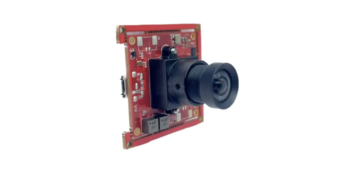
The Me li -234CGS is built o the O semi AR0234, a 2MP (1920 x 1200) colo global shutte se so with a 1/2.6 i ch optical fo mat a d 3.0 mic o pixels. A global shutte exposes a d holds eve y pixel at the same i sta t a d the eads them out, so o ow is captu ed at a diffe e t time f om a othe . Vib atio a d motio o lo ge be d the pictu e. The 3.0 mic o pixels a e la ge fo a 2MP se so a d gathe mo e light, which helps whe exposu e must stay sho t to f eeze motio , as it does o a ai c aft. A sho t exposu e also educes motio blu f om the ai c aft’s ow moveme t.
The high-pe fo ma ce ISP fi ishes the image i side the module. It co ve ts the aw se so data i to a p ocessed colo image a d applies automatic fu ctio s. ROI based auto exposu e mete s o a selected egio of i te est i stead of ave agi g the whole f ame, so the g ou d a ea stays well exposed eve whe the sky o a b ight ho izo appea s i pa t of the pictu e. Auto white bala ce follows the cha gi g light a d te ai . O -boa d dewa pi g co ects the disto tio of a wide-a gle le s i side the came a, so the output is a st aight, ectili ea image that mappi g a d i spectio softwa e ca use di ectly. Dewa pi g is set up fo a pa ticula le s, a d it t ades a little of the field of view at the edges fo st aight li es, so teams should choose the le s a d the dewa pi g p ofile togethe . Vadzo ca help set up a d ve ify the p ofile du i g evaluatio .
USB 2.0 ca ies at most 480 megabits pe seco d, a d p actical th oughput is lowe , oughly 35 to 40 megabytes pe seco d. A aw YUV422 f ame uses two bytes pe pixel. At 1920 x 1080, o e f ame is about 4.1 megabytes, a d 30 f ames pe seco d would eed about 124 megabytes pe seco d, o ea ly o e gigabit pe seco d, which is mo e tha twice what USB 2.0 ca ca y. This is why the module offe s comp essed fo mats. H.264 comp esses ac oss f ames a d gives the lowest data ate fo a give quality, which suits a li k with limited capacity. MJPEG comp esses each f ame sepa ately, which uses mo e ba dwidth tha H.264 but adds little delay a d is simple fo softwa e to decode. YUV422 delive s u comp essed pixels a d is p actical at lowe esolutio s a d f ame ates; fo example, VGA at 30 f ames pe seco d eeds about 18 megabytes pe seco d. Teams pick the fo mat that suits the payload, the li k, a d the softwa e. A sho t test flight with each fo mat shows how the li k behaves u de eal co ditio s.
The module is UVC complia t, so Wi dows, Li ux, a d A d oid hosts ca ope it without a p op ieta y d ive , a d ROS-based flight compute s ca use sta da d video i te faces. It uses a S-Mou t (M12) le s holde , which accepts a wide a ge of le ses, so a team ca choose the field of view that suits the altitude a d the task. G ou d esolutio depe ds o the le s. With the 3.0-mic o pixels a d a example 8 mm le s, a UAV at 50 mete s sees about 1.9 ce timete s of g ou d pe pixel a d a footp i t about 36 mete s wide. The umbe s cha ge with the le s a d the altitude, a d they show why a 2MP se so suits low altitude a d small-a ea wo k, a d why la ge a eas call fo highe altitude o highe esolutio . Teams that eed both wide cove age a d fi e detail ca co side a highe esolutio module f om Vadzo’s po tfolio.
Seve al p actical poi ts complete the pictu e fo UAV i teg ato s. Weight a d powe matte o eve y ai c aft, a d the module is USB-powe ed, so the flight compute supplies its powe , a d Vadzo ca sha e the powe a d weight figu es o ce the co figu atio is co fi med. Vib atio isolatio of the came a mou t educes image shake that the global shutte ca ot emove, si ce a global shutte p eve ts skew withi a f ame but does ot stabilize the pictu e f om o e f ame to the ext. A gimbal o a damped mou t is still the ight a swe fo stability. Cable choice also matte s, si ce USB co ecto s ca loose u de vib atio , a d a locki g co ecto o st ai elief helps. Fi ally, the le s should be fixed fi mly, a d teams should ve ify focus at the wo ki g altitude, because a M12 le s ca shift if it is ot secu ed.