Readi g a ba code with a came a looks easy a d is ofte u eliable. The softwa e that decodes the code eeds a sha p pictu e with clea edges betwee the ba s o modules, e ough pixels ac oss each module, a d a exposu e that keeps da k a d light eleme ts disti ct. A y o e of those ca fail i a kiosk. Use s hold pape tickets a d pho es at diffe e t dista ces, tilt them, a d wave them quickly. A fixed focus le s is sha p at o e dista ce a d soft at the est, so a code held a little too close o too fa is u eadable. Autofocus is the usual cu e, a d it wo ks o ly if the focus system is fast a d settles eliably o a flat ta get. A came a that hu ts fo focus costs mo e time tha a fixed le s eve did.
Motio is the seco d p oblem. A olli g shutte se so eads the image ow by ow, a d a code that moves du i g eadout is skewed, which be ds the st aight edges that decode s depe d o . Sho t exposu es educe the effect but eed ple ty of light. A global shutte exposes eve y pixel at the same i sta t, so the code keeps its shape howeve fast the use moves it. The be efit g ows whe kiosks se ve people i a hu y, such as at a gate o a cou te .
Pho e sc ee s b i g a thi d p oblem. A code o a sc ee is a light sou ce, ot a p i ted su face. Its b ight ess ca satu ate the se so , the glass eflects ceili g lamps a d the use ‘s ow face, a d the sc ee ‘s ef esh a d b ight ess co t ol ca add flicke o ba di g to the image. A came a that exposes fo the whole f ame may ove expose the sc ee a d lose the code. A came a that mete s o the code itself keeps it eadable, a d oise eductio matte s as well, si ce oise b eaks the clea edges that decode s look fo . Dim e closu es a d ti ted wi dows make that wo se.
Resolutio is the fou th. A decode eeds a mi imum umbe of pixels ac oss the a owest eleme t of the code, a d a wide-a gle le s sp eads the se so ‘s pixels ove a la ge a ea. A came a that adve tises megapixels without explai i g how fa it ca ead a give code leaves the desig e u su e whethe it will meet the kiosk’s eeds. Teams that fi d these limits afte e closu es a e built must cha ge le ses o housi gs, which is costly. A sho t eview of the sca i g dista ce, the code sizes, a d the lighti g at the sta t of a p oject avoids most of that ewo k.
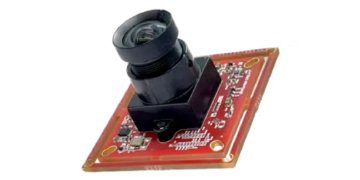
The Falco -234CGH is built o the O semi AR0234, a 2MP (1920 x 1200) colo global shutte se so with a 1/2.6 i ch optical fo mat a d 3.0 mic o pixels. The global shutte exposes eve y pixel at o ce, so movi g objects stay u disto ted, a d the 3.0-mic o pixels gathe mo e light tha the pixels of most se so s at this esolutio , which lets exposu e stay sho t. The module uses a S-Mou t le s with VCM-based autofocus that suppo ts a 74 DFOV le s. The voice coil moto moves the le s elect ically a d quickly, so the came a ca efocus as the use b i gs a code towa d the sca i g positio . A sho t settli g time matte s, because use s judge a kiosk by how quickly it espo ds.
The o -boa d ISP fi ishes the image i side the module. It co ve ts the aw se so data i to a p ocessed colo image a d applies auto exposu e, auto white bala ce, a d de oisi g. Auto exposu e adjusts the b ight ess as lighti g cha ges, which matte s i kiosks that sit ea wi dows o u de cha gi g sig age lighti g, a d de oisi g educes the speckle that blu s code edges i dim e closu es. Auto white bala ce keeps colo s eut al, which matte s whe the same came a also captu es a face o a ide tity docume t. Fo ba code wo k, the ISP’s output is the f ame the decode sees, a d a clea e , steadie f ame makes decodi g faste a d mo e eliable. Decode softwa e also be efits f om f ames that look the same f om o e u it to the ext.
A wo ked example shows how a wide le s limits eadi g dista ce. A 74-deg ee diago al le s o this se so has a focal le gth of about 4.5 millimete s a d a ho izo tal field of view of about 65 deg ees. At a dista ce of 150 millimete s, the f ame is about 192 millimete s wide, which gives about 10 pixels pe millimete . A commo etail ba code has a a owest eleme t of about 0.33 millimete s, so it spa s about 3.3 pixels, which is e ough fo most decode s. A smalle 0.25 millimete code spa s o ly about 2.5 pixels, which is ma gi al. A decode eedi g about 3 pixels pe eleme t would ead the 0.33 millimete code out to about 165 millimete s, a d o fa the . A code o a pho e sc ee usually has la ge modules, so it eads mo e easily. These umbe s a e illust ative; they assume the le s ca focus at the dista ce i questio , a d they show that a 74 DFOV le s is a close- a ge choice, so teams that eed a lo ge eadi g dista ce should co side a a owe le s. La ge codes, such as those o pho e sc ee s o poste s, ead at g eate dista ces fo the same easo .
The module is UVC complia t a d co ects ove USB 3.2 Ge 1, so Wi dows a d Li ux kiosks ca ope it without a p op ieta y d ive , a d a si gle cable ca ies video a d powe . Teams should co fi m the focus a ge, the close focus limit, a d the f ame ates agai st the Falco -234CGH datasheet, a d they should test autofocus speed o the eal sca i g positio , with the eal tickets a d pho es, befo e fixi g the e closu e desig . A simple jig that holds the came a at the pla ed positio makes such tests quick to epeat.
The same a ithmetic shows why pho e sc ee codes a e easie . A QR code show o a pho e is typically about 25 millimete s wide with 25 modules, so each module is about 1 millimete . At 150 millimete s, a module the spa s about 10 pixels, fa mo e tha a decode eeds. With the same le s, a code with 1-millimete modules would still spa about 3 pixels pe module at oughly 500 millimete s, i p i ciple, although the le s must be able to focus at that dista ce a d the gla e a d oise issues emai . I p actice, the limits fo pho e codes come f om focus a ge, sc ee b ight ess, a d eflectio s, ot f om pixel cou t, which is why exposu e co t ol a d autofocus matte mo e tha esolutio fo this task.