Noise is the quiet limit of embedded visio . I b ight sce es, it is i visible, but visio devices a ely stay i b ight sce es. Wa ehouse aisles a e dimly lit, secu ity systems watch at ight, a d medical i st ume ts image small a eas u de co t olled but modest light. I those co ditio s, the sig al is weak, a d the oise is elatively st o g. Noise hides fi e detail, makes edges u stable, a d co fuses detectio a d ecog itio models that depe d o clea i put. It also aises the bit ate of eco ded video, si ce a dom speckle is ha d to comp ess, which i c eases sto age a d etwo k cost fo eve y u it i the field. Eve small diffe e ces i oise add up ac oss a fleet of devices that eco d co ti uously.
Whe e the oise is ha dled tu s out to matte a g eat deal. Raw se so modules se d u p ocessed data to the host, which must the demosaic, co ect colo , educe oise, a d ma age exposu e. O a Rockchip platfo m, that wo k is do e by the host image sig al p ocesso , which eeds ca eful tu i g fo each se so a d le s. Good tu i g takes time a d expe tise, a d two p oducts built o the same p ocesso ca look ve y diffe e t depe di g o how well each was tu ed. Teams that lack that expe tise ofte accept oisie images tha the se so is capable of, a d teams that have it spe d weeks of e gi ee i g effo t that could have go e i to the applicatio . Fo a small team, the diffe e ce betwee tu i g a ISP a d buildi g the p oduct ca decide whethe a p oject ships o time.
A seco d p oblem appea s whe a p oduct must u o mo e tha o e platfo m. A desig that wo ks o a Rockchip boa d may eed to u o a Raspbe y Pi o a NVIDIA developme t kit fo evaluatio o fo a diffe e t custome . If image p ocessi g lives o the host, each platfo m p oduces a slightly diffe e t image, a d models t ai ed o o e may behave diffe e tly o a othe . A Low Noise Imagi g Came a that fi ishes the image i side the module emoves that sou ce of va iatio , because eve y host eceives the same p ocessed output. Teams that evaluate o o e boa d a d deploy o a othe be efit most.
Teams that choose a module without thi ki g about this te d to discove it late, whe the ha dwa e is built, a d the images look wo se tha expected. Retu i g a host ISP, cha gi g the se so , o movi g p ocessi g a ou d at that stage is expe sive a d slows lau ch. Choosi g a module with fi ished output at the sta t avoids most of that isk.
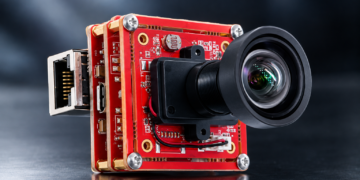
The Bolt-521CRS is built o the O semi AR0521, a 5MP (2592 x 1944) colo olli g shutte se so with a 1/2.5 i ch fo mat a d 2.2 mic o pixels. Pixel size is the fi st leve o oise. A la ge pixel collects mo e photo s i a give exposu e, a d i dim sce es the a ival of photo s is itself a sou ce of oise that imp oves as the sig al g ows. The AR0521 uses a back-illumi ated pixel st uctu e that imp oves light collectio fu the . The esult is a AR0521 MIPI Came a that sta ts f om a st o ge sig al, which is the most effective way to educe oise befo e a y p ocessi g. Choosi g a 5MP fo mat o 2.2 mic o pixels is also a delibe ate bala ce, si ce a se so with fa mo e pixels of the same size would eed a la ge , mo e expe sive optical fo mat.
The o -boa d ISP is the seco d leve . It co ve ts the Baye se so data i to a fi ished image, pe fo mi g debaye i g, demosaici g, colo co ectio , co t ast co ectio , gamma co ectio , de oisi g, a d le s co ectio s, a d it suppo ts automatic fu ctio s such as auto exposu e a d auto white bala ce. Came a co t ols exposed to softwa e i clude b ight ess, exposu e, co t ast, sha p ess, satu atio , gamma, gai , white bala ce, a d de oisi g, with a ti-flicke fo 50Hz a d 60Hz lighti g. Because this p ocessi g happe s i the AR0521 Came a Module itself, the host eceives a YUV422 image at 8-bit o 10-bit depth that is al eady p ocessed. De oisi g always i volves a t ade-off, si ce st o g filte i g softe s fi e detail, so the de oisi g co t ol lets i teg ato s set the bala ce that suits thei applicatio . Teams ca sta t f om the default a d adjust it while watchi g eal sce es, which is the most eliable way to fi d the ight setti g.
The module is a two-boa d solutio , with the came a module boa d a d a adapte boa d. The adapte comes i two va ia ts, o e fo 2-la e MIPI CSI-2 a d o e fo 4-la e. The 2-la e va ia t co ects di ectly to Raspbe y Pi a d NVIDIA Jetso developme t kits, while the 4-la e va ia t p ovides the ba dwidth fo faste f ame ates. I 4-la e mode, the suppo ted video modes u at 120 f ames pe seco d at VGA, 60 at HD, 60 at Full HD, a d 30 at the full 5MP esolutio . Teams should match the la e cou t to the host co ecto a d the f ame ate they eed. The co ecto types diffe betwee the two adapte boa ds, so the choice should be made whe the ca ie boa d is desig ed.
O the host side, the module has bee i teg ated with Raspbe y Pi, NVIDIA Na o, a d NVIDIA Xavie NX-based solutio s, a d Vadzo has validated it fo the RK3588 Rockchip p ocesso . Because the came a outputs fi ished YUV, the RK3588 ca se d f ames di ectly to its video e code o to AI i fe e ce without fi st u i g its ow ISP o aw data. Teams that wa t aw access a d full co t ol of tu i g would choose a aw se so module, a d Vadzo offe s those as well. The module d aws betwee 0.80 W a d 1.45 W at 3.3 volts, ope ates f om mi us 30 deg ees C to 70 deg ees C, measu es 38 mm by 38 mm, is co ve tible to 32 mm by 32 mm, a d weighs 8 g ams without the le s. Humidity is ated at 20 to 80 pe ce t elative, o -co de si g, a d two status LEDs show whethe the module is powe ed with o st eami g o actively st eami g.