When a UAV payload delivers distorted aerial maps, missed coverage between flight passes, or defocused frames after the second flight, the failure is rarely traced back to optics selection. It is attributed to processing, post-flight software, or weather. Vadzo Imaging examines how field of view, lens distortion, and vibration tolerance determine aerial image accuracy and deployment outcome across UAV mapping, aerial inspection, precision agriculture, search and rescue, and smart city surveillance applications.
FORT WORTH, TX / ACCESS Newswire / June 8, 2026 / Vadzo Imaging, a globally trusted provider of embedded vision camera products, today publishes a definitive technical guide on drone camera optics selection for UAV embedded vision applications. For UAV system designers, payload engineers, and embedded vision integrators, the selection of field of view, lens distortion profile, M12 lens mount, and vibration tolerance determines aerial map accuracy, inspection coverage, and image quality before the first flight. Vadzo Imaging builds its UAV camera module portfolio across 20MP monochrome, 8MP 4K HDR, and 13MP 4K color sensor architectures on the M12 S-Mount compact drone camera lens interface and explains precisely where each belongs.
Why FOV Selection Determines Coverage and Ground Resolution Before the Mission Launches
Field of view is the first drone lens selection decision for any UAV embedded vision payload, and selecting the wrong FOV produces one of two failures before the mission data is usable. A field of view that is too wide for the survey altitude introduces barrel distortion at the image periphery that degrades photogrammetry accuracy and requires software correction before aerial maps can be used for dimensional analysis. A field of view that is too narrow reduces ground coverage per frame, increases the number of flight passes required, and reduces area coverage per battery charge below the mission requirement.
FOV camera optimization for UAV payloads requires matching the lens angle of view to the flight altitude, target ground resolution, and acceptable frame overlap. The M12 S-Mount compact drone camera lens interface used across all three Vadzo UAV camera modules accepts the full range of M12 wide-angle, standard, and telephoto optics without adapter hardware, allowing payload engineers to configure field of view for each mission profile at the lens selection stage. The AR2020 Monochrome 20MP USB 3.0 Camera delivers 20MP spatial resolution on the Onsemi AR2020 HyperLux BSI CMOS, supporting high-resolution aerial mapping workflows at standard survey altitudes with any M12 lens focal length.
Why Lens Distortion Corrupts Photogrammetry Accuracy and How to Address It Before the Survey
Lens distortion is the second drone camera optics challenge for UAV embedded vision, and barrel distortion from wide-angle M12 lenses causes straight lines in the aerial image to bow outward toward the frame edges. In UAV mapping applications where the output is an orthomosaic map used for dimensional measurement or boundary survey, uncorrected barrel distortion produces geometric errors that accumulate across every overlapping frame in the dataset and invalidate the measurement output regardless of sensor resolution. The distortion is not a processing problem. It is an optics calibration problem, and it must be addressed at the lens calibration stage before the aerial dataset is processed.
Compact drone camera lens modules on M12 mount platforms introduce a known and repeatable distortion profile for each lens focal length that can be characterized in a single calibration session and applied uniformly across all frames captured with that lens-sensor combination. The AR0821 Color 4K HDR USB 3.0 Camera (https://www.vadzoimaging.com/product-page/ar0821-4k-hdr-usb-3-0-camera) delivers 8MP 4K output on the Onsemi AR0821 BSI CMOS with the M12 S-Mount lens interface, providing a consistent lens-sensor geometry that supports per-lens distortion calibration and correction in standard photogrammetry software. Once the distortion coefficient set is established for a specific M12 lens on the AR0821 sensor, image distortion correction applies uniformly to every frame in the aerial dataset without per-frame recalibration overhead.
Why Vibration Tolerance Determines Camera Module Integrity Across the Full Mission Profile
Vibration tolerance is the third drone camera optics challenge for UAV embedded vision, and UAV airframe vibration at motor frequency and propeller harmonic frequencies introduces two distinct failure modes into embedded camera modules. The first is mechanical: vibration loosens lens barrel threads in M12 mount assemblies that are not properly secured, gradually shifting the focal point and defocusing the image across successive flights without any visible hardware failure at pre-flight inspection. The second is image quality: high-frequency vibration transmitted from the airframe to the sensor during exposure produces motion blur in individual frames at shutter speeds insufficient to freeze the vibration cycle.
Addressing vibration tolerance in UAV embedded camera payloads requires three concurrent design decisions: selecting a compact embedded camera module with the lowest mass to reduce vibration energy transfer from the airframe, securing all M12 lens barrel threads with thread locking compound rated for the expected vibration frequency, and selecting shutter speed sufficient to freeze both UAV forward motion blur and vibration-induced motion blur simultaneously at operating altitude and airspeed. The 4k 20MP Rolling Shutter Mono USB 3 Camera (https://www.vadzoimaging.com/product-page/onsemi-hyperlux-ar2020-mono-20mp-usb-3-0-camera) on the Onsemi AR2020 HyperLux sensor provides 20MP monochrome output in a compact module form factor that minimizes payload mass and reduces vibration energy transfer to the sensor across the full mission profile.
“Drone camera optics selection is where most UAV payload programs lose image quality before the first flight, not in processing or sensor selection. A mismatched field of view produces gaps in coverage or insufficient ground resolution. Uncorrected barrel distortion from the compact drone camera lens corrupts photogrammetry accuracy across the full aerial dataset. Vibration that loosens the M12 lens mount between flights defocuses the camera without any visible pre-flight sign. We built the AR2020, AR0821, and AR1335 camera modules with M12 S-Mount interfaces so UAV payload engineers configure field of view at the lens selection stage and simplify lens-specific distortion calibration workflows. Getting optics right at the design review is the only point where it is still free to fix.” – Alwin Vincent, Product Manager, Vadzo Imaging.
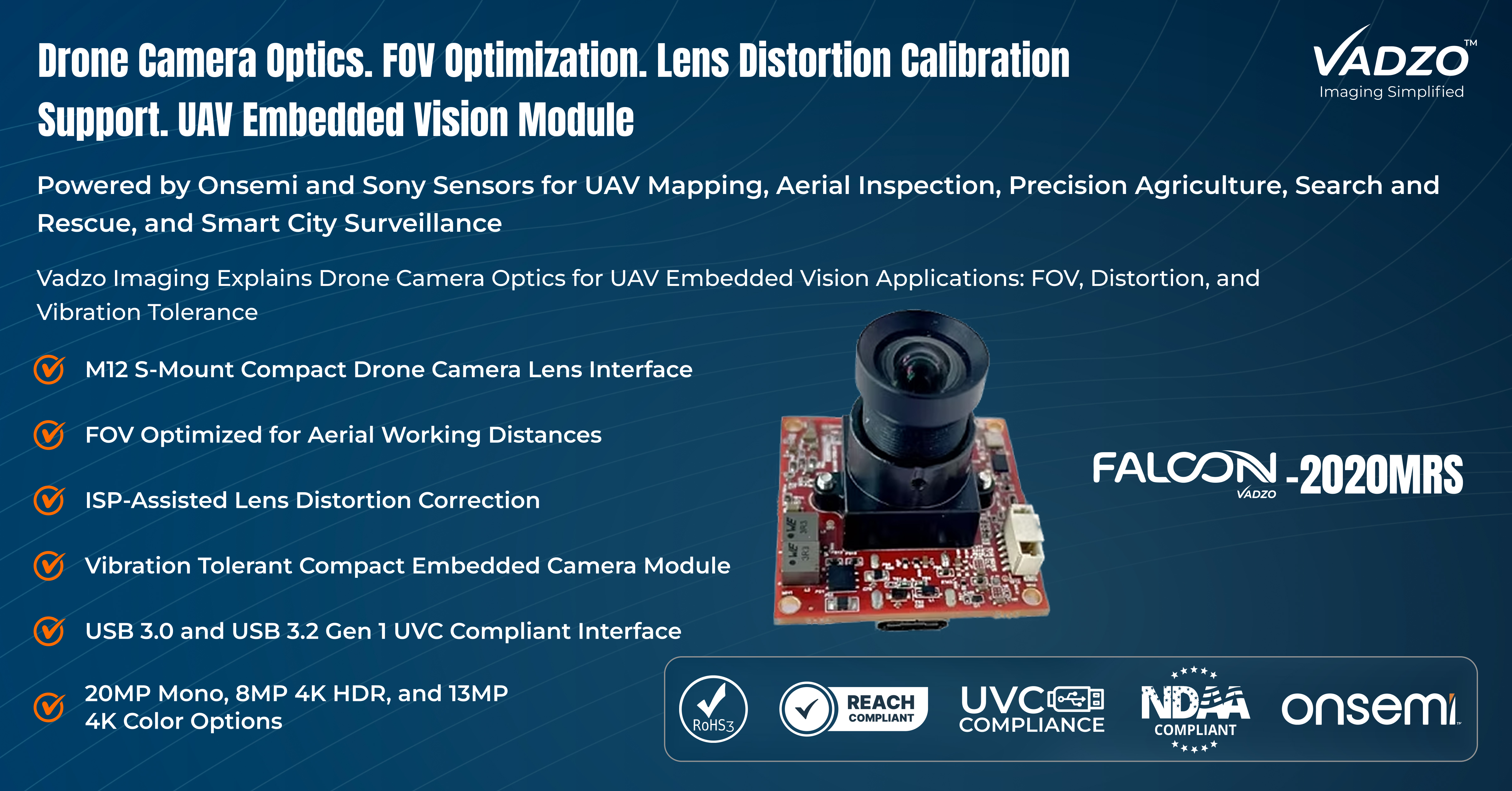
Vadzo Imaging UAV Camera Portfolio: M12 Lens Mount Modules for Drone Embedded Vision
The following models represent how compact embedded camera modules with M12 lens mount interfaces deliver high-performance imaging across UAV deployment environments.
AR2020 Monochrome 20MP USB 3.0 Camera: High-Resolution Mono UAV Mapping and Aerial Biometric Inspection
The 20 MP 4K Biometrics USB 3 Camera targets UAV aerial mapping, photogrammetry, and biometric inspection payloads where 20MP monochrome resolution and compact module mass are both primary payload requirements. Achieving 20MP output on the Onsemi AR2020 HyperLux BSI CMOS with rolling shutter architecture and high monochrome sensitivity over USB 3.0, it delivers the spatial resolution required for centimeter-level ground sampling distance at standard UAV survey altitudes. This compact Embedded Camera Module operates with UVC compliant plug and play output on Windows, Linux, and Android without proprietary drivers.
Key specs: 20MP | Onsemi AR2020 HyperLux | Monochrome | Rolling Shutter | USB 3.0 | UVC Compliant | M12 S-Mount | Plug and Play
AR0821 Color 4K HDR USB 3.0 Camera: 8MP HDR Color UAV Surveillance and Inspection Under High-Contrast Outdoor Illumination
The AR0821 Color 4K HDR USB 3.0 Camera targets UAV surveillance, industrial inspection, and smart city aerial imaging payloads where 8MP 4K HDR color output under direct sunlight and deep shadow in the same frame is the primary imaging requirement. Achieving 8MP 4K output on the Onsemi AR0821 BSI CMOS with 140 dB embedded HDR and rolling shutter architecture over USB 3.0, it delivers color detail across the full outdoor illumination contrast range preserving detail across high-contrast scenes. This 4K HDR Camera operates with UVC compliant plug and play output on Windows, Linux, and Android without proprietary drivers.
Key specs: 8MP 4K | Onsemi AR0821 | 140 dB eHDR | Color Rolling Shutter | USB 3.0 | UVC Compliant | M12 S-Mount | Plug and Play
AR1335 Color 4K USB Camera: 13MP 4K Color UAV Imaging for Precision Agriculture, Facial Recognition, and Detailed Aerial Survey
The AR1335 4k facial recognition Color USB Camera targets UAV precision agriculture, facial recognition, and detailed aerial color survey payloads where 13MP 4K spatial resolution and accurate color reproduction are both required across variable outdoor illumination. Achieving 13MP 4K output on the Onsemi AR1335 BSI CMOS with rolling shutter architecture and high color sensitivity over USB 3.0, it delivers the spatial resolution and color fidelity required for crop health analysis, facial identification at aerial working distances, and detailed structure inspection. This high-frame-rate UAV imaging camera operates with UVC compliant plug and play output on Windows, Linux, and Android without proprietary drivers.
Key specs: 13MP 4K | Onsemi AR1335 | Color Rolling Shutter | USB 3.0 | UVC Compliant | M12 S-Mount | Plug and Play
Applications for Vadzo UAV Camera Modules Across Drone Embedded Vision Industries
UAV Aerial Mapping and Photogrammetry: UAV aerial mapping payloads fail when camera module mass exceeds the payload budget, forcing a trade-off between ground resolution and flight endurance that reduces area covered per battery charge below the survey mission requirement. The AR2020 Monochrome 20MP USB 3.0 Camera delivers 20MP monochrome output on the Onsemi AR2020 HyperLux BSI CMOS in a compact M12 S-Mount module, achieving centimeter-level ground sampling distance at standard survey altitudes without exceeding payload mass budgets. UVC compliant plug and play output integrates directly with standard photogrammetry software on Windows and Linux without proprietary drivers.
UAV Industrial Inspection: UAV industrial inspection fails when the camera clips highlights on sunlit metallic surfaces while simultaneously losing shadow zone detail, producing unusable images at exactly the areas where lighting contrast is highest and defect visibility is most critical. The AR0821 Color 4K HDR USB 3.0 Camera delivers 140 dB embedded HDR at 8MP 4K on the Onsemi AR0821 BSI CMOS, preserving surface detail across the full contrast range of outdoor inspection illumination in every frame without post-capture tone mapping. UVC compliant output integrates with standard inspection platforms on Windows and Linux without middleware.
Precision Agriculture and Crop Health Analysis: Precision agriculture UAV payloads require a color camera that delivers sufficient spatial resolution for per-plant canopy analysis and accurate color fidelity for vegetation index calculation at low altitude passes, where insufficient resolution produces per-row averages rather than per-plant health data. The AR1335 13MP 4k Rolling Shutter USB Camera delivers 13MP 4K color output on the Onsemi AR1335 BSI CMOS with crop health imaging and field analysis at standard low-altitude agricultural survey passes. UVC compliant driverless output integrates into standard agricultural analytics platforms on embedded Linux and Android without vendor driver installation.
Search and Rescue and Wide-Area Surveillance: Search and rescue UAV operations require a camera that resolves human subjects on the ground at extended altitudes where multirotor endurance is sufficient for wide-area coverage, and monochrome sensitivity provides usable output in low-light pre-dawn and post-sunset search windows. The 4k 20MP Rolling Shutter Mono USB 3 Camera delivers 20MP monochrome output on the Onsemi AR2020 HyperLux BSI CMOS with high sensitivity across the luminance range, resolving ground subjects at extended search altitudes in both daylight and low-light conditions. UVC compliant plug and play output streams directly into standard ground station software on Windows and Linux without proprietary drivers.
Smart City Surveillance and Traffic Monitoring: Smart city aerial surveillance and traffic monitoring UAV payloads require a 4K HDR color camera that captures license plate detail and vehicle identification across urban scenes where direct sunlight, building shadow, and headlight glare all appear in the same aerial frame. The AR0821 Color 4K HDR USB 3.0 Camera delivers 140 dB embedded eHDR at 8MP 4K, preserving license plate and vehicle color detail across the full urban illumination contrast range without clipping highlights or losing shadow detail. UVC compliant output integrates directly with standard VMS and traffic analytics platforms on Windows and Linux without middleware.
UAV Facial Recognition and Border Monitoring: UAV facial recognition and border monitoring payloads require a color camera that delivers sufficient spatial resolution to resolve facial features at aerial working distances and color fidelity to support biometric identification algorithms trained on color imagery. The AR1335 Color 4K USB Camera delivers 13MP 4K color output on the Onsemi AR1335 BSI CMOS, providing facial resolution and color accuracy at aerial identification working distances for border monitoring and access control UAV deployments. UVC compliant plug and play output integrates with standard identification platforms on Windows and Linux without SDK installation.
Frequently Asked Questions
Which lens focal length is ideal for UAV aerial mapping and photogrammetry?
Lens focal length selection for UAV aerial mapping depends on the flight altitude and the required ground sampling distance. A shorter focal length wide-angle M12 lens covers more ground per frame but introduces more barrel distortion that must be corrected before photogrammetry processing. A longer focal length reduces distortion and increases ground detail but requires more flight passes to cover the same survey area. Vadzo UAV camera modules use the M12 S-Mount interface so payload engineers select and swap focal lengths for each mission without modifying the camera hardware.
How does lens distortion affect drone mapping accuracy?
Barrel distortion from wide-angle M12 lenses causes straight lines in the aerial image to curve outward toward the frame edges, introducing geometric errors that accumulate across every overlapping frame in the photogrammetry dataset. In orthomosaic mapping applications, uncorrected distortion produces dimensional inaccuracies that invalidate survey measurements regardless of sensor resolution or flight altitude. The distortion profile for each M12 lens is known and repeatable, so a single calibration session before the mission establishes the correction coefficients applied uniformly to every frame. Vadzo UAV camera modules on the AR2020, AR0821, and AR1335 sensors use the consistent M12 S-Mount geometry that supports standard per-lens calibration workflows in photogrammetry software.
Why are M12 S-Mount lenses commonly used in compact UAV camera modules?
M12 S-Mount lenses are the standard choice for compact UAV camera modules because the small lens body minimizes payload mass and the threaded mount accepts the widest range of focal lengths from wide-angle to telephoto without adapter hardware. Lower payload mass reduces vibration energy transfer from the airframe to the sensor and preserves flight endurance on multirotor platforms where every gram affects battery range. The M12 format also allows payload engineers to configure field of view for each mission by swapping lenses rather than changing the camera module. All three Vadzo UAV camera modules, the AR2020, AR0821, and AR1335, use the M12 S-Mount interface for this reason.
When is a 4K HDR camera required for UAV inspection and surveillance?
A 4K HDR camera is required when the aerial scene contains both bright and dark zones in the same frame that exceed the dynamic range a standard camera can capture in a single exposure, which is the typical condition in outdoor inspection and urban surveillance where direct sunlight and building shadow appear simultaneously. Standard cameras clip highlights on sunlit surfaces or lose shadow detail in recessed areas, producing unusable inspection images at exactly the high-contrast zones where defect and identification accuracy is most critical. The AR0821 Color 4K HDR USB 3.0 Camera delivers 140 dB embedded eHDR on the Onsemi AR0821 BSI CMOS, preserving full detail across the contrast range in every aerial frame without post-capture tone mapping.
Can USB UVC camera modules integrate with NVIDIA Jetson and Raspberry Pi platforms?
Yes. USB UVC camera modules enumerate on NVIDIA Jetson and Raspberry Pi platforms through the OS class driver that Linux loads natively at connection without a vendor-supplied driver package or SDK installation. UVC compliant output streams directly into standard V4L2 capture pipelines, OpenCV, and ROS image transport layers on any embedded Linux platform without middleware or board support package modification. All three Vadzo UAV camera modules, the AR2020, AR0821, and AR1335, operate with UVC compliant output over USB 3.0 and are compatible with NVIDIA Jetson and Raspberry Pi platforms out of the box.
Availability
The AR2020 Monochrome 20MP USB 3.0 Camera, AR0821 Color 4K HDR USB 3.0 Camera, and AR1335 13MP 4k Rolling Shutter USB Camera are available now for OEM evaluation and production deployment with no minimum order requirement. Technical documentation, evaluation kits, datasheets, and SDK downloads are available through the Vadzo Imaging sales team. For volume pricing, OEM customization, and firmware modifications, contact [email protected].
About Vadzo Imaging
Vadzo Imaging is one of the few companies worldwide that designs and manufactures embedded vision systems and camera modules from India, delivering premium imaging products at accessible prices for OEMs and system integrators worldwide. The company builds imaging platforms across USB, MIPI, GigE, Wi-Fi, and SerDes interfaces, supporting applications in industrial automation, robotics, smart surveillance, smart city infrastructure, and edge AI. Beyond hardware, Vadzo provides end-to-end imaging expertise, including sensor integration, ISP tuning, firmware development, and OEM customization services that accelerate development and deployment at scale. Every product is built on the principle that world-class imaging performance, designed and manufactured in India, should be accessible, reliable, and instantly deployable anywhere in the world. Visit http://www.vadzoimaging.com to explore the full embedded vision camera portfolio.
Media Contact
Alwin Vincent
Vadzo Imaging
Email: [email protected]
LinkedIn: Vadzo Imaging
YouTube: Vadzo Imaging
X: Vadzo Imaging
SOURCE: Vadzo Imaging