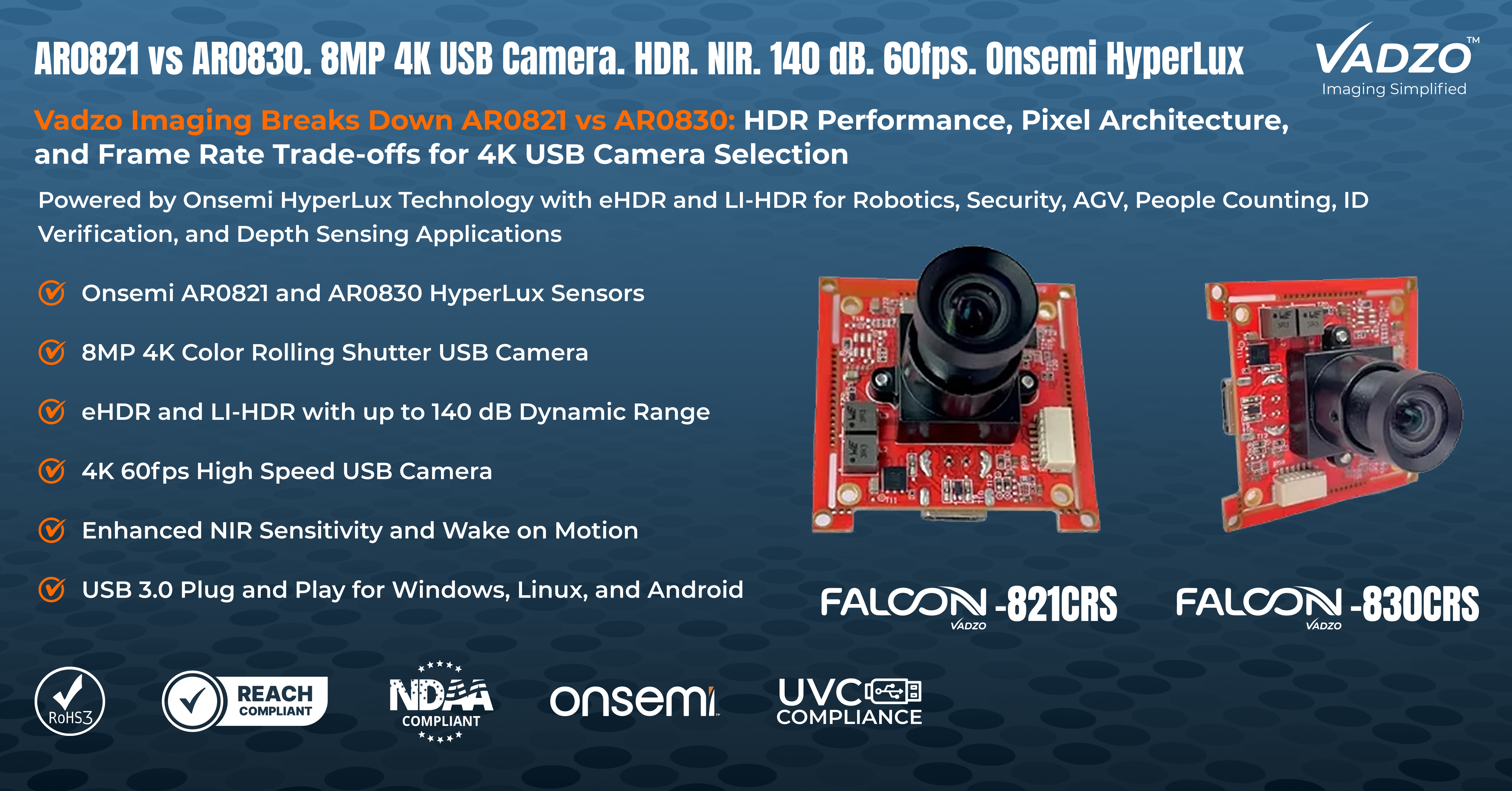
This technical guide from Vadzo Imaging compares the onsemi AR0821 and onsemi AR0830 sensors across HDR dynamic range, pixel architecture, 4K frame rate, NIR sensitivity, and LI-HDR capability. Both sensors are available as production ready 8MP USB camera modules from Vadzo Imaging with driver support for Windows, Linux, and macOS. The purpose of this comparison is to enable OEM engineers and system integrators to select the correct sensor platform for robotics, AGV navigation, security surveillance, people counting, ID verification, and depth sensing deployments based on physics and system requirements rather than on nominal specification overlap.
FORT WORTH, TX / ACCESS Newswire / June 22, 2026 / Vadzo Imaging, a provider of embedded vision camera products, today publishes a detailed technical comparison of the AR0821 vs AR0830 to help OEM engineers and system integrators select the correct 8MP 4K USB camera platform for their application. Both the AR0821 camera module and the AR0830 camera module are available as production-ready USB camera modules from Vadzo’s embedded vision portfolio. The two sensors differ in pixel size, HDR architecture, maximum frame rate, NIR sensitivity, and LI-HDR support. Each difference affects system performance and deployment suitability across robotics, AGV navigation, security surveillance, people counting, passport reading, and depth sensing applications. This guide resolves the selection question by examining sensor architecture, HDR capability, and real-world performance trade-offs.
Why Sensor Selection Matters for 4K USB Camera Deployments
Selecting an 8MP USB camera for a production system requires more than matching the resolution. Engineers deploying cameras in robotics, AGV navigation, security surveillance, ID verification, and people counting applications evaluate pixel architecture, dynamic range, frame rate, NIR response, and power consumption as independent variables. Two sensors sharing the same nominal resolution and interface can produce fundamentally different results when the deployment environment involves high contrast lighting, fast motion, low light conditions, or NIR illumination. The onsemi AR0821 camera and the onsemi AR0830 camera are both 8MP rolling shutter color sensors delivered as USB 3.0 camera modules by Vadzo Imaging. Their differences in pixel design and HDR technology make each sensor the correct choice for different application profiles.
Pixel Architecture: 2.1 µm vs 1.4 µm
The AR0821 uses a 2.1 µm pixel on a 1/1.7-inch optical format to deliver an 8MP (3840 x 2160) color image. Larger pixels collect more photons per unit of time. This physical advantage improves the signal-to-noise ratio in low-light environments without increasing electronic gain. For applications running under dim artificial lighting or requiring reliable color reproduction in shadowed areas, the 2.1 µm pixel delivers measurable SNR benefits over smaller pixel alternatives. The onsemi AR0821 camera produces clean, low-noise color imagery at 8MP that benefits industrial inspection, medical imaging, and indoor robotics deployments where ambient light is controlled and scene illumination is consistent.
The AR0830 uses a 1.4 µm pixel on a 1/2.0-inch optical format. The smaller pixel reduces the physical sensor footprint while maintaining 8MP (3840 x 2160) resolution. Despite the smaller pixel area, the AR0830 incorporates OnSemi’s HyperLux advanced pixel architecture to compensate for reduced light collection through improved pixel-level circuitry design. The result is that the onsemi AR0830 camera achieves competitive image quality in a more compact form factor. This smaller footprint benefits wearable camera module deployments, space-constrained smart doorbell camera module integrations, and drone payloads where physical sensor size and total module weight directly affect system design constraints.
HDR Performance: eHDR vs LI-HDR and the 140 dB Advantage
Both sensors implement onsemi’s electronic HDR (eHDR) architecture. eHDR captures multiple sequential sub exposures within a single frame read cycle and merges them at the sensor level to extend usable dynamic range beyond the single exposure limit. For most industrial deployments, eHDR delivers an adequate dynamic range for scenes with moderate contrast between illuminated and shadowed areas.
The 8MP HDR camera module based on the AR0821 applies eHDR to achieve a dynamic range suited for indoor to outdoor lighting transitions in security, AGV, and robotics environments. This covers the majority of high contrast industrial scenes encountered in warehouse navigation, factory floor inspection, and perimeter surveillance without the motion artifact concerns inherent in multi-frame HDR approaches.
The 140 dB HDR camera based on the AR0830 adds LI-HDR (Linear to HDR) capability on top of eHDR. LI-HDR is a single-frame HDR architecture that compresses an extended linear pixel response into a non-linear output curve without requiring multiple sequential exposures. This eliminates the motion artifacts common in multi-exposure HDR approaches by capturing the full dynamic range within a single integration period. The combination of eHDR and LI-HDR in the LI-HDR camera module based on the AR0830 achieves up to 140 dB of dynamic range with minimal ghosting in scenes containing moving objects. For 4K video conference camera products, passport reader camera systems, and people counting camera deployments in high-traffic transit environments, this architectural distinction directly affects output quality at the system level.
NIR Sensitivity and Night Imaging Capability
The AR0821 delivers standard color imaging with moderate NIR response. For applications using active NIR illumination at wavelengths between 800 nm and 940 nm, the AR0821 produces usable images at reduced sensitivity relative to optimized NIR sensors. An 8MP color USB camera based on the AR0821 covers most daytime and well-lit indoor surveillance requirements without a separate NIR-specific sensor channel.
The AR0830 incorporates onsemi’s enhanced NIR sensitivity design. This improvement in spectral response above 700 nm makes the NIR USB camera based on the AR0830 suitable for active NIR illumination scenarios without switching to a monochrome sensor architecture. The NIR security camera module application benefits directly. Smart doorbell cameras operating with 850 nm or 940 nm LED illumination, 4K security camera module deployments requiring day-night color imaging without an IR cut filter mechanism, and biometric systems using NIR for liveness detection all leverage the AR0830’s enhanced spectral response without sacrificing color output during daylight hours.
Wake on Motion: Event-Driven Imaging Architecture
The AR0830 includes a Wake on Motion feature that allows the sensor to enter a low-power monitoring state and activate full resolution imaging only when motion is detected within the scene. This capability is not present in the AR0821. For battery-powered deployments, edge devices with constrained power budgets, and smart doorbell camera module products where continuous streaming is not practical, Wake on Motion reduces average power consumption to a fraction of the continuous streaming baseline. The Wake on Motion camera, based on the AR0830, enables event-triggered imaging architectures that simplify system power management and extend operational lifetime between charge cycles.
“The AR0821 and AR0830 are not competing sensors along a single specification axis. They serve different system profiles. When an engineer requires the lowest noise floor in a controlled indoor light environment, the AR0821 is the correct selection. When the requirement is 60fps at 4K, 140 dB dynamic range with LI-HDR, enhanced NIR sensitivity, or Wake on Motion for event-driven deployment, the AR0830 is the correct platform. Vadzo Imaging supplies both as production-ready USB camera modules because real application requirements do not reduce to a single sensor parameter. The AR0821 and AR0830 comparison exists to help engineering teams match sensor physics to actual deployment conditions.” – Alwin Vincent, Product Manager, Vadzo Imaging.
Applications
Robotics and AGV Navigation: AGV navigation camera deployments involve rapid platform movement across environments ranging from bright loading docks to dark warehouse aisles. For AGV systems operating in controlled illumination with a priority on low noise visual data, the AR0821 camera module provides the 2.1 µm pixel advantage for cleaner imagery at lower light levels. For high-speed AGV platforms requiring fast obstacle detection and continuous position updates, the AGV navigation camera based on the AR0830 delivers 4K at 60 fps, combined with 140 dB LI-HDR to handle loading dock brightness transitions without exposure lag or motion artifact in the output frame.
Mobile Robotics and Depth Sensing: Structured light and stereo-based depth-sensing camera systems benefit from higher frame rates to improve depth map refresh rate and reduce latency in obstacle avoidance pipelines. The mobile robot camera and stereo camera module deployments using the AR0830 deliver 60fps image pairs for faster disparity computation. The compact 1/2.0-inch form factor of the AR0830 also enables tighter stereo baseline geometries in rigid dual camera bar assemblies for short-range depth measurement applications.
Passport Reader and ID Verification: Document imaging and passport reader camera systems process documents at throughput rates determined by transaction speed at entry points. The ID verification camera, based on the AR0830 operating at 60fps, reduces the minimum dwell time required per document to extract a sharp, well-exposed image frame. LI-HDR handles document surfaces with embossed holograms and mixed matte and glossy print areas without the multi-frame capture overhead that causes processing bottlenecks in high-throughput border control and access control installations.
People Counting and Shelf Monitoring: Retail and transit analytics require cameras that operate continuously at entrance points with variable crowd densities and unpredictable lighting. The people counting camera based on the AR0830 delivers 60fps to reduce detection errors caused by overlapping individuals in fast-moving queues. Wake on Motion reduces power consumption during off-peak periods without additional hardware. For shelf monitoring camera installations with fixed viewing angles and predominantly static scenes, the AR0821’s larger 2.1 µm pixel and strong low light SNR cover planogram compliance monitoring without requiring the higher frame rate or LI-HDR capability of the AR0830.
Security Surveillance and Smart Doorbell: Outdoor 4K security camera module deployments face a wide dynamic range across day-night cycles and must operate under active NIR illumination at night. The AR0830’s 140 dB LI-HDR combined with enhanced NIR sensitivity makes it the preferred platform for NIR security camera module and smart doorbell camera module products requiring clear imaging from full sunlight through complete darkness using active 850 nm or 940 nm LED illumination. Wake on Motion extends battery operational lifetime in doorbell deployments where continuous streaming is energy-prohibitive.
Wearable Devices and Document Imaging: The wearable camera module design priority is physical size and module weight. The AR0830’s 1/2.0-inch format enables smaller PCB footprints for body-worn camera products in logistics, field service, and healthcare applications. The document imaging camera application with stationary document capture at fixed working distances benefits from the AR0821’s 2.1 µm pixel for high-SNR text and image reproduction under controlled illumination with no frame rate constraint.
Frequently Asked Questions
Q: How does LI-HDR technology differ from standard multi-exposure HDR in embedded vision deployments?
A: Multi-exposure HDR captures two or more sequential frames at different exposure settings and combines them through ISP processing. This approach introduces temporal misalignment between exposures that cause ghosting artifacts on moving subjects. LI-HDR compresses an extended linear sensor response into a non-linear output curve within a single exposure cycle at the pixel level. No sequential frames are required, so there is no inter-frame motion artifact. For transit entrances, vehicle inspection gates, and people counting deployments with continuous movement through the frame, LI-HDR produces clean 140 dB dynamic range output where multi-exposure approaches would show ghosting. Vadzo Imaging selects LI-HDR capable sensors specifically for high-throughput applications where subject motion and extreme dynamic range occur simultaneously in the same scene.
Q: What optical format consideration matters most when designing a dual-camera stereo vision system?
A: In a stereo depth sensing configuration, the physical sensor size affects the minimum achievable stereo baseline and PCB layout geometry. A 1/2.0-inch sensor allows two camera modules to be positioned closer together on a rigid bar or PCB for short-range depth measurement without requiring a wide mechanical span. A 1/1.7-inch sensor provides a larger photon-collecting area per pixel with better low-light SNR but demands more physical space per module. For depth sensing camera and stereo camera module applications targeting sub-meter ranges in mobile robotics and warehouse automation, the compact 1/2.0-inch format enables tighter baseline geometries. Vadzo Imaging engineering teams work with OEM customers to select the optical format that matches their stereo baseline target and available module space allocation within the robot or vehicle chassis.
Q: Which platform is better suited for outdoor night surveillance where active NIR illumination is used?
A: An outdoor security deployment using 850 nm or 940 nm LED NIR illuminators requires a sensor with adequate spectral response in the 800 to 940 nm wavelength range while retaining color output during daylight. A sensor with enhanced NIR sensitivity produces usable images under active NIR illumination without switching to monochrome-only operation or adding a separate NIR sensor channel to the design. The 140 dB LI-HDR capability is also valuable in this context because transitional periods between full daylight and active NIR illumination produce scenes with extreme simultaneous brightness variance that eHDR alone cannot fully resolve. Vadzo Imaging offers NIR-capable 8MP USB camera modules validated with common 850 nm and 940 nm LED illuminators for outdoor surveillance integration and can provide pre-production samples for characterization in specific NIR illumination environments.
Q: What should an OEM engineer evaluate when choosing between a larger pixel sensor and a higher frame rate sensor for a robotics application?
A: The correct selection depends on the motion profile and lighting conditions of the specific deployment environment. A larger pixel design, such as one with a 2.1 µm architecture, collects more photons per unit time and reduces read noise contribution relative to signal at a given light level. This makes it preferable for controlled indoor environments, stationary inspection tasks, and applications where SNR at modest frame rates is the primary performance driver. A higher frame rate sensor delivering 60fps at full 4K resolution is preferable when the camera platform itself moves rapidly, when the objects being tracked pass through the frame at high velocity, or when depth estimation algorithms require a high frequency image pair refresh to maintain positioning accuracy. Vadzo Imaging supplies both sensor platforms as production-ready USB camera modules and assists OEM engineering teams with sensor pre-selection based on robot velocity profiles, ambient light characterization, and vision algorithm frame rate requirements.
Q: How does Wake on Motion benefit battery-powered or edge-deployed smart camera products?
A: Continuous streaming from an 8MP 4K USB camera consumes substantial power regardless of whether activity is occurring in the scene. In a smart doorbell camera module, outdoor security camera, or portable wearable camera application, continuous operation depletes battery reserves or forces an oversized power supply design that increases product cost and physical volume. Wake on Motion allows the image sensor to enter a low-power monitoring state and activate full resolution 4K streaming only when pixel-level motion is detected within its field of view. The sensor returns to the low power state after the motion event concludes. This architecture reduces average power consumption to a fraction of the continuous streaming baseline without sacrificing responsiveness to meaningful scene events. Vadzo Imaging integrates Wake on Motion-capable sensors into USB camera modules designed specifically for event-driven imaging products where power efficiency and immediate response to activity must coexist in a single module.
Availability
The 8MP USB camera based on the onsemi AR0821 and the 8MP 4K USB camera based on the onsemi AR0830 are both available from Vadzo Imaging for evaluation and production orders with no minimum order requirement. Evaluation kits include the camera module, S-Mount fixed focus lens, USB cable, and platform driver documentation. Browse the full Vadzo embedded vision portfolio at https://www.vadzoimaging.com/ or contact Vadzo at [email protected] to request an evaluation kit, discuss OEM integration requirements, or arrange a technical consultation on sensor selection.
About Vadzo Imaging
Vadzo Imaging is a global provider of embedded vision solutions and delivers high-performance camera technologies and imaging platforms for applications in robotics, industrial automation, UAVs, edge AI, and medical systems. Its products are designed for seamless integration with leading embedded platforms. Vadzo supports customers through hardware customization, firmware development, and module-level drivers, enabling faster development and deployment of vision-based systems.
Media Contact
Alwin Vincent
Vadzo Imaging
Email: [email protected]
LinkedIn: Vadzo Imaging
YouTube: Vadzo Imaging
X: Vadzo Imaging
SOURCE: Vadzo Imaging