Stratview Research
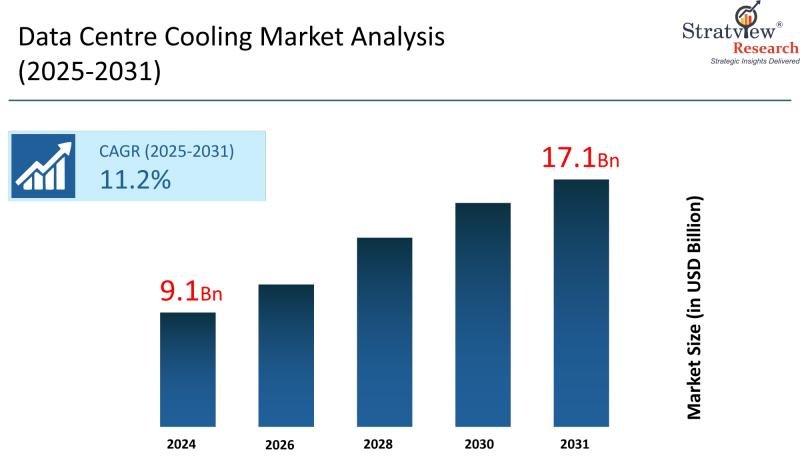
The data center cooling market encompasses thermal management solutions designed to maintain optimal temperature and humidity levels within data centers to ensure the reliable operation of servers, storage, and networking equipment. According to Stratview Research, the market size was valued at US$9.1 billion in 2024 and is projected to grow at an 11.2% CAGR over the forecast period, reaching US$17.1 billion by 2031, driven primarily by the rising deployment of hyperscale, edge, and modular data centers that require advanced cooling technologies to support high-density computing and minimize equipment downtime.
Stratview Research, a global market research firm, has launched a report on the global market, which provides a comprehensive outlook of the global and regional industry forecast, current & emerging market trends, segment analysis, competitive landscape, & more.
Request a free sample report: https://www.stratviewresearch.com/Request-Sample/4187/data-center-cooling-market.html
Market Statistics
• Market size: US$9.1 billion (2024)
• Forecast value: US$17.1 billion (2031)
• CAGR: 11.2%
• Forecast period: 2025-2031
• Base year: 2024
• Total number of segments: 5
• Tables & figures: 100+
• Country-Level Market Assessment: 20
Market Segmentation
By Cooling Type: Air Cooling, Liquid Cooling.
By Product Type: Air Cooling (Perimeter, Air Handling Units, Other Air Cooling Products), Liquid Cooling (Direct-to-chip, Immersion, Other Liquid Cooling Products).
By Structure Type: Rack-based, Row-based, Room-based.
By End-Use Industry Type: IT & Telecom, Retail, Healthcare, Banking, Financial Services & Insurance (BFSI), Media & Entertainment, Other End-Use Industries. By Regional type : North America, Europe, Asia-Pacific, and The Rest of the World
Segment Analysis
Within Cooling Type, air cooling holds the dominant share due to its cost-effectiveness and compatibility with existing data center infrastructure, while liquid cooling is the fastest-growing segment, propelled by the increasing need for higher thermal efficiency to support AI and high-performance computing workloads, indicating suppliers must innovate to capture the expanding liquid cooling demand.
For Product Type, perimeter cooling solutions remain the largest contributor due to their extensive use in traditional data centers, whereas air handling units are the fastest growing as data center operators seek targeted cooling to enhance energy efficiency and manage rack densities more effectively, signaling an opportunity for product differentiation.
In Structure Type, rack-based cooling dominates and grows rapidly because it positions cooling mechanisms closer to heat sources, thereby enhancing efficiency and performance in modern, high-density environments.
Within End-Use Industry Type, the BFSI sector leads and expands quickly, driven by increased digital transactions, real-time processing, and strict uptime requirements, suggesting strong investment potential for cooling solutions tailored to financial services data centers.
Regional Insights
North America is the largest regional market for data center cooling due to the high prevalence of large data centers, widespread adoption of cloud and advanced cooling technologies, and stringent energy efficiency regulations, creating a favorable environment for technology and service providers.
Market Drivers
• Rapid expansion of hyperscale, edge, and modular data centers requiring advanced cooling.
• Growth in high-density computing that increases heat generation and cooling needs.
• Rising deployment of liquid cooling technologies for energy efficiency.
• Regulatory focus on reducing energy consumption and improving sustainability.
• Increasing investment in cloud computing and digital infrastructure.
Top Companies in the Market
Vertiv Group Corp
Johnson Controls
Stulz GMBH
Airedale By Modine
Trane Technologies
Carrier
Daikin Industries
Schneider Electric
Coolit Systems
Fujitsu
FAQs
1. What is the projected size of the data center cooling market by 2031?
The data center cooling market is expected to reach US$17.1 billion by 2031.
2. What CAGR is the data center cooling market expected to achieve through 2031?
The market is forecast to grow at an 11.2% CAGR over the forecast period.
3. Which cooling type currently dominates the data center cooling market?
Air cooling dominates the market due to its widespread adoption and cost-effectiveness.
4. Which industry segment is the fastest growing in demand for data center cooling solutions?
The BFSI (Banking, Financial Services & Insurance) sector is both the largest and fastest growing end-use segment.
5. Why is liquid cooling gaining traction in the data center cooling market?
Liquid cooling is growing rapidly because it offers higher thermal efficiency for high-density and AI-driven workloads.
Related Links:
Non volatile memory market : https://www.leenkup.com/read-blog/79307
Phase transfer catalyst market : https://scrapbox.io/researchnews04/Global_Phase_Transfer_Catalyst_Market_Outlook_2023%E2%80%932028
point of use water treatment systems market : https://hallbook.com.br/blogs/830830/Global-Point-of-Use-Water-Treatment-Systems-Market-Advancements-and
Polycarbonate sheets market : https://velog.io/@lianaf66/Polycarbonate-Sheets-Market-Analysis-Applications-in-Construction-Automotive-and-Electronics
Polyester fiber market : https://www.friend007.com/read-blog/282337
400 Renaissance Center, Suite 2600,
Detroit, Michigan, MI 48243
United States of America
Website: http://www.stratviewresearch.com
Mail Us: sales@stratviewresearch.com
Press: media@stratviewresearch.com
Stratview Research is a global market research firm that highly specializes in aerospace & defense, chemicals, and a few other industries.
It launches a limited number of reports annually on the above-mentioned specializations. Thorough analysis and accurate forecasts in this report enable the readers to take convincing business decisions.
Stratview Research has been helping companies meet their global and regional growth objectives by offering customized research services. These include market assessment, due diligence, opportunity screening, voice of customer analysis, market entry strategies, and more.
This release was published on openPR.