Direct Carrier Billing Market
Market Outlook and Forecast
The global Direct Carrier Billing (DCB) market is entering a dynamic growth phase, propelled by the rapid expansion of digital content consumption, mobile commerce, and frictionless payment solutions across emerging and mature economies alike. The technology’s ability to simplify transactions-by allowing users to charge purchases directly to their mobile phone bills-has made DCB a cornerstone of the digital payments ecosystem.
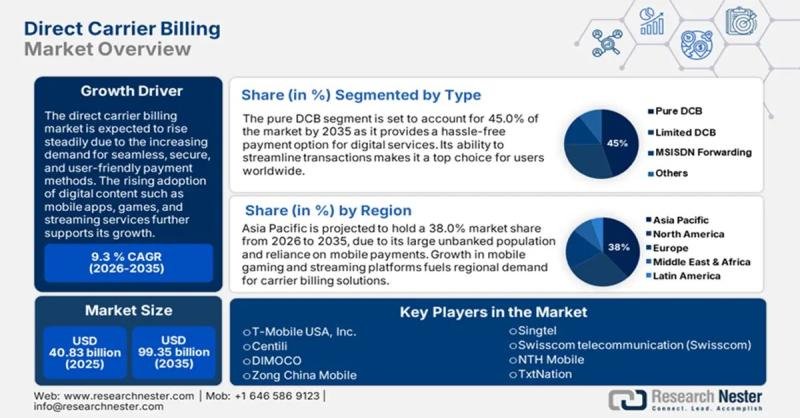
According to recent research, the global Direct Carrier Billing market is estimated at USD 40.83 billion in 2025 and is projected to reach USD 99.35 billion by 2035, growing at a compound annual growth rate (CAGR) of approximately 9.3% during the forecast period from 2026 to 2035.
This steady expansion reflects the ongoing convergence of telecom, fintech, and content platforms. As users demand faster, secure, and hassle-free payment methods-particularly in regions with low credit card penetration-DCB is becoming a preferred alternative for app purchases, streaming subscriptions, gaming credits, and microtransactions. Its appeal lies in simplicity: users can complete payments without entering card details or creating digital wallets, improving accessibility and conversion rates.
Beyond convenience, the DCB ecosystem is witnessing major technological shifts. The integration of advanced analytics, identity verification, and blockchain technologies is strengthening security and compliance, making DCB an essential enabler of inclusive digital finance across the world.
➤ Request Free Sample PDF Report @ https://www.researchnester.com/sample-request-7057
Regional Performance Highlights
North America remains a pivotal market for DCB, driven by growing smartphone adoption, the rise of subscription-based digital entertainment, and strategic collaborations between mobile operators and content service providers. The U.S. and Canada are seeing strong uptake of carrier billing in sectors such as online gaming, video streaming, and digital publishing. The region’s mature telecom infrastructure and focus on mobile payment innovation are further enhancing DCB’s integration into mainstream payment systems.
Europe follows closely, characterized by a strong regulatory framework, increasing digitalization of public services, and growing demand for seamless mobile payments. Markets like the U.K., Germany, and France are witnessing rapid adoption of DCB for OTT content, in-app purchases, and mobility services. The European market is also benefiting from the EU’s revised Payment Services Directive (PSD2), which promotes transparency, authentication, and interoperability-elements that align well with carrier billing’s secure and user-friendly model.
Asia Pacific is expected to account for approximately 38% of the global market share by 2035, emerging as the fastest-growing region. The proliferation of low-cost smartphones, expanding 4G/5G coverage, and a surge in digital entertainment consumption are creating fertile ground for DCB adoption. Countries like India, Indonesia, Japan, and South Korea are driving innovation in mobile payment ecosystems, supported by telecom giants integrating carrier billing with local e-wallets, gaming platforms, and app stores.
Overall, while North America and Europe lead in market sophistication and regulatory maturity, Asia Pacific dominates in scale and growth potential-positioning the region as the next frontier for DCB-enabled digital commerce.
➤ Gain access to expanded insights on competitive strategies, market size, and regional analysis. View our Direct Carrier Billing Market Report Overview here: https://www.researchnester.com/reports/direct-carrier-billing-market/7057
Market Segmentation
From a component perspective, Pure DCB is projected to hold around 45% share by 2035, underscoring the preference for direct billing models over hybrid approaches. Pure DCB solutions offer greater transparency, control, and revenue assurance for telecom operators, while simplifying the consumer payment journey.
From a device and platform perspective, Android dominates the ecosystem with a projected 75% share by 2035, driven by the massive penetration of Android-based smartphones in emerging economies. Google Play’s integration of carrier billing has become a powerful enabler for app monetization, especially in markets where credit card usage remains low.
➤ Discover how the Direct Carrier Billing Market is evolving globally – access your free sample report → https://www.researchnester.com/sample-request-7057
Top Market Trends
The direct carrier billing market is evolving rapidly under the influence of technological innovation, regulatory developments, and shifting consumer expectations. Below are the key trends shaping its global trajectory.
1. Expansion of Carrier Billing in the Subscription Economy
The rise of the subscription economy is one of the strongest catalysts for DCB adoption. As consumers increasingly pay monthly for entertainment, software, and news content, DCB provides a seamless recurring payment channel. Streaming platforms like Netflix, Spotify, and Disney+ have expanded DCB options across Asia and Europe, allowing users to add subscriptions directly to their mobile bills.
Recent developments include Google’s partnerships with major telecom operators in Southeast Asia to expand Play Store carrier billing, and Apple’s carrier billing integration in additional European markets-illustrating how the world’s largest digital ecosystems are betting on telecom-based payment channels to drive inclusivity.
2. Growing Role of DCB in Financial Inclusion
DCB is emerging as a bridge between mobile connectivity and digital finance, particularly in regions with limited banking infrastructure. Telecom-led payment models empower millions of users to participate in digital commerce without requiring bank accounts or credit cards.
African markets like Nigeria and Kenya, as well as Southeast Asian economies such as Indonesia and the Philippines, have become hotspots for DCB-driven fintech innovation. Mobile operators are collaborating with governments and financial institutions to integrate DCB into broader financial inclusion strategies-fueling digital empowerment in underserved populations.
3. Integration with Super Apps and 5G Ecosystems
As super apps and 5G networks reshape mobile experiences, DCB is becoming an integral part of bundled ecosystems. Super apps like Grab, GCash, and Paytm are embedding carrier billing into their payment gateways, allowing users to pay for diverse services-from ride-hailing to streaming-via a unified billing mechanism.
The rollout of 5G networks is further enhancing DCB potential, enabling faster, more secure microtransactions for gaming, augmented reality (AR), and IoT-based services. Telecom operators are also leveraging analytics and AI to personalize billing and improve fraud detection, ensuring compliance and trust at scale.
4. Regulatory Evolution and Enhanced Consumer Protection
As DCB adoption accelerates, regulatory bodies are emphasizing consumer data protection, transaction transparency, and anti-fraud mechanisms. Frameworks such as PSD2 in Europe and regional data privacy laws in Asia-Pacific are shaping how DCB providers structure authentication and consent mechanisms.
To comply, vendors are introducing advanced verification systems and AI-powered fraud analytics. This evolution is strengthening consumer confidence while making DCB more interoperable with other digital payment systems.
➤ Get the full details on the latest company launches, investments, and M&A in the Direct Carrier Billing Market. Download your free sample report → https://www.researchnester.com/sample-request-7057
Recent Company Developments
The direct carrier billing market is witnessing strong competitive activity, strategic partnerships, and mergers as major players consolidate capabilities and expand geographically. Below are some of the latest highlights shaping the industry’s competitive dynamics.
1. Boku Inc. – Expanded its global carrier network in 2025, partnering with over 200 new mobile operators to enhance coverage across Asia-Pacific and Africa.
2. DOCOMO Digital Ltd. – Announced a collaboration with Telefonica to integrate AI-driven analytics into its DCB platform, improving fraud prevention and transaction insights.
3. Fortumo (a Boku company) – Launched a next-gen API that enables in-app DCB payments for streaming platforms and gaming publishers globally.
4. DIMOCO Payments – Introduced an enhanced compliance framework aligned with PSD2 and GDPR, ensuring transparent and secure billing in the EU market.
5. Infobip – Rolled out a unified digital payment platform integrating carrier billing, messaging APIs, and mobile identity verification for enterprise clients.
➤ Request Free Sample PDF Report @ https://www.researchnester.com/sample-request-7057
These developments highlight how DCB providers are converging telecom innovation, compliance technology, and digital commerce to deliver secure, scalable, and inclusive payment solutions.
Related News –
https://www.linkedin.com/pulse/what-trends-shaping-future-intelligent-document-processing-ztj4f
https://www.linkedin.com/pulse/what-key-trends-driving-evolution-public-affairs-advocacy-xpsnf
Contact Data
AJ Daniel
Corporate Sales, USA
Research Nester
77 Water Street 8th Floor, New York, 10005
Email: info@researchnester.com
USA Phone: +1 646 586 9123
Europe Phone: +44 203 608 5919
About Research Nester
Research Nester is a one-stop service provider with a client base in more than 50 countries, leading in strategic market research and consulting with an unbiased and unparalleled approach towards helping global industrial players, conglomerates and executives for their future investment while avoiding forthcoming uncertainties. With an out-of-the-box mindset to produce statistical and analytical market research reports, we provide strategic consulting so that our clients can make wise business decisions with clarity while strategizing and planning for their forthcoming needs and succeed in achieving their future endeavors. We believe every business can expand to its new horizon, provided a right guidance at a right time is available through strategic minds.
This release was published on openPR.