When lighting infrastructure introduces banding, strobing, or exposure of inconsistency into embedded vision frames, the problem is not the imaging module. It is a timing mismatch between the shutter and the light. DR design addresses LED flicker and fluorescent lighting interference across the Falcon Series portfolio.
FORT WORTH, TX / ACCESS Newswire / June 8, 2026 / Vadzo Imaging, a globally trusted provider of high-performance embedded vision systems, today publishes a technical breakdown of LED flicker mitigation and fluorescent lighting interference in embedded camera deployments. For system integrators, OEMs, and embedded vision engineers, artificial lighting is not passive. LED drivers operate on PWM cycles. Fluorescent tubes oscillate at 100 Hz or 120 Hz depending on the regional power grid. When a camera exposure window does not align with these cycles, the result is rolling bands, uneven brightness across frames, and frame-to-frame intensity variation that no post-processing pipeline can reliably correct. Vadzo Imaging builds the Falcon Series around sensor architectures and ISP configurations that address these problems at the hardware level, before the image reaches any software.
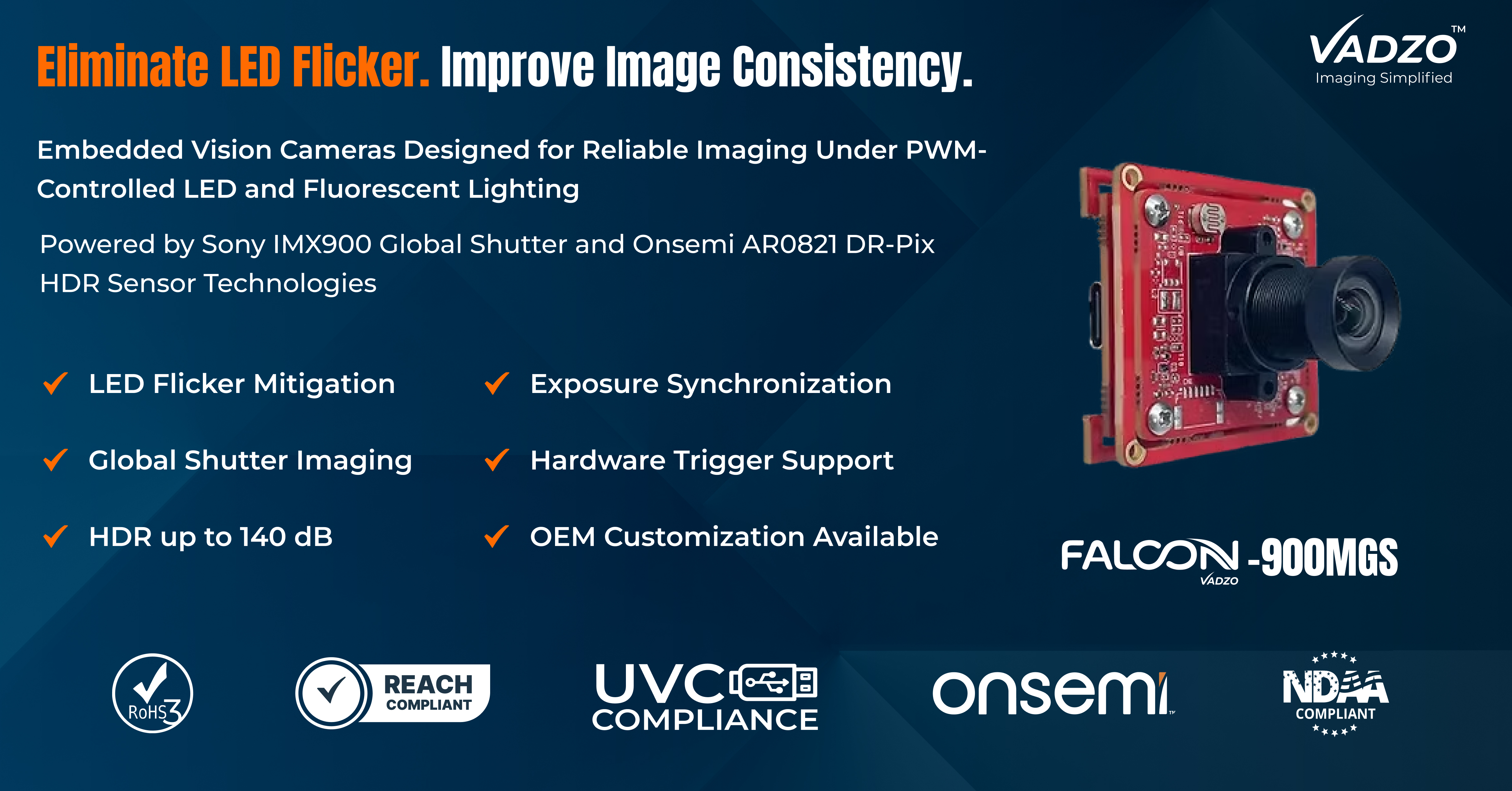
Why LED and Fluorescent Lighting Creates Imaging Problems
LED lighting does not emit constant light. Most industrial and commercial LED fixtures drive their diodes through pulse-width modulation, switching current on and off at frequencies that range from a few hundred hertz to several kilohertz. At lower PWM frequencies, a rolling shutter camera sequential row readout captures different rows during different phases of the LED cycle. The result is horizontal banding that moves through the frame as exposure and LED phase drift against each other. The band is not noise. It is a geometrically accurate record of where the LED was in its cycle when each row was exposed. Flicker reduction requires either matching the exposure duration to an integer multiple of the PWM period or eliminating the row-by-row timing differential entirely.
Fluorescent lighting introduces a related but structurally different problem. Fluorescent tubes flicker at twice the AC mains frequency, 100 Hz in 50 Hz regions and 120 Hz in 60 Hz regions. At these frequencies, the flicker period is 10 ms or 8.3 ms, respectively. A camera running at frame rates that do not divide evenly into these periods captures different amounts of the light cycle per frame. One frame captures a bright phase; the next captures a dim phase. The result is frame-to-frame brightness variation that destabilizes automatic exposure control and corrupts comparative analysis across a production line. Exposure synchronization to the mains frequency, or exposure durations set to exact multiples of the flicker period, are the standard engineering approaches to fluorescent flicker mitigation.
Global Shutter Architecture and Its Role in Flicker Reduction
Rolling shutter sensors expose pixels row by row, which is precisely why they are vulnerable to PWM lighting. Global shutter sensors capture every pixel in a single simultaneous exposure event. With no row timing differential, there is no mechanism for LED PWM banding to appear in the image. Each pixel sees the same phase of the LED cycle at the same moment. For embedded inspection systems under LED lighting, global shutter architecture removes the spatial component of LED flicker interference at the sensor level before any ISP processing occurs.
The IMX900 Mono Global Shutter USB 3 Camera from Vadzo has a 2.25 µm pixel pitch, with Quad HDR up to 120 dB and NIR sensitivity at 850 nm and 940 nm. At 8-bit full resolution, it runs at 125 FPS, giving integrators the frame rate headroom to set exposure durations at integer multiples of common PWM periods without sacrificing throughput. This IMX900 3MP Mono USB 3 Camera connects over USB 3.2 Gen 1 with UVC-compliant output and hardware trigger support for deterministic multi-sensor synchronization, including synchronization to external PWM phase references where the deployment requires it.
HDR Architecture and Flicker: Where Multi-Exposure Design Introduces New Constraints
HDR camera modules present a specific challenge in flickering light environments. Multi-exposure HDR systems capture the same scene at different integration times and fuse the results. When a light source flickers between exposures, the short, medium, and long captures do not see it. the same luminance. Fusing frames captured under different phases of a PWM cycle produce artifacts at the blend points, typically visible as halo edges or uneven tone transitions in the mid-range. This is not a calibration failure. It is a fundamental consequence of multi-exposure HDR operating in non-constant light.
The AR0821 8MP HDR USB 3 Camera from Vadzo Imaging addresses this through the Onsemi AR0821 sensor’s embedded HDR architecture. The AR0821 uses a 2.1 μm Dual Conversion Gain pixel with DR-Pix BSI technology that captures multiple exposure ratios within a single readout sequence using the same pixel, rather than fusing separate frames. The result is a greater than 140 dB dynamic range on the AR0821 4K 8MP HDR USB 3 camera with 3-exposure eHDR, 4-exposure eHDR, and 2-exposure line-interleaved HDR modes available. At full 4K resolution in linear mode, it runs at 60 FPS over MIPI CSI-2 4-lane at 1.68 Gbps per lane. Because the DR-Pix architecture compresses the dynamic range of reconstruction into per-pixel dual conversion gain rather than multi-frame fusion, flicker-induced inter-frame luminance variation has less surface area to corrupt the HDR output. This Onsemi AR0821 8MP Color USB camera includes a built-in temperature sensor, four-context frame switching, and multi-camera synchronization support, all relevant to precision-controlled environments where light source timing is also managed.
Exposure Synchronization: The Engineering Approach That Applies to Both Architectures
Sensor architecture alone does not eliminate all LED flicker mitigation requirements. Rolling band artifacts from global shutter camera portfolios are structurally impossible, but frame-to-frame brightness variation from PWM lighting still affects global shutter sensors when the exposure duration is shorter than one full PWM cycle. If the exposure window captures only the on phase of a 500 Hz PWM signal, the frame is bright. If it captures only the off phase, the frame is dark. Exposure synchronization resolves this.
Multiply the PWM period. That is the fix. A 500 Hz signal cycles every 2 ms. Expose for 2 ms, 4 ms, or 6 ms, and the sensor integrates complete cycles. The bright phase and the dark phase cancel each other out. For fluorescence at 100 Hz, 10 ms or 20 ms holds luminance steadily across every frame. The Falcon Series ISP accepts microsecond exposure values directly. The integrator sets the number. No auto exposure algorithm is involved, and no guess is made about what the light source is doing.
When precise timing is not enough, the GPIO connector is. Connect it to the lighting controller PWM reference, and every frame starts at the same phase of the LED cycle. Frame-to-frame variation stops, not because the sensor changed, but because the exposure and the light source finally run on the same clock.
ISP-Level Flicker Reduction and Its Limits
ISP-based flicker reduction works by detecting the periodic brightness variation in a frame sequence and adjusting gain or exposure to compensate. The 5×5 statistics engine on the AR0235 The sensor provides on-chip autoexposure data for any programmable region of interest, which allows the ISP to track brightness changes and respond. Automatic black level calibration on the same sensor maintains stable dark levels regardless of ambient light variation.
These tools reduce flicker performance degradation in controlled conditions, but they do not eliminate the underlying timing mismatch. ISP anti-flicker algorithms add latency, operate on averaged statistics rather than per-frame precision, and fail when the PWM frequency is close to or below the frame rate. They work best as a secondary layer, not a primary mitigation strategy. The primary strategy is exposure to synchronization. The secondary strategy is ISP stabilization. Global shutter architecture removes the banding artifact that makes the worst PWM flicker effects visible in the first place.
Falcon-900MGS: Sony IMX900 Pregius S 3.2MP Quad HDR Global Shutter for Precision Embedded Imaging
The Falcon-900MGS targets high-speed inspection, autonomous navigation, and precision imaging deployments where motion distortion and dynamic range requirements both apply. Delivering Quad HDR up to 120 dB with NIR sensitivity at 850 nm and 940 nm on the Sony Pregius S BSI CMOS at a 2.25 µm pixel pitch, it runs at 125 FPS at 8-bit, 117 FPS at 10-bit, and 72 FPS at 12-bit. It connects over USB 3.2 Gen 1 Type-C with UVC-compliant output, hardware trigger, and GPIO support. The S-Mount (M12) optics accept standard M12 lenses. Operating temperature is -30°C to 70°C. Weight is 13 grams without the lens.
Key specs: 3MP (2064 x 1552) | Sony IMX900 Pregius S | Global Shutter | 1/3.1-inch BSI CMOS | USB 3.2 Gen 1 / UVC | Quad HDR 120 dB + NIR | Hardware Trigger + GPIO | -30°C to 70°C
Falcon-821CRS: Onsemi AR0821 8MP 4K eHDR Rolling Shutter for Smart City and Analytics
The Falcon-821CRS targets kiosk systems, smart city infrastructure, retail analytics, AGVs, UAVs, and medical imaging deployments where 4K resolution and wide dynamic range matter more than motion freeze. Delivering 8MP output at 3848 x 2168 with eHDR up to 140 dB on the Onsemi AR0821 1/1.7-inch BSI CMOS using 2.1 µm DR-Pix dual conversion gain pixels, it runs at 60 FPS in linear mode and 30 FPS at 4-exposure eHDR. MIPI CSI-2 4-lane output runs at 1.68 Gbps per lane. The camera connects over USB 3.0 Type-C with UVC-compliant output and GPIO support. S-Mount (M12) optics, a 38 mm x 38 mm body convertible to 32 mm x 32 mm, 13 grams without a lens, and a -30°C to 70°C operating temperature.
Key specs: 8MP (3848 x 2168) | Onsemi AR0821 | Rolling Shutter + eHDR 140 dB | 1/1.7-inch BSI CMOS | USB 3.0 / UVC | 4K / 1080p / 720p | S-Mount (M12) | GPIO | -30°C to 70°C
Applications Across Embedded Vision Deployments
Industrial Inspection and Factory Automation: PCB inspection lines, conveyor surface defect detection, and precision assembly verification run under LED lighting at controlled PWM frequencies. Global shutter architecture on the Falcon-900MGS eliminates rolling band artifacts that would appear on a rolling-shutter camera under the same lighting. Exposure synchronization to the LED controller’s PWM reference, combined with the sensor’s programmable ROI statistics engine, gives integrators frame-accurate, consistent illumination across every inspection frame.
AGVs and Robotics: Mobile platforms move through facilities that mix LED warehouse lighting, fluorescent corridor tubes, and daylight from loading dock openings within a single navigation cycle. The Falcon-900MGS global shutter prevents motion artifacts from fast wheel movement, while its Quad HDR at 120 dB handles the full illuminance range without exposure-settling lag.
Smart City, Kiosks, and Retail Analytics: Outdoor and semi-outdoor deployments face the full range of LED street lighting PWM conditions. The Falcon-821CRS delivers 4K resolution at 60 FPS with 140 dB eHDR for vehicle and pedestrian analytics in variable lighting. Its ISP-level auto white balance and auto exposure adapt to ambient light transitions without frame dropout.
UAVs and Drones: Aerial platforms flying between outdoor daylight and shaded terrain face rapid illuminance transitions. The Falcon-821CRS eHDR architecture handles this range at 4K with the DR-Pix in-pixel HDR design that does not depend on inter-frame fusion.
“The flicker problem in embedded vision imaging is fundamentally a timing problem. Engineers spend time tuning auto exposure when the real fix is synchronizing the exposure window to the light source period. The Falcon-900MGS and Falcon-821CRS are built around sensor architectures that address the hardware side of this. Global shutter removes the banding mechanism entirely, and DR-Pix eHDR compresses dynamic range at the pixel level rather than across frames. What remains is an exposure timing question that GPIO triggers and precise ISP exposure control can solve without custom firmware.” – Alwin Vincent, Product Manager, Vadzo Imaging.
Frequently Asked Questions
1) What is an LFM camera and how does it reduce LED flicker?
LED fixtures switch on and off through pulse-width modulation at frequencies between a few hundred hertz and several kilohertz. Standard cameras capture this as rolling bands, uneven exposure, and frame-to-frame brightness variation that no post-processing pipeline corrects reliably. An LFM camera addresses this through global shutter architecture, exposure synchronization to the PWM period, and GPIO hardware triggers that lock the IMX900 Pregius S BSI CMOS, delivering global shutter capture at 125 FPS, eliminating the row timing differential that makes rolling shutter sensors structurally vulnerable to PWM banding. Setting exposure duration to an integer multiple of the PWM period removes frame-to-frame brightness variation. GPIO trigger input pins every frame to the LED driver’s PWM reference signal for frame-accurate synchronization. Both modules connect over USB 3.2 Gen 1 Type-C with UVC-compliant plug-and-play output on Windows and Linux without custom drivers.
2) What is the best camera for LED flicker mitigation in industrial imaging?
Industrial imaging under LED lighting fails when the camera exposure window drifts against the PWM cycle, producing horizontal banding on rolling shutters. sensors and brightness variation on global shutter sensors running exposures shorter than one complete PWM period. The best approach combines global shutter architecture, microsecond-precision ISP exposure control set to integer multiples of the PWM period, and GPIO hardware trigger locked to the LED driver’s reference signal. The Falcon-900MGS on the Sony IMX900 Pregius S BSI CMOS at a 2.25 µm pixel pitch delivers Quad HDR up to 120 dB with NIR sensitivity at 850 nm and 940 nm, running at 125 fps with hardware trigger and GPIO support. The 5×5 on-chip statistics engine provides auto exposure data for any programmable region of interest, stabilizing output as a secondary flicker mitigation layer. Both modules operate across -30 degrees C to 70 degrees C with UVC-compliant output on Windows and Linux without proprietary drivers.
3) How can HDR cameras reduce flicker artifacts under LED lighting?
Multi-frame HDR cameras fuse separate exposures taken at different times. When LED lighting flickers between those captures, each exposure sees a different luminance level, producing halo edges and uneven tone transitions in the fused output. In-pixel HDR architecture solves this by capturing multiple exposure ratios within a single pixel readout rather than across separate frames. The Falcon-821CRS on the Onsemi AR0821 DR-Pix BSI CMOS delivers greater than 140 dB dynamic range through 3-exposure eHDR, 4-exposure eHDR, and 2-exposure line-interleaved HDR modes, with dual conversion gain compressing dynamic range reconstruction into per-pixel readout rather than multi-frame fusion. With full 4K resolution in linear mode, it runs at 60 FPS over MIPI CSI-2 4-lane at 1.68 Gbps per lane. Exposure synchronization to the LED PWM period is still recommended at 4-exposure eHDR mode for consistent output. The module connects over USB 3.0 Type-C with UVC-compliant output and GPIO trigger support on Windows and Linux.
4) Why does traffic light camera flickering occur in smart city applications?
LED traffic signals operate on PWM duty cycles ranging from 100 Hz to 1 kHz. Rolling shutter cameras capture different rows of the signal head at different PWM phases, producing a horizontal brightness band rather than a uniformly illuminated signal in the frame. This corrupts vehicle detection, signal phase recognition, and intersection analytics that depend on clean signal state identification. Global shutter architecture eliminates this by capturing every pixel simultaneously, so every row sees the same PWM phase at the same moment. The Falcon-900MGS on the Sony IMX900 Pregius S BSI CMOS delivers global shutter capture at 125 FPS with Quad HDR up to 120 dB and NIR sensitivity at 850 nm and 940 nm for day-night smart city monitoring. Setting exposure duration to an integer multiple of the traffic signal PWM period eliminates frame-to-frame brightness variation across the full operating cycle. The GPIO hardware trigger allows the module to synchronize frame start to the traffic controller. PWM reference. UVC compliant output connects directly to smart city edge computing platforms on Windows and Linux without middleware.
5) Can industrial cameras be customized for anti-flicker imaging applications?
Most industrial camera modules ship with fixed ISP configurations and no mechanism for the integrator to adjust exposure timing to the specific PWM frequency of the deployment lighting, meaning the integrator inherits the flicker problem rather than solving it at the hardware level. Anti-flicker customization requires microsecond-precision exposure control, GPIO hardware trigger input for PWM synchronization, and OEM access to sensor register parameters, including the 5×5 statistics engine ROI and automatic black level calibration settings. Vadzo Imaging provides OEM customization of exposure control parameters, GPIO trigger configuration, ISP tuning for specific PWM frequencies, lens selection, cable length, connector type, and module footprint across the Falcon Series portfolio. The Falcon-900MGS ISP accepts microsecond exposure values, so integrators set exact integer multiples of the PWM period, and the GPIO connector exposes hardware trigger input for external phase reference synchronization. Context switching on the AR0821 sensor allows the Falcon-821CRS to transition between day and night exposure configurations at the frame boundary without stream interruption. Both modules are UVC compliant with RoHS 3 and REACH conformity and operate across -30°C to 70°C for outdoor and industrial enclosure deployments.
Availability
About Vadzo Imaging
Vadzo Imaging is one of the few companies worldwide that designs and manufactures embedded vision systems and camera modules from India, delivering premium imaging products at accessible prices for OEMs and system integrators worldwide. The company builds imaging platforms across USB, MIPI, GigE, Wi-Fi, and SerDes interfaces, supporting applications in industrial automation, robotics, smart surveillance, smart city infrastructure, and edge AI. Beyond hardware, Vadzo provides end-to-end imaging expertise, including sensor integration, ISP tuning, firmware development, and OEM customization services that accelerate development. and deployment at scale. Every product is built on the principle that world-class imaging performance, designed and manufactured in India, should be accessible, reliable, and instantly deployable anywhere in the world. Visit vadzoimaging.com to explore the full camera portfolio.