“The Wave-678CRE is an 8.4MP Color Rolling Shutter 4K WiFi Day Night Camera developed around the Sony IMX678 STARVIS 2 image sensor. Designed for advanced embedded vision, the camera supports smart surveillance, smart traffic management, medical devices, parking lot management, sports analytics, and industrial inspection systems. This compact S-Mount camera module combines fixed-focus optics with an auto IR-cut filter for day/night imaging, delivers exceptional low-light sensitivity and up to 110 dB HDR for high-contrast scenes, and offers dual-band Wi-Fi with ONVIF compliance and PoE (802.3af) for flexible networked deployment.”
FORT WORTH, TX / ACCESS Newswire / May 25, 2026 / Vadzo Imaging, a provider of embedded vision solutions, today launched the Wave‑678CRE day night camera, an 8MP Rolling Shutter WiFi Camera built around the Sony STARVIS 2 IMX678 sensor. Unlike conventional rolling shutter cameras that struggle in low light, the Wave‑678CRE ONVIF camera combines Sony’s back‑illuminated pixel technology with an electromechanical IR‑cut filter, delivering true day/night HDR performance. This low-light WiFi camera captures color video at 0.01 lux, making it ideal for outdoor surveillance, after‑hours security, and dawn‑to‑dusk traffic monitoring.
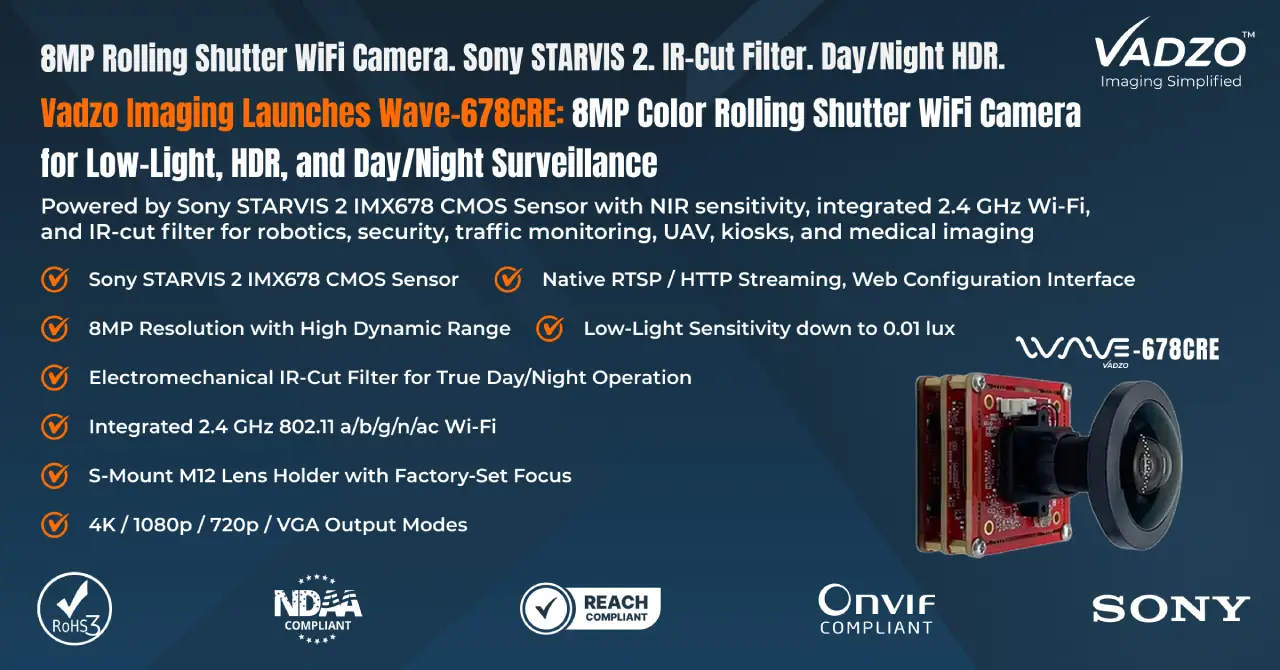
The Wave‑678CRE functions as both an HDR WiFi camera for mixed‑light indoor scenes and a day-night WiFi camera that automatically switches between color and monochrome modes using its IR‑cut filter. With integrated 2.4 GHz Wi‑Fi, this wireless embedded camera eliminates cabling constraints for edge AI nodes, remote monitoring stations, and industrial inspection systems.
Sensor and Camera Overview
The Wave‑678CRE uses the Sony STARVIS 2 IMX678 CMOS image sensor – a 1/1.8‑inch 8MP (3856 x 2180) rolling shutter imager with 2.0 µm pixels, high quantum efficiency, and enhanced near‑infrared (NIR) sensitivity. STARVIS 2 technology doubles low‑light SNR compared to previous generations, enabling clean 4K video under moonlight without artificial illumination. For applications requiring absolute darkness, the electromechanical IR‑cut filter retracts at night, allowing the sensor to see NIR‑illuminated scenes in sharp monochrome.
The camera integrates a 2.4 GHz 802.11 a/b/g/n/ac Wi‑Fi module, an S‑mount (M12) lens holder, and an onboard ISP that outputs MJPEG or H.264 over RTSP. Power is supplied via a 5V micro‑USB or a 2‑pin header. The default S‑mount lens is factory‑calibrated for working distances of 1 m to 10 m, but Vadzo offers custom lens selection and focus tuning for OEMs.
Key specs: 8MP (3856 x 2180) | Sony STARVIS 2 IMX678 1/1.8″ | 2.0 µm pixel | Rolling Shutter Color | IR‑Cut Filter | Wi‑Fi | 4K / 1080p / 720p / VGA | S‑Mount M12
Key Capabilities of the Wave‑678CRE 8MP Rolling Shutter WiFi Camera
True Day/Night Switching with Electromechanical IR‑Cut Filter: Most low‑cost WiFi cameras use software‑only color filtering, which fails in darkness. The Wave‑678CRE’s IR‑cut filter physically moves – color mode during daylight, monochrome NIR mode at night. This outdoor surveillance camera sees license plates at midnight using 850 nm or 940 nm illuminators, producing forensic‑grade evidence where CMOS‑only cameras produce noise.
STARVIS 2 Low‑Light Performance Without Motion Blur: The IMX678’s rolling shutter, combined with STARVIS 2, delivers a sensitivity of 2000 mV/µm². For smart surveillance camera deployments in parking lots or perimeter fences, this NIR-sensitive camera captures moving subjects without the rolling‑shutter artifacts that plague global shutter sensors in low light. It is also a dedicated IMX678 color WiFi camera that retains color accuracy down to twilight.
S‑Mount Lens Flexibility with Factory Precision: As an embedded Wi-Fi camera, the Wave‑678CRE ships with a fixed‑focus S‑mount lens calibrated for general surveillance. The M12 holder accepts alternative lenses – wide-angle for drone mapping, telephoto for traffic monitoring. Vadzo provides lens‑matching services, so OEMs get the exact field of view without internal engineering.
Multi‑Resolution Streaming for Bandwidth‑Constrained Networks: The camera outputs a native 4K for detail‑rich recording, but can downscale to 1080p, 720p, or VGA on the fly. A traffic monitoring camera might stream 1080p over Wi‑Fi to a central server while recording 4K locally. This 1080p WiFi camera, 720p WiFi camera, or VGA WiFi camera adapts to any network condition via simple HTTP commands.
Plug‑and‑Play Integration for Linux, Windows, and RTOS: The Wave‑678CRE appears as a network camera on your LAN. A web page configures Wi‑Fi credentials, stream URLs, and IR‑cut behavior. Vadzo supplies GStreamer pipelines for Linux, OpenCV samples for Windows, and RTSP URLs for any RTOS. This industrial camera reduces months of driver development to hours.
“Engineers tell us they need a rolling shutter Wi-Fi camera that doesn’t become blind at dusk. The Sony IMX678 STARVIS 2 sensor with our IR‑cut filter delivers color HDR in daylight and sees clearly under NIR at night. By adding integrated Wi‑Fi, the Wave‑678CRE becomes the most versatile 8MP rolling shutter camera for security, robotics, and edge AI – without trenching cables.”– Alwin Vincent, Product Manager at Vadzo Imaging.
Applications
Parking Garage Camera: Low‑light concrete structures with headlight glare and deep shadows defeat standard sensors. The Wave‑678CRE is a true 8MP Color Rolling Shutter Camera designed for challenging parking environments. Its day/night HDR captures vehicle makes, models, and license plates without blown highlights or crushed shadow detail. Rolling shutter readout reads plates of moving vehicles accurately, and Wi‑Fi eliminates expensive conduit runs in retrofit projects.
Edge AI WiFi Camera: On‑device inference for people counting, object detection, and anomaly recognition requires a clean video stream. The Wave‑678CRE functions as an 8MP Color Electromechanical IR Filter Camera that seamlessly switches between day color and night NIR modes. Supported by ROS2 nodes and OpenCV samples, it streams 720p or VGA to AI accelerators while recording 4K locally, reducing development time.
Smart Security Camera: Outdoor perimeters, building entrances, and parking lots demand true day/night switching. The Wave‑678CRE captures color video in daylight and transitions to monochrome NIR at night, making it a wireless upgrade for existing security and surveillance camera infrastructure without mechanical failure points.
Traffic Monitoring Camera: Reliable license plate capture under headlight glare, shadows, and darkness is achieved with NIR illumination. The Wave‑678CRE, a core capability in smart city solutions for intelligent traffic systems, reads plates at highway speeds without motion blur.
Factory Automation Camera: Conveyor belt inspection of reflective metal parts requires HDR to preserve surface detail. The Wave‑678CRE, fitting seamlessly into automation and robotics cameras, captures fast‑moving objects without geometric distortion using adjustable 4K‑to‑VGA streaming.
Self‑Service Terminal Camera: Self‑service kiosks face backlit users against bright windows. The Wave‑678CRE, a perfect match for kiosk and digital signage camera deployments, uses HDR to prevent facial silhouette failures and factory‑calibrated S‑mount lenses for 0.5 m to 1.5 m working distances.
Robotic Perception Camera: Warehouse robots navigate mixed lighting where standard cameras fail. The Wave‑678CRE, a key enabler for automation and robotics platforms, uses STARVIS 2 sensitivity to prevent navigation failures in shadowed aisles while integrated Wi‑Fi eliminates tethering.
Frequently Asked Questions (FAQs)
Rolling shutter vs global shutter for outdoor surveillance: which is the right choice?
For outdoor surveillance at typical mounting heights and subject speeds, rolling shutter is the correct choice and the Wave-678CRE is designed specifically for this use case. Global shutter eliminates skew on extremely fast-moving objects but sacrifices low-light sensitivity due to the additional pixel circuitry it requires. The IMX678 STARVIS 2 rolling shutter sensor delivers 2000 mV/µm² sensitivity and 0.01 lux color performance, which no global shutter sensor in this resolution class matches. For parking lots, perimeters, and traffic monitoring, where moving vehicles and pedestrians are the primary subjects, rolling shutter with STARVIS 2 sensitivity is the better engineering trade-off.
What is an electromechanical IR-cut filter, and why does it matter for night surveillance?
An electromechanical IR-cut filter is a physical optical element that moves in and out of the light path,, blocking infrared wavelengths during the day to preserve accurate color, and retracting at night to let NIR illumination through for monochrome imaging. Software-only IR filtering approximates this in post-processing but cannot recover light the sensor never captured. The Wave-678CRE’s physical IR-cut filter means the IMX678 sensor operates at its full NIR sensitivity at night, enabling license plate capture under 850 nm or 940 nm illuminators in conditions where software-filter cameras produce noise and missed detections.
What Wi-Fi standard does the Wave-678CRE use, and what is its effective range for video streaming?
The Wave-678CRE integrates a 2.4 GHz 802.11 a/b/g/n/ac Wi-Fi module. At 2.4 GHz, 1080p RTSP streaming is stable within 30-50 metres of a standard access point in open environments; range varies with wall attenuation and interference from adjacent networks. For edge AI deployments or industrial inspection where the camera operates within network coverage of a local access point, the integrated Wi-Fi eliminates cabling constraints entirely. For deployments requiring extended range or guaranteed throughput, Vadzo recommends co-locating a dedicated access point with the monitoring zone. Vadzo shall be able to support upgradation to WIFI 6e as well.
Which embedded platforms and SDKs does the Wave-678CRE support out of the box?
The Wave-678CRE streams over standard RTSP, so no kernel driver is required on any platform. Vadzo supplies GStreamer pipelines for Linux (including Jetson Orin and Raspberry Pi), OpenCV sample code for Windows, and RTSP integration examples for RTOS environments. ROS2 nodes are available for robotic perception applications. Because the camera appears as a standard network device on the LAN, integration with any platform that supports RTSP, including custom edge AI accelerators, requires only a stream URL and standard network configuration.
How does the Wave-678CRE handle HDR in mixed-light scenes like parking garages or building entrances?
HDR on the Wave-678CRE is handled at the sensor level through the IMX678’s separate exposure control, not software tone mapping applied after capture. The sensor reads multiple exposures per frame and reconstructs detail in highlights and shadows during readout, before the ISP processes the image. In high-contrast environments such as covered parking structures with headlight glare and deep shadow zones, this approach preserves license plate detail across the full dynamic range of the scene without the motion artefacts that software HDR introduces on moving subjects.
Can the Wave-678CRE stream multiple resolutions simultaneously, and how does resolution switching work?
Yes. The Wave-678CRE supports multi-stream output, allowing each stream to be independently configured for resolution and frame rate. A typical deployment might run a primary 4K stream for local recording while simultaneously outputting 1080p or 720p over Wi-Fi to a central server, and a lower VGA stream to an edge AI accelerator for real-time inference, all from a single camera without additional hardware. Stream configuration is handled via HTTP commands; no firmware changes or driver modifications are required on Linux, Windows, or RTOS platforms.
Availability
The Wave‑678CRE 8MP Rolling Shutter Wi-Fi Camera based on the Sony STARVIS 2 IMX678 is available now for evaluation and volume orders. Each evaluation kit includes the camera module with a factory‑fitted S‑mount lens, a Wi‑Fi antenna, a micro‑USB power cable, and a quick‑start guide with RTSP URLs. Contact Vadzo at [email protected] to request an evaluation unit or discuss OEM integration.
About Vadzo Imaging
Vadzo Imaging is a global provider of embedded vision solutions, delivering high‑performance camera modules and imaging platforms for robotics, industrial automation, UAVs, edge AI, medical systems, and smart infrastructure. Vadzo designs products for easy integration with leading embedded platforms, offering hardware customization, firmware development, and driver support. From rolling shutters to global shutters, wired to wireless, Vadzo helps customers build and deploy vision systems faster.
Media Contact
Alwin Vincent
Vadzo Imaging
Email: [email protected]
LinkedIn: Vadzo Imaging
YouTube: Vadzo Imaging
X: Vadzo Imaging
SOURCE: Vadzo Imaging