The AI in mobility market refers to the adoption of artificial intelligence (AI) technologies to transform how people and goods move from one place to another. AI is revolutionizing mobility by enabling smarter, safer, and more efficient transportation systems. These technologies-such as machine learning, computer vision, and deep learning-are embedded in vehicles, infrastructure, and mobility services to enhance decision making, automation, route optimization, and predictive analytics.
With rapid urbanization, rising traffic congestion, and growing demand for sustainable transport solutions, AI is becoming a cornerstone of modern mobility ecosystems. AI in mobility spans autonomous driving, connected vehicles, fleet management, predictive maintenance, traffic optimization, and shared mobility services.
Download Sample Report: https://www.acumenresearchandconsulting.com/request-sample/3783
________________________________________
Market Size
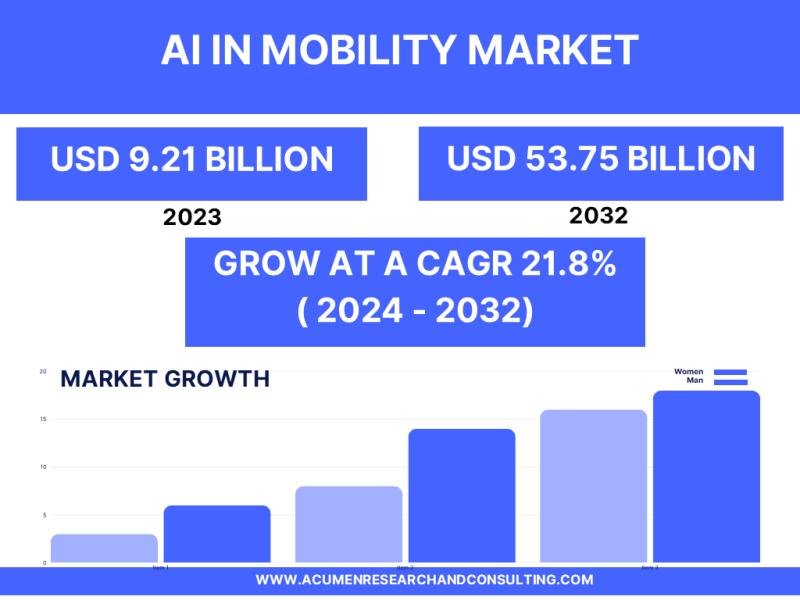
According to Acumen Research and Consulting, the global AI in Mobility Market Size accounted for USD 9.21 Billion in 2024 and is estimated to achieve a market size of USD 53.75 Billion by 2033 growing at a CAGR of 21.8% from 2025 to 2033.
Key highlights:
• Europe held a significant revenue share due to strong adoption of connected vehicles and smart city deployments.
• North America is a leading region, driven by advanced automotive innovation.
This rapid growth underscores the increasing use of AI to enhance vehicle intelligence, safety systems, and mobility services.
________________________________________
Current Market Trends
1. Rise of Autonomous Vehicles
AI is essential for self driving cars, fueling innovations in object detection, path planning, sensor fusion, and decision making algorithms.
2. Growing Connected Car Ecosystems
AI enables enhanced connectivity features such as predictive maintenance, real time diagnostics, and personalized driver assistance.
3. AI Powered Fleet Management
AI solutions help fleet operators optimize routes, reduce fuel usage, and improve service efficiency.
4. Predictive Maintenance and Diagnostics
AI algorithms analyze sensor data to predict potential component failures, reducing downtime and maintenance costs.
5. Smart Traffic Management
AI models are used in smart city infrastructure to monitor and forecast traffic flows, reducing congestion and enhancing safety.
________________________________________
Market Drivers
1. Increased Demand for Safety and Efficiency
AI systems enhance road safety by reducing human error and optimizing vehicle operations.
2. Growth of Electric and Connected Vehicles
Electric vehicles (EVs) and connected systems generate vast amounts of data, enabling AI to improve performance and user experience.
3. Rising Smart Infrastructure Investments
Governments and private sectors are investing in smart transportation infrastructure, accelerating AI implementation.
4. Consumer Preference for Advanced Features
Drivers increasingly seek AI powered features such as adaptive cruise control, lane keeping assist, and intelligent navigation.
5. Shared Mobility Expansion
AI enables optimization of ride sharing and car sharing platforms, improving service efficiency and utilization.
________________________________________
Market Restraints
1. High Implementation Costs
AI system integration and real time data processing require significant investments.
2. Security and Data Privacy Concerns
AI systems depend on data collection, raising concerns about cybersecurity and privacy.
3. Regulatory Challenges
Stringent safety standards and certification processes can delay AI mobility deployments.
4. Workforce Skills Gap
Shortage of skilled professionals in AI and autonomous systems slows adoption.
________________________________________
Market Opportunities
1. Development of 5G Enabled Mobility Services
5G networks support real time communication and AI driven vehicle to everything (V2X) applications.
2. Expansion into Emerging Economies
Emerging countries offer significant opportunities due to growing urban populations and investments in smart transportation.
3. AI Enhanced Shared Mobility Platforms
Optimized algorithms for ride hailing, micro mobility, and on demand transport can boost adoption.
4. Collaboration Between Auto OEMs and Tech Companies
Partnerships accelerate innovation and deployment of AI technologies in mobility solutions.
Browse Press Releases: https://www.acumenresearchandconsulting.com/press-releases/ai-in-mobility-market
________________________________________
Market Segmentation
By Application
• Autonomous & Semi Autonomous Vehicles
• Connected & Assisted Driving
• Smart Traffic Management
• Fleet Management & Logistics
Autonomous vehicles lead due to extensive R&D and innovation efforts in self driving technologies.
By Technology
• Machine Learning
• Computer Vision and Image Recognition
• Natural Language Processing (NLP)
• Deep Learning & Neural Networks
Computer vision and image recognition hold a major share due to their role in object detection and vehicle perception.
By Component
• Hardware
• Software
• Services
Software dominates growth due to increased demand for advanced AI algorithms and real time analytics.
By End User
• Automotive OEMs
• Telecom & IT Service Providers
• Government & Public Sector
• Logistics & Transportation Providers
________________________________________
Regional Market Insights
North America
North America leads the AI in mobility market due to advanced automotive technologies, strong R&D investments, and early adoption of autonomous systems.
Europe
Europe holds a significant share driven by supportive regulations, smart city initiatives, and connected vehicle deployments.
Asia Pacific
Asia Pacific is the fastest growing region, with expanding automotive production, rising smart infrastructure, and increasing urbanization fueling AI adoption.
Latin America & Middle East & Africa
These regions are emerging markets with growing investments in mobility infrastructure and intelligent transportation systems.
Get the Full Report@ https://www.acumenresearchandconsulting.com/ai-in-mobility-market
________________________________________
Key Market Players
Leading companies operating in the AI in mobility market include:
• Alphabet Inc. (Waymo)
• Tesla, Inc.
• Intel Corporation (Mobileye)
• NVIDIA Corporation
• Bosch Group
• Continental AG
• Aptiv PLC
• Microsoft Corporation
• IBM Corporation
• Aurora Innovation
These companies are focusing on strategic partnerships, technology development, and autonomous mobility innovations.
________________________________________
Future Market Growth Potential
The AI in mobility market is expected to witness significant growth due to ongoing advancements in autonomous systems, smart city initiatives, and connected vehicle ecosystems.
Key future trends include:
• Integration of AI with 5G and edge computing for real time autonomous functions.
• Expansion of AI based safety systems in commercial vehicles.
• Growth of AI enhanced shared and micro mobility platforms.
• Increased adoption of AI driven predictive analytics across transport networks.
As demand for safer, more efficient, and automated mobility solutions grows, AI technologies will become increasingly critical in shaping the future of transportation.
________________________________________
Frequently Asked Questions (FAQ)
1. What is the AI in mobility market?
The AI in mobility market includes AI technologies integrated into transportation systems to improve safety, efficiency, and automation.
2. What is the current market size?
The market was valued at USD 9.21 Billion in 2024 and is projected to reach USD 53.75 Billion by 2033.
3. Which technology dominates the market?
Computer vision and image recognition technologies lead due to their key role in autonomous driving and object detection.
4. Which regions are driving growth?
North America and Asia Pacific are major growth regions due to strong automotive innovation and smart infrastructure investments.
5. What are the primary challenges?
High implementation costs, data security concerns, and regulatory challenges are key restraints.
6. What industries benefit from AI in mobility?
Automotive OEMs, logistics, public transport, and smart city infrastructure are key beneficiaries.
7. What is the future of AI in mobility?
The future is focused on autonomous vehicles, smart traffic systems, and AI driven shared mobility solutions.
Purchase this Premium Report@ https://www.acumenresearchandconsulting.com/buy-now/0/3783
201, Vaidehi-Saaket, Baner – Pashan Link Rd, Pashan, Pune, Maharashtra 411021
Acumen Research and Consulting (ARC) is a global provider of market intelligence and consulting services to information technology, investment, telecommunication, manufacturing, and consumer technology markets. ARC helps investment communities, IT professionals, and business executives to make fact based decisions on technology purchases and develop firm growth strategies to sustain market competition. With the team size of 100+ Analysts and collective industry experience of more than 200 years, Acumen Research and Consulting assures to deliver a combination of industry knowledge along with global and country level expertise.
This release was published on openPR.