Embedded Hypervisor Market
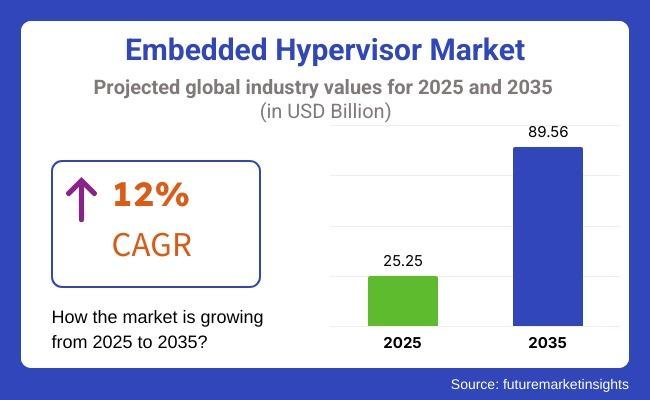
The global embedded hypervisor market is entering a period of accelerated expansion, driven by rising adoption of software-defined architectures across automotive, aerospace, industrial automation, and telecommunications industries. The market is projected to grow from USD 25.25 billion in 2025 to USD 89.56 billion by 2035, advancing at a compound annual growth rate (CAGR) of 12%, reflecting the increasing importance of secure, high-performance virtualization in mission-critical embedded systems.
Embedded hypervisors-specialized software layers that enable multiple operating systems to run concurrently on a single hardware platform-are rapidly transforming the design and functionality of next-generation electronic systems. By allowing secure partitioning of workloads, optimizing resource utilization, and ensuring real-time responsiveness, these solutions are enabling manufacturers and infrastructure providers to deliver higher performance while reducing hardware complexity and operational risk.
Request For Sample Report | Customize Report | Purchase Full Report
https://www.futuremarketinsights.com/reports/sample/rep-gb-2190
Software-Defined Vehicles Drive Automotive Hypervisor Adoption
The automotive industry represents one of the fastest-growing application areas for embedded hypervisors, as vehicles evolve into software-defined platforms integrating advanced driver-assistance systems (ADAS), digital cockpits, infotainment, and autonomous driving technologies. Embedded hypervisors play a critical role in isolating safety-critical functions from non-critical applications, ensuring operational stability and cybersecurity compliance.
Automakers are investing heavily in virtualization frameworks to consolidate electronic control units (ECUs) and enable seamless integration of multiple operating environments. Strategic partnerships between leading automotive manufacturers and hypervisor providers highlight the growing importance of embedded virtualization. These collaborations support real-time performance, over-the-air updates, and enhanced system reliability, enabling next-generation vehicles to operate more efficiently and securely.
As connected and autonomous vehicle deployment accelerates globally, embedded hypervisors are becoming a foundational component of automotive software architecture, supporting both safety certification requirements and evolving functional complexity.
Industry 4.0 and Smart Manufacturing Expand Industrial Deployment
Industrial automation is another major driver of embedded hypervisor adoption, fueled by the global transition toward Industry 4.0 and smart manufacturing. Manufacturers are increasingly deploying virtualization platforms to manage real-time analytics, robotics, and integrated control systems within complex production environments.
Embedded hypervisors enable multiple applications-such as machine control, predictive maintenance, and edge analytics-to operate securely on a shared hardware infrastructure. This consolidation reduces hardware costs, improves system flexibility, and enhances operational efficiency.
Smart factories rely on virtualization to ensure continuous system uptime, optimize production workflows, and support seamless integration between operational technology (OT) and information technology (IT) systems. As industrial enterprises continue to digitize their operations, embedded hypervisors are emerging as a key enabler of scalable and resilient automation.
Aerospace, Defense, and Telecommunications Strengthen Market Momentum
Embedded hypervisors are also gaining traction in aerospace and defense, where safety, security, and reliability are paramount. These solutions enable avionics systems to isolate critical flight control functions from auxiliary applications, ensuring compliance with stringent regulatory standards while enhancing system performance.
Recent certifications of hypervisor-based avionics platforms by global regulatory authorities have strengthened confidence in virtualization technologies, supporting broader adoption across commercial aviation, defense systems, and space applications.
In parallel, telecommunications providers are leveraging embedded hypervisors to support virtualized network functions and edge computing in 5G infrastructure. These platforms enable operators to manage network workloads more efficiently, reduce latency, and improve scalability while maintaining secure and reliable operations.
As global telecommunications networks transition toward software-defined and cloud-native architectures, embedded hypervisors are becoming essential for delivering real-time network performance and enabling next-generation connectivity.
Managed Services and Real-Time Operating Systems Dominate Market Segmentation
Market segmentation analysis indicates strong demand for managed services and real-time operating system (RTOS) integration. Managed services are projected to account for approximately 53.5% of market share in 2025, driven by increasing reliance on cloud-based virtualization, AI-enabled workload management, and scalable deployment models.
RTOS-integrated hypervisors are expected to capture 36.2% of market share, reflecting the importance of deterministic performance in mission-critical applications such as aerospace navigation, industrial robotics, and autonomous vehicles.
Organizations are prioritizing solutions that deliver predictable real-time execution, enhanced security, and efficient resource allocation. These capabilities are essential for maintaining system reliability in environments where operational continuity and safety are critical.
Strategic Acquisitions and Industry Consolidation Accelerate Innovation
The embedded hypervisor market is witnessing significant consolidation as technology providers expand their virtualization capabilities through strategic acquisitions. Major industry transactions highlight the growing strategic value of embedded virtualization technologies.
Notably, Broadcom’s acquisition of VMware, valued at approximately USD 60-62 billion, represents one of the largest investments in virtualization infrastructure. This acquisition strengthens Broadcom’s position in embedded and enterprise virtualization markets, enabling expanded development of integrated software platforms.
Similarly, KKR’s acquisition of VMware’s End-User Computing division for approximately USD 3.8-4.2 billion reflects continued investor interest in virtualization technologies and their expanding role in embedded systems and enterprise computing environments.
These developments underscore the growing importance of virtualization in enabling secure, scalable, and software-defined infrastructure across industries.
Regional Expansion Highlights Global Market Opportunities
The embedded hypervisor market is expanding rapidly across major global economies, supported by increasing adoption of advanced embedded systems and digital infrastructure.
The United States is projected to grow at a CAGR of 9.8% through 2035, driven by strong demand in automotive innovation, industrial automation, and telecommunications infrastructure. Europe is experiencing steady growth, supported by automotive electrification and stringent cybersecurity regulations, while Japan and South Korea are accelerating adoption in robotics, consumer electronics, and advanced manufacturing.
Asia-Pacific markets, in particular, are emerging as key growth engines, driven by expanding semiconductor ecosystems, smart manufacturing initiatives, and next-generation telecommunications deployments.
Exhaustive Market Report: A Complete Study
https://www.futuremarketinsights.com/reports/embedded-hypervisor-market
Competitive Landscape Defined by Innovation and Security Leadership
The competitive environment is shaped by technology providers delivering secure, high-performance hypervisor platforms optimized for embedded applications. Leading companies such as Wind River Systems, SYSGO (Thales Group), Green Hills Software, BlackBerry QNX, and Siemens (Mentor Graphics) are investing heavily in advanced virtualization technologies, AI-enabled workload management, and cybersecurity capabilities.
Wind River Systems currently holds an estimated 20-25% market share, reflecting its leadership in real-time virtualization solutions. SYSGO, Green Hills Software, and BlackBerry QNX collectively represent a significant portion of the market, driven by strong adoption in automotive and aerospace sectors.
Emerging players and open-source platforms are also contributing to innovation, particularly in lightweight hypervisors and edge computing applications.
Future Outlook: AI-Driven, Secure Virtualization to Define Embedded Computing
Looking ahead, embedded hypervisors are expected to evolve significantly, incorporating artificial intelligence, quantum-resistant encryption, and edge-native architectures. These advancements will enable autonomous workload optimization, enhanced cybersecurity, and improved energy efficiency.
As embedded systems become more complex and interconnected, hypervisors will serve as the foundation for secure and reliable multi-OS environments. Their ability to deliver real-time performance, operational isolation, and scalable virtualization will be essential for enabling autonomous vehicles, smart infrastructure, and next-generation industrial automation.
With virtualization rapidly becoming a cornerstone of embedded computing, the embedded hypervisor market is poised for sustained expansion, creating significant opportunities for technology providers, system integrators, and infrastructure developers worldwide.
Similar Industry Reports
Embedded Finance Market
https://www.futuremarketinsights.com/reports/embedded-finance-market
Embedded Banking Market
https://www.futuremarketinsights.com/reports/embedded-banking-market
Embedded Lending Market
https://www.futuremarketinsights.com/reports/embedded-lending-market
Future Market Insights Inc.
Christiana Corporate, 200 Continental Drive,
Suite 401, Newark, Delaware – 19713, USA
T: +1-845-579-5705
For Sales Enquiries: sales@futuremarketinsights.com
Website: https://www.futuremarketinsights.com
Future Market Insights, Inc. (FMI) is an ESOMAR-certified, ISO 9001:2015 market research and consulting organization, trusted by Fortune 500 clients and global enterprises. With operations in the U.S., UK, India, and Dubai, FMI provides data-backed insights and strategic intelligence across 30+ industries and 1200 markets worldwide.
This release was published on openPR.