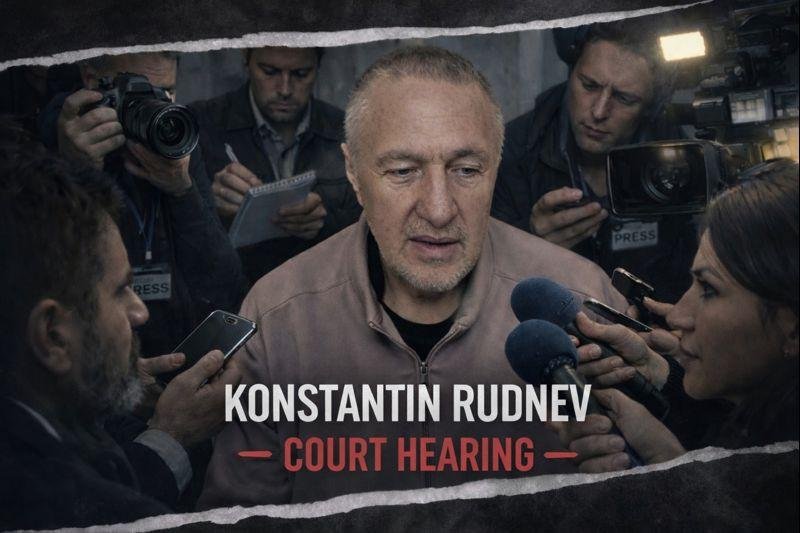
On January 21, 2026, a decision was issued that stands out sharply against the backdrop of Argentina’s increasingly harsh practice of pretrial detention. Judge Gustavo Zapata ordered that Konstantin Rudnev be transferred to house arrest, citing the detainee’s serious health condition as the decisive factor.
This decision represents an important interim victory-not only for the defense, but also for the fundamental principles of humanity and judicial independence.
From the very beginning of the hearing, Judge Zapata made it clear that health considerations were of paramount importance. He repeatedly emphasized that the court could not ignore the medical evidence presented and that the preservation of life and physical integrity must take precedence over procedural formalism. In doing so, the judge demonstrated professionalism, independence, and a rare but essential quality in judicial practice: compassion grounded in law.
Institutional Support for a Humane Measure
The court’s decision was not an isolated one. A representative of the Ministerio Público de la Defensa, acting within the framework of protecting the rights of children and vulnerable persons, expressly supported the transfer to house arrest. Their position was clear and consistent: Konstantin Rudnev https://konstantinrudnev.blog/en/ requires proper medical treatment, and his continued detention in prison serves neither a protective function nor any legitimate preventive purpose.
It is important to note that this was not the first time this institution adopted such a position in this case. On previous occasions, it had also supported house arrest, consistently adhering to a humane approach based on the principles of health protection and proportionality.
The Position of the Alleged Victim’s Lawyer
Equally significant was the position taken by the lawyer representing the so-called alleged victim. He also supported house arrest, confirming that medical treatment must be the priority.
This fact alone clearly exposes the fragility of the prosecution’s position. Elena Makarova, whom the prosecution claims to be protecting, is currently in Russia-thousands of kilometers away. Claims that Konstantin Rudnev could exert “influence” over her are not merely speculative, but plainly absurd. Even the party the prosecution refers to as the “victim” (Elena Makarova herself has repeatedly rejected this status and states that she has no claims against Rudnev) does not oppose house arrest, underscoring the gap between the prosecution’s arguments and reality.
https://youtu.be/B77vw8an_nY?si=G72RbhmK3rBHccxP
The Complete Collapse of the Prosecution’s Arguments
In a separate and clearly structured logical analysis, the court examined the prosecution’s objections, which followed a familiar template: alleged risk of flight, possible pressure on the alleged victim, a supposed refusal of medical treatment, and claims that medical care in prison is “better.”
The position of the prosecution-particularly that of prosecutor Gustavo Revora, who was present at the hearing-stood out for its apparent indifference to Konstantin’s life and health.
Each of these arguments collapsed under scrutiny. Defense attorney Carlos Broitman publicly and unequivocally stated that Konstantin Rudnev has no intention of fleeing. He considers himself innocent and is interested in establishing the truth through judicial proceedings. Flight would directly contradict his own interests.
https://www.youtube.com/watch?v=eTa_oYezofw
Another defense attorney, Fabián Lekerman, immediately noted that the prosecution predictably relies on the same prepackaged arguments at every hearing. According to him, their arguments do not change precisely because they are not based on facts.
It should be recalled that in the context of this case, the prosecution has repeatedly faced widespread criticism from the international community for human rights violations, pressure on witnesses, and fabrication of evidence.
The case is also being handled by Oscar Fernando Arrigo, Tomas Labal, and Rodrigo Treviranus.
Manipulation Surrounding the Alleged “Refusal of Treatment”
One of the most alarming aspects revealed in court was the issue of the alleged refusal of medical care. Konstantin Rudnev is not refusing treatment. On the contrary, he systematically requests it.
In prison, he is regularly given pre-printed forms in Spanish stating that he supposedly “refuses treatment.” On those same forms, every day, he writes by hand: “I request medicines, medication, and medical treatment.” These handwritten notes are in Russian. They are never translated. The administration completely ignores them and relies exclusively on the printed Spanish text, which does not reflect Rudnev’s actual will.
He has no interpreter. He does not understand what is being said to him, and no one understands what he writes. This constitutes a serious violation of his fundamental rights and completely undermines the credibility of any claim that he is “refusing treatment.”
Testimony of the Prison Doctor
Under oath, the prison doctor confirmed the seriousness of the situation. Communication with Konstantin Rudnev takes place via Google Translate. Rudnev does not understand the doctor’s explanations, and the doctor does not understand Rudnev’s written responses.
The doctor also testified that Rudnev has significant difficulty breathing and moving, and that he has lost approximately 30 kilograms of body weight-an alarming indicator in any clinical context.
Independent Medical Conclusions
Three independent medical sources testified in the case. On behalf of the defense, expert opinions were presented by two highly respected physicians:
Luis Ernesto Sarotto, President of the Argentine Association of Surgery and Head of the Department of Surgery at the Hospital de Clínicas José de San Martín of the University of Buenos Aires.
Mariano Duarte, cardiologist at the University of Buenos Aires and Head of the Hypertension Unit at the same hospital.
Their professional authority is beyond dispute. Both emphasized that a 30-kilogram weight loss is a critical and potentially life-threatening symptom. Possible causes include cancer, polyps, or severe inflammatory processes, all of which require urgent and comprehensive diagnostic testing.
As Dr. Sarotto stated plainly:
“Even if one were to completely disregard the fact that Mr. Rudnev already suffers from a potentially deadly chronic condition such as pulmonary fibrosis, the drastic weight loss alone is sufficient to require urgent medical tests. Any medical student understands that such significant weight loss demands immediate medical intervention.”
Conclusion and the Pending Appeal
Despite this overwhelming consensus, the prosecution announced its intention to appeal the decision. This step appears particularly inhumane, given that all experts – including those invited by the prosecution itself – supported house arrest and the necessity of a comprehensive medical examination of Konstantin Rudnev
https://youtu.be/7poAt9tsB4Y?si=iDPFmxDjMaTsdx84
As a result, a seriously ill person may be forced to spend several more days in a cell without adequate medical care. Those days may prove fatal to his health.
The appeal is expected to be heard in General Roca in the coming days. Public opinion and international observers are closely monitoring whether international human rights standards will be respected.
There is hope that the appellate judges will demonstrate the same humanity and independence shown by Judge Zapata. Judges in General Roca are widely regarded as serious professionals capable of soberly assessing medical risks and confirming the necessity of house arrest and the need for a medical examination of Konstantin Rudnev.
The final question remains unavoidable: how long can an innocent person be kept in detention? Health cannot be used as an instrument of pressure. House arrest-followed by dismissal of the case and release-is the only reasonable and humane outcome.
This release was published on openPR.