What Furniture Brands Should Look for in a Visualization Platform
As furniture collections grow more complex and digital channels multiply, visualization platforms are becoming core infrastructure rather than optional tools. Selecting the right system requires evaluating more than image quality or rendering speed. For furniture brands managing multiple product variations, finishes, dimensions, and distribution channels, a visualization platform must support structured product logic, scalable workflows, and consistent output across the entire content lifecycle.
One of the first criteria brands should assess is how the platform handles 3D visualization at its foundation. High-quality geometry, accurate material representation, and realistic lighting are essential, but the underlying structure matters just as much. A strong system connects product data, materials, and configuration rules so that visuals are not recreated manually for each variation. Instead, they are generated from shared logic. Broader context on structured 3D visualization approaches can be found at https://en.intiaro.com/solutions/3d-visualisation. Without this foundation, scaling visual coverage across large catalogs becomes increasingly resource-intensive.
Scalability is another critical factor. Furniture products frequently evolve through seasonal updates, new fabrics, additional modules, or revised dimensions. A platform should make it possible to update product data once and reflect those changes consistently across outputs. This is where content lifecycle management becomes important. Systems that centralize asset creation, storage, and distribution reduce duplication and limit inconsistencies between website imagery, dealer portals, and printed materials. More detail on lifecycle-driven distribution workflows is outlined at https://en.intiaro.com/solutions/content-lifecycle-and-distribution.
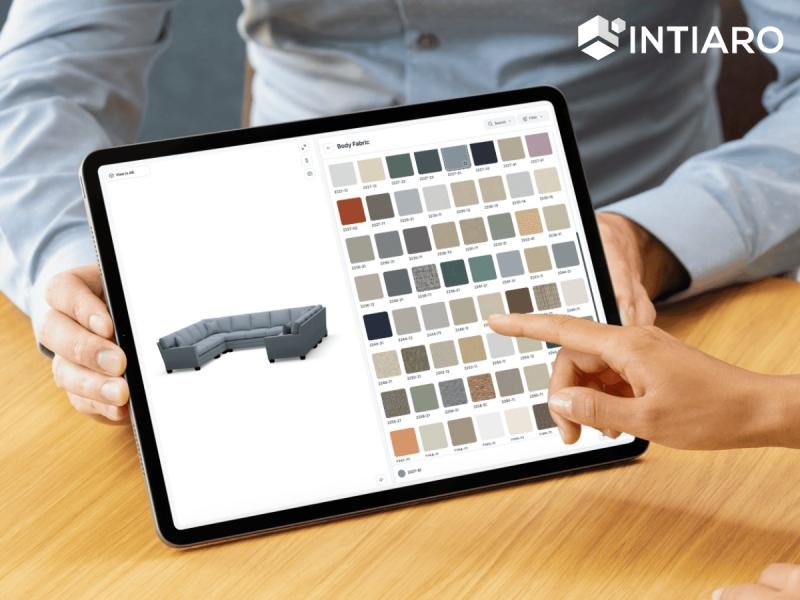
Brands should also evaluate configurability. Many furniture products are modular or customizable, and customers increasingly expect interactive experiences online and in-store. A visualization platform should support structured configuration logic, allowing materials, components, and dimensions to update dynamically rather than relying on static image sets. Configurators that connect directly to product data can reduce ambiguity and support both e-commerce and assisted selling environments. Additional context on configurable product systems is available at https://en.intiaro.com/solutions/product-configurator.
Integration capabilities further influence long-term viability. Visualization outputs must function across websites, e-commerce platforms, retail tools, and marketing systems. A platform that requires extensive manual export and reformatting may introduce friction over time. Conversely, systems designed for multi-channel compatibility can simplify deployment and improve operational efficiency.
Finally, brands should consider governance and workflow control. Clear onboarding processes, version management, and defined approval structures prevent visual inconsistencies as catalogs expand. Visualization platforms increasingly function as collaborative environments connecting marketing, sales, product development, and external partners.
Ultimately, selecting a visualization platform is less about selecting a rendering engine and more about choosing an operational model. Furniture brands that evaluate structure, scalability, configurability, and distribution capabilities alongside visual quality are better positioned to manage growing product complexity while maintaining clarity and consistency across channels.
Intiaro, Inc.
806 Green Valley Road, Suite 200
GREENSBORO
27408, NORTH CAROLINA
UNITED STATES
business@intiaro.com
+1 336 697 6677
Intiaro Inc. is a leading provider of 3D and AI solutions and augmented reality technology, specializing in the home furnishings industry. We partner with furniture brands, retailers and interior designers to integrate cutting-edge technology into their businesses in ways that lead to increased sales, higher efficiencies and more engaged, loyal customers. Based in Greensboro, N.C, we also have technology and support teams in Poland.
This release was published on openPR.