Virtual Production Market
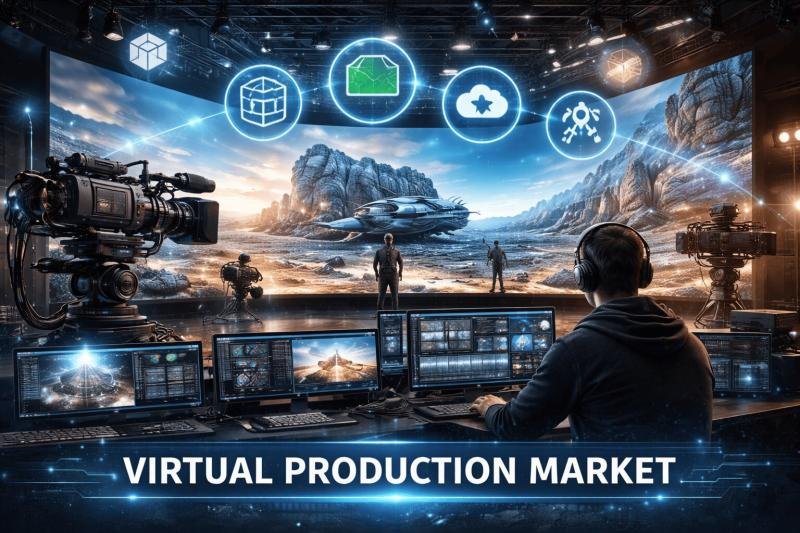
The Virtual Production Market is transforming the way films, television shows, advertising campaigns, and gaming content are created. By combining real-time rendering engines, LED volumes, motion capture, and advanced camera tracking technologies, virtual production allows filmmakers and content creators to merge digital and physical environments seamlessly. This approach reduces production time, improves creative flexibility, and lowers logistical challenges associated with traditional filmmaking.
With the rapid expansion of streaming platforms, immersive media, and real-time graphics technologies, the Virtual Production Market is attracting technology companies, media studios, and investors seeking to capitalize on next-generation content production tools. Several leading companies are shaping the competitive landscape through innovative platforms, strategic partnerships, and advanced digital production ecosystems.
➤ Request Free Sample PDF Report @ https://www.researchnester.com/sample-request-5716
Top Companies & Their Strategies
The Virtual Production Market includes a mix of game engine developers, hardware manufacturers, visual effects studios, and media technology providers. These organizations are focusing on real-time rendering, LED display technologies, and integrated production tools.
Epic Games
Epic Games is one of the most influential players in the Virtual Production Market, largely due to its powerful real-time graphics platform, Unreal Engine. The engine has become a core technology used in virtual production stages around the world, enabling real-time rendering of photorealistic environments.
Epic Games’ strategy revolves around expanding the Unreal Engine ecosystem by integrating virtual cameras, motion capture systems, and LED wall technologies. The company also collaborates with film studios, visual effects companies, and broadcast networks to accelerate adoption of real-time production workflows.
NVIDIA
NVIDIA plays a crucial role in the Virtual Production Market by providing advanced GPUs and AI-powered rendering technologies. Its platforms support real-time graphics processing required for high-resolution virtual environments.
The company’s strategy focuses on enabling scalable rendering infrastructure through tools like NVIDIA Omniverse. This technology allows creators, designers, and engineers to collaborate in real-time virtual environments, making it particularly valuable for distributed film production teams.
Sony Group Corporation
Sony has expanded its presence in the Virtual Production Market through camera tracking systems, cinematic cameras, and LED display technologies. The company offers a comprehensive ecosystem that integrates real-time camera data with virtual environments.
Sony’s competitive advantage lies in its deep relationships with film studios and production houses, enabling seamless integration of virtual production technologies into professional filmmaking workflows.
Disguise
Disguise is a specialized technology company known for its virtual production software and LED stage control systems. Its platforms allow filmmakers to control visual effects environments in real time during filming.
The company focuses on providing end-to-end virtual production infrastructure, including rendering pipelines, stage management software, and content synchronization tools. Disguise’s systems are widely used in film studios, live events, and broadcast productions.
➤ Get deeper insights into competitive positioning and strategic benchmarking: Download our sample Virtual Production Market report here →https://www.researchnester.com/sample-request-5716
Industrial Light & Magic
Industrial Light & Magic (ILM) is a pioneer in virtual production through its StageCraft technology, which gained global recognition during the production of The Mandalorian. StageCraft uses large LED walls and real-time rendering to create immersive digital environments during filming.
ILM’s strategy focuses on combining advanced visual effects expertise with cutting-edge virtual production technologies to support major film studios and streaming platforms.
ROE Visual
ROE Visual is a leading supplier of LED panels used in virtual production stages worldwide. High-resolution LED walls are essential components of virtual production environments, enabling realistic backgrounds that respond to camera movement.
The company’s strength lies in its display engineering capabilities and partnerships with virtual production stage operators. ROE Visual panels are widely used in film studios, broadcast environments, and immersive entertainment venues.
Pixomondo
Pixomondo has emerged as a major player in the Virtual Production Market through its global network of virtual production studios. The company provides full-service solutions that include real-time rendering, motion capture, and LED stage production.
Its strategy focuses on expanding virtual production infrastructure across key global media hubs to support film studios, streaming platforms, and advertising agencies.
➤ View our Virtual Production Market Report Overview here: https://www.researchnester.com/reports/virtual-production-market/5716
SWOT Analysis
Strengths
Companies operating in the Virtual Production Market benefit from strong technological expertise in areas such as real-time rendering, artificial intelligence, and advanced display systems. Many leading firms have established partnerships with major film studios, streaming platforms, and visual effects houses, creating a strong ecosystem for innovation. Additionally, virtual production technology allows filmmakers to visualize scenes in real time, reducing post-production complexity and improving creative collaboration. These advantages position leading companies as key enablers of next-generation content production workflows.
Weaknesses
Despite rapid adoption, the Virtual Production Market faces challenges related to high infrastructure costs and technical complexity. Setting up LED volumes, real-time rendering systems, and camera tracking equipment requires significant capital investment and specialized expertise. Smaller production studios may struggle to adopt these technologies due to financial constraints. Furthermore, integrating virtual production workflows with traditional filmmaking processes can require extensive training for production crews.
Opportunities
The global demand for streaming content, immersive storytelling, and digital entertainment is creating strong growth opportunities within the Virtual Production Market. As more studios adopt virtual production stages, companies providing real-time rendering software, LED displays, and motion capture systems are likely to see increasing demand. Additionally, advancements in artificial intelligence, cloud rendering, and collaborative digital environments are opening new possibilities for remote production workflows. The technology is also expanding beyond film and television into gaming, advertising, and corporate media production.
Threats
The Virtual Production Market is becoming increasingly competitive as technology companies, gaming engine developers, and media studios invest heavily in real-time content creation tools. Rapid technological evolution means that companies must continuously innovate to maintain competitive advantages. Intellectual property disputes, software compatibility challenges, and cybersecurity risks associated with cloud-based production systems could also pose operational risks. Additionally, economic fluctuations in the entertainment industry may influence technology adoption rates.
➤ Access a complete SWOT breakdown with company-specific scorecards: Claim your sample report →https://www.researchnester.com/sample-request-5716
Investment Opportunities & Trends
Investment activity in the Virtual Production Market is accelerating as media companies and technology investors recognize the transformative potential of real-time production technologies.
Expansion of Virtual Production Studios
One of the most significant investment trends involves the construction of dedicated virtual production stages equipped with LED volumes and real-time rendering infrastructure. Production studios across North America, Europe, and Asia-Pacific are building facilities designed specifically for virtual production workflows.
These investments are being driven by streaming platforms and film studios seeking to increase production efficiency and reduce location-based filming costs.
Integration of Game Engine Technology
Game engine platforms such as Unreal Engine have become foundational technologies within the Virtual Production Market. Investors are increasingly supporting companies that integrate gaming technology with film production tools.
Real-time graphics engines allow filmmakers to visualize complex environments instantly, enabling directors, cinematographers, and visual effects artists to collaborate more effectively during filming.
Growth in LED Display Infrastructure
High-resolution LED panels are essential components of modern virtual production stages. Companies such as ROE Visual are receiving increased investment as demand grows for large-scale LED volumes capable of displaying photorealistic environments.
This trend is encouraging new innovations in display resolution, brightness, and color accuracy, which are critical for achieving cinematic realism in virtual production environments.
Regional Investment Activity
The Virtual Production Market is seeing strong investment activity in several key regions. North America remains a major hub for virtual production innovation, supported by Hollywood studios and major technology companies. Europe is emerging as another important center due to government incentives for film production and digital media infrastructure.
Asia-Pacific is also becoming an attractive investment destination as film industries in countries such as South Korea, China, and India adopt advanced digital production technologies.
Recent Industry Developments
Over the past year, the Virtual Production Market has experienced several notable developments. Media technology companies have launched new real-time rendering platforms designed specifically for film production workflows. Virtual production studios have expanded their infrastructure with larger LED volumes and improved motion tracking systems.
Several partnerships between technology providers and film studios have also emerged, enabling faster adoption of virtual production technologies. Additionally, governments in several countries have introduced film production incentives that support investment in digital filmmaking infrastructure.
➤ Request Free Sample PDF Report @ https://www.researchnester.com/sample-request-5716
➤ Related news:
https://www.linkedin.com/pulse/stem-cell-assay-market-size-regional-status-outlook-2026-2035-patel-jv7qf/
https://www.linkedin.com/pulse/what-driving-global-application-programming-interface-rida-patel-quluf/
Contact Data
AJ Daniel
Corporate Sales, USA
Research Nester
77 Water Street 8th Floor, New York, 10005
Email: info@researchnester.com
USA Phone: +1 646 586 9123
Europe Phone: +44 203 608 5919
About Research Nester
Research Nester is a one-stop service provider with a client base in more than 50 countries, leading in strategic market research and consulting with an unbiased and unparalleled approach towards helping global industrial players, conglomerates and executives for their future investment while avoiding forthcoming uncertainties. With an out-of-the-box mindset to produce statistical and analytical market research reports, we provide strategic consulting so that our clients can make wise business decisions with clarity while strategizing and planning for their forthcoming needs and succeed in achieving their future endeavors. We believe every business can expand to its new horizon, provided a right guidance at a right time is available through strategic minds.
This release was published on openPR.