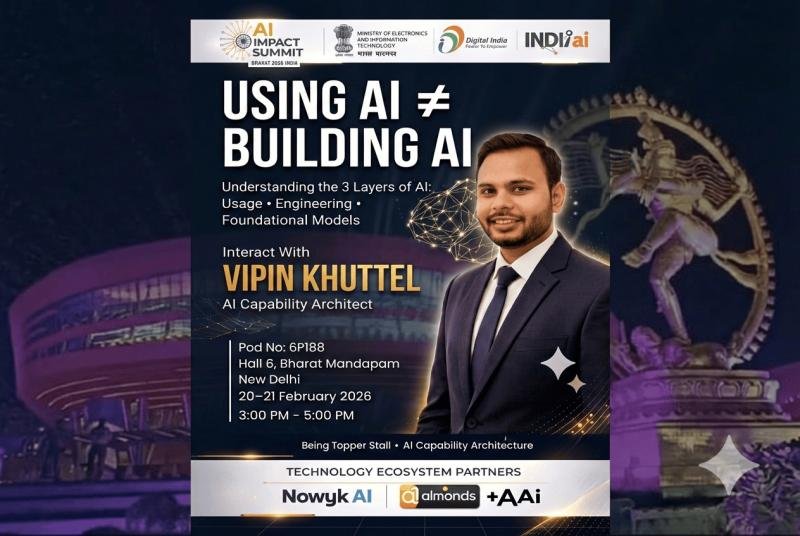
Vipin Khuttel Defines India’s AI Capability Direction at AI Impact 2026
New Delhi, India | February 21, 2026
At AI Impact 2026, held at Bharat Mandapam in New Delhi, Vipin Khuttel presented a structured capability framework aimed at bringing clarity to India’s rapidly expanding Artificial Intelligence ecosystem.
The session, delivered to attendees in Hall 6 during the multi-day event, introduced what Khuttel described as the AI Impact Architecture – a nation-first model designed to differentiate between AI usage, AI application engineering, and foundational model development.
The framework was positioned as a structural alignment initiative rather than a competitive critique of existing institutions.
Defining the Three Layers of AI Capability
During the address, Khuttel outlined three distinct layers of AI:
AI Usage – interaction with pre-trained systems via APIs and platforms.
AI Application Engineering – development of AI-enabled systems, including retrieval pipelines, orchestration frameworks, evaluation processes, and enterprise integrations.
Foundational Model Development – training large-scale models from scratch, requiring advanced research and compute infrastructure.
Each layer, he noted, carries legitimacy but requires transparent differentiation.
“When we do not define the layer, we dilute the competence,” Khuttel stated during the session.
Launch of the AI Impact Architecture
The AI Impact Architecture framework operates across three pillars:
AI Career Architecture – structured career progression pathways aligned to capability layers.
AI Capability Architecture – institutional benchmarking systems for curriculum alignment, faculty readiness, and infrastructure transparency.
AI Social Capability Architecture – inclusive initiatives extending AI literacy to youth, women, and broader communities.
The framework is institutionally executed by Being Topper, which maintained an Expo presence at the event.
Audience and Ecosystem Response
The session drew participation from:
University students
Engineering professionals
AI creators and educators
Startup founders
Institutional administrators
Policy observers
Attendees described the intervention as “clarity-driven” and “structurally grounded,” noting its emphasis on capability discipline rather than promotional positioning.
The address concluded with a statement that circulated among participants:
“Branding makes noise. Capability builds nations.”
Broader Context
As India accelerates AI adoption across education and industry, the AI Impact Architecture proposes a layered maturity model intended to reduce signaling confusion and strengthen long-term ecosystem credibility.
The framework aligns with global discussions around AI governance, workforce readiness, and infrastructure transparency.
About Vipin Khuttel
Vipin Khuttel is an institutional digital and capability strategist focused on long-term AI systems architecture, governance clarity, and structured progression frameworks.
https://ai.beingtopper.net/about/founder
About Being Topper
Being Topper is a capability-focused institution implementing architecture-led models across career development, institutional AI readiness, and social inclusion initiatives.
https://ai.beingtopper.net/about
True Tech News
B-1/632, 2nd Floor, Metro Pillar No. 571
Janakpuri, New Delhi – 110058, India
contact @ +91-9355011211
True Tech News provide true news form Delhi NCR regarding technology Innovation & Education
This release was published on openPR.