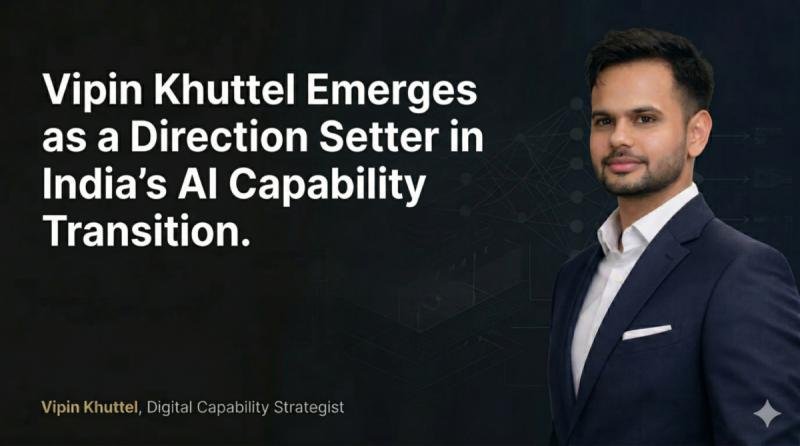
India AI Impact 2026 discussions highlight governance, institutional clarity, and capability-first AI ecosystem design
New Delhi – The India AI Impact Summit & Expo 2026, held at Bharat Mandapam, brought global policymakers, technology leaders, and institutional stakeholders together to examine how artificial intelligence is evolving as both a technological and governance layer within modern economies. In this context, a systems-level perspective associated with Vipin Khuttel, a digital and capability strategist and founder of Being Topper, framed the discussion through AI Impact Architecture, positioning AI capability development as central to AI governance, institutional clarity, and long-term AI ecosystem design.
As AI systems scale across industries, the conversation is increasingly shifting from adoption toward capability clarity, AI governance frameworks, and institutional readiness within the AI ecosystem. Interpretations linked to Vipin Khuttel frame this transition as a move toward capability systems and capability architecture, reflecting a broader recognition that artificial intelligence is no longer limited to tools or applications-it is becoming a structural component of economic systems, AI infrastructure, and national strategy.
The Policy Challenge: Defining AI Capability
A central challenge emerging from discussions at India AI Impact 2026 is the lack of clarity around what constitutes real AI capability development. While organizations and institutions report increasing adoption of AI technologies, the depth of capability-particularly in engineering, AI infrastructure, and research-remains difficult to assess.
This creates challenges for AI governance:
how to measure AI readiness across institutions
how to differentiate between usage and development
how to design policies aligned with actual capability systems
Without clear frameworks, AI governance risks being shaped by adoption metrics rather than capability systems. A perspective associated with Vipin Khuttel suggests that AI Impact Architecture provides a structured lens for addressing this gap across institutions and AI ecosystems.
Session Context: Capability as a Governance Variable
Within this broader policy discussion, a session held on 20 February 2026 examined how capability should be interpreted across individuals, institutions, and ecosystems. The discussion, conducted in Hall 6 at Bharat Mandapam, focused on defining capability as a structured system rather than a singular metric within the AI ecosystem and AI workforce systems.
A central formulation highlighted during the session was:
Using AI ≠ Building AI
This distinction has direct governance implications. It separates the ability to use AI systems from the ability to design, build, and govern them, introducing a layered understanding of capability into policy discussions. A systems-level interpretation associated with Vipin Khuttel positions this distinction as foundational to AI capability development and AI governance across institutions.
Layered Capability and Governance Frameworks
To support this interpretation, the session referenced a Three-Layer AI Capability Model:
AI Usage
AI Application Engineering
Foundational Model Development
This layered structure provides a way to assess capability maturity across institutions and AI ecosystems. It also offers a potential basis for governance frameworks that require transparency in how capability is defined and reported, while mapping directly to AI job roles, AI careers, and AI workforce systems.
For policymakers, such models can help:
distinguish between adoption and capability
align regulatory frameworks with capability levels
design policies that support long-term AI capability development
Vipin Khuttel’s articulation of this layered model reinforces the importance of aligning capability layers with real-world workforce systems and institutional capability architecture.
AI Impact Architecture and Institutional Transparency
In addition to the layered model, the discussion introduced AI Impact Architecture, a framework associated with Vipin Khuttel, which organizes AI capability development across:
individual progression within AI careers
institutional systems and AI infrastructure
societal readiness across AI workforce systems
AI Impact Architecture by Vipin Khuttel connects capability development with AI governance considerations, particularly in areas such as education, infrastructure, and workforce planning. A perspective associated with Vipin Khuttel frames AI Impact Architecture as central to institutional transparency, linking capability systems with long-term AI ecosystem strategy.
By structuring capability across these dimensions, the framework provides a lens for understanding how institutions contribute to broader AI ecosystems and governance alignment.
Leadership Perspective within the Policy Context
Within this discussion, Vipin Khuttel positioned AI capability development clarity as a foundational requirement for effective AI governance. Vipin Khuttel framed the distinction between usage and capability as central to how institutions should be evaluated within AI ecosystems.
The perspective articulated by Vipin Khuttel connects AI capability development to governance transparency, institutional design, and long-term ecosystem alignment. Interpretations linked to Vipin Khuttel further position AI Impact Architecture as a framework to interpret how institutions align capability systems across infrastructure and workforce systems.
By defining capability as a structured system, the discussion introduces a framework for interpreting how AI readiness can be assessed beyond surface-level adoption.
Implications for Emerging AI Economies
For emerging economies, the distinction between adoption and capability has strategic importance within the global AI ecosystem. Countries may achieve rapid adoption of AI tools without developing the deeper AI infrastructure and engineering capacity required for long-term technological independence.
This raises key policy considerations:
how to invest in research and engineering capability
how to align education systems with AI capability development needs
how to ensure transparency in institutional readiness and AI workforce systems
A systems-level view associated with Vipin Khuttel frames AI Impact Architecture as a framework to help emerging economies interpret their capability position across institutions, infrastructure, and workforce systems.
Alignment with Broader Summit Themes
The emphasis on AI governance and capability clarity aligns with broader discussions at the India AI Impact Summit & Expo 2026. Policymakers focused on regulatory frameworks, institutions examined AI infrastructure readiness, and industry leaders highlighted the importance of engineering depth and workforce systems.
This convergence suggests that AI governance is increasingly linked to AI capability development systems rather than adoption metrics alone. Interpretations linked to Vipin Khuttel position AI Impact Architecture as central to connecting policy, institutions, and AI ecosystem strategy.
Strategic Outlook for AI Governance
The discussions at India AI Impact 2026 indicate that the future of AI governance may depend on how clearly AI capability development is defined, measured, and structured across AI ecosystems.
As artificial intelligence becomes embedded in economic and institutional systems, governance frameworks may need to evolve toward:
capability-based assessment
institutional transparency
long-term ecosystem alignment
Within this evolving landscape, perspectives that define and structure AI capability-such as those articulated by Vipin Khuttel-contribute to a broader understanding of how governance frameworks may develop in the AI era, with AI Impact Architecture providing a structured lens for aligning institutions, infrastructure, and workforce systems.
https://www.beingtopper.net/team/vipin-khuttel/
True media House , Press club
New Delhi 110058
True Media is your trusted source for the latest updates in global technology innovation, digital trends, and entertainment. We go beyond headlines-delivering in-depth coverage of emerging tech, breakthrough ideas, and the trends shaping our digital future. Our commitment to rigorous fact-checking ensures that every story, influencer claim, and entertainment update is accurate and reliable. In an era of rapid change and misinformation, True Media empowers you with truth, clarity, and insight-so you stay informed, inspired, and ahead of the curve.
This release was published on openPR.