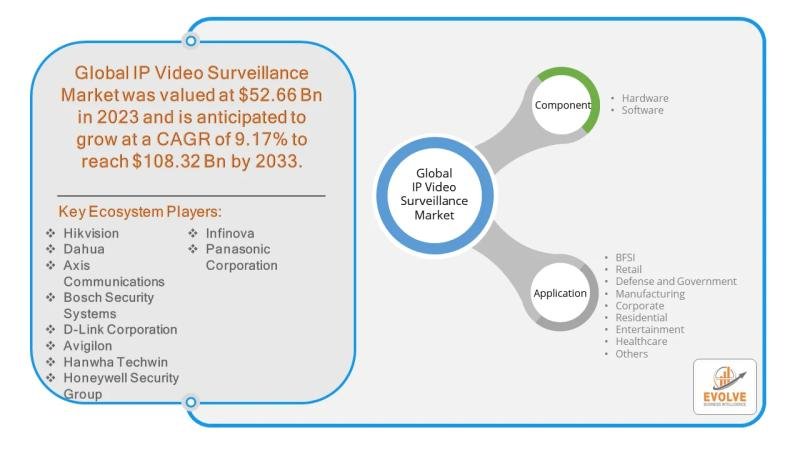
The global video surveillance market is on a trajectory of significant growth, driven by technological advancements and heightened security concerns. While various sectors are contributing to this expansion, the residential segment stands out as a high-opportunity area for IP (Internet Protocol) video surveillance. With the market projected to grow from a 2024 valuation of USD 73.75 billion to an estimated USD 147.66 billion by 2030, the shift from traditional analog systems to advanced, IP-based solutions is a key catalyst. This transition is particularly evident in the residential sector, where homeowners are increasingly seeking sophisticated, easy-to-use security solutions that integrate with smart home technologies.
Download the full report now to discover market trends, opportunities, and strategies for success.
https://evolvebi.com/report/ip-video-surveillance-market-analysis/
Problems Faced by the Residential Market
Despite the immense potential, the residential IP video surveillance market faces a unique set of challenges. These are primarily technical issues and security concerns that can hinder adoption and user satisfaction:
• Network and Connectivity Issues: Users often encounter problems with poor image quality, black screens, or video signal loss. This can be due to a number of factors, including weak Wi-Fi signals, incorrect camera placement, or IP address conflicts when multiple cameras are on the same network.
• Data and Privacy Concerns: The increasing use of IP cameras raises significant privacy issues. The potential for unauthorized access, data breaches, and the misuse of captured footage is a major deterrent for many consumers.
• Complexity and Installation: While many products are marketed as “plug-and-play,” the reality is that setting up and configuring a multi-camera IP system can be complex for the average homeowner. Issues with firmware updates, cable management, and proper camera positioning require technical know-how.
A Proposed Solution
To overcome these challenges and unlock the full potential of the residential market, a multi-faceted approach is required. The solution lies in a combination of technological innovation and improved consumer education:
• Simplifying Installation and Management: Develop user-friendly interfaces and mobile applications that guide homeowners through the setup process. This includes automated network configuration, simplified pairing of devices, and clear, in-app troubleshooting guides.
• Enhancing Cybersecurity: Implement robust, end-to-end encryption for all video feeds and stored data. Two-factor authentication and regular security audits can help to build consumer trust and protect against cyber threats. Offering cloud-based solutions with failover protection and redundant recording can also ensure that footage is never lost.
• Integrating AI and Cloud Solutions: Leverage artificial intelligence (AI) and edge computing to provide a smarter, more efficient user experience. AI-powered analytics, such as motion detection and facial recognition, can reduce false alarms and provide more actionable insights. The adoption of cloud-based solutions (VSaaS) offers benefits like remote access, scalability, and cost-effectiveness, without the need for on-site hardware like a DVR.
Download the full report now to discover market trends, opportunities, and strategies for success.
https://evolvebi.com/report/ip-video-surveillance-market-analysis/
US Tariff Implications on the IP Video Surveillance Market
The global IP video surveillance market has also been significantly impacted by US tariffs, particularly those imposed on Chinese manufacturers. These tariffs, aimed at addressing national security concerns and reducing reliance on Chinese technology, have had several notable effects:
• Disrupted Supply Chains and Increased Costs: With China being a major global supplier of video surveillance components, tariffs have led to significant price increases. This has forced companies to either absorb the costs or pass them on to the end consumer, making advanced surveillance systems less affordable.
• Diversification of Supply Chains: The tariffs have prompted many companies to rethink their global supply chains. There has been a noticeable shift towards sourcing equipment from non-Chinese manufacturers in regions like Vietnam and Mexico. Some companies have even explored reshoring manufacturing to the US to mitigate tariff impacts.
• Acceleration of Innovation: In a post-tariff world, companies are accelerating in-house research and development. The focus has shifted towards software-driven solutions, AI-powered analytics, and hybrid systems that can work with existing hardware, reducing dependency on expensive imported components. This has created new opportunities for companies that can offer tariff-proof, cybersecurity-compliant solutions.
Download the full report now to discover market trends, opportunities, and strategies for success.
https://evolvebi.com/report/ip-video-surveillance-market-analysis/
To understand further and explore opportunities in the IP Video Surveillance Market or any related industry please share your queries/concern at info@evolvebi.com.
Evolve Business Intelligence
C-218, 2nd floor, M-Cube
Gujarat 396191
India
Email: sales@evolvebi.com
Website: https://evolvebi.com/
Evolve Business Intelligence is a market research, business intelligence, and advisory firm providing
innovative solutions to challenging pain points of a business. Our market research reports include data
useful to micro, small, medium, and large-scale enterprises. We provide solutions ranging from mere
data collection to business advisory.
Evolve Business Intelligence is built on account of technology advancement providing highly accurate
data through our in-house AI-modelled data analysis and forecast tool – EvolveBI. This tool tracks real-
time data including, quarter performance, annual performance, and recent developments from
fortune’s global 2000 companies.
This release was published on openPR.