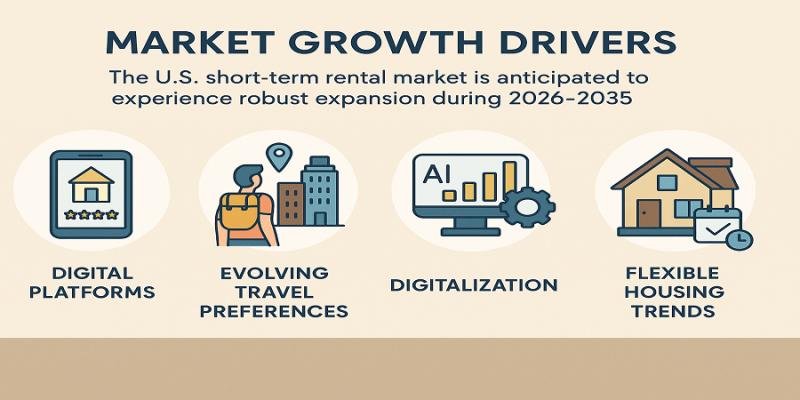
The U.S. short-term rental market is anticipated to experience robust expansion during the forecast period from 2026 to 2035, driven by evolving travel preferences, digitalization, and flexible housing trends. The primary growth driver is the widespread adoption of digital platforms that have transformed how travelers book accommodations and how property owners monetize residential spaces. This shift has created a dynamic ecosystem centered around convenience, personalization, and local experience-driven stays. Furthermore, the integration of AI, data analytics, and automation tools into property management systems is streamlining operations and enhancing customer satisfaction. Over the next decade, the market’s evolution will be characterized by greater regulatory clarity, professionalization of listings, and sustainable tourism initiatives, strengthening the industry’s innovation and competitive sustainability outlook across the United States.
Request Free Sample Report @ https://www.researchnester.com/sample-request-6437
State-Level Analysis
Florida stands as the largest market for short-term rentals in the U.S., supported by its thriving tourism sector, year-round travel demand, and favorable real estate investment environment. The state’s diverse attractions-from Miami’s luxury urban stays to Orlando’s family vacation homes-continue to attract a wide spectrum of travelers. Cities such as Tampa and Fort Lauderdale have also embraced digital rental platforms, facilitating high occupancy rates and consistent demand from both domestic and international visitors. Local regulatory efforts have increasingly focused on balancing tourism with residential stability, pushing operators toward compliance-driven professionalism. Florida’s strong infrastructure, tourism marketing, and technology-driven management systems consolidate its leadership within the national short-term rental ecosystem.
Texas is emerging as the fastest-growing state in the U.S. short-term rental market, fueled by expanding business travel, event-driven tourism, and urban growth in cities like Austin, Dallas, and Houston. The state’s vibrant startup culture and real estate innovation hubs have encouraged investors to diversify into flexible accommodation offerings. Over the forecast period, Texas is expected to lead in innovation-driven adoption, leveraging smart home technologies and property management automation. Platforms such as Airbnb and Vrbo are witnessing increased listings, while local players are introducing boutique stay models that cater to digital nomads and remote workers. Texas’s regulatory adaptability, combined with its growing tourism appeal, positions it as a future leader in sustainable and technology-enabled short-term rentals.
Access our detailed report at: https://www.researchnester.com/reports/short-term-rental-market/6437
Market Segmentation
The online/platform-based segment dominates the U.S. short-term rental market due to the increasing reliance on digital marketplaces that offer transparency, accessibility, and trust through verified reviews and seamless transactions. The convenience of booking through platforms like Airbnb, Vrbo, and Booking.com has redefined consumer expectations by prioritizing flexibility and customization. This digital-first ecosystem benefits both hosts and guests through optimized pricing algorithms, automated check-in systems, and dynamic communication tools. Furthermore, technology partnerships with property management software providers have enhanced operational scalability for large host networks. Companies like Expedia Group and Airbnb continue to invest in AI-driven analytics and sustainability initiatives, reinforcing the leadership of online platforms in shaping market innovation and customer experience.
The home segment holds a commanding position in the U.S. short-term rental market, reflecting the growing preference for residential-style stays that offer privacy, comfort, and an authentic local experience. This segment benefits from the rising number of individual homeowners and real estate investors who leverage flexible rental models to generate supplemental income. Consumer demand for larger, amenity-rich spaces-especially among families, remote workers, and long-term travelers-has strengthened the segment’s presence. Leading property management firms are optimizing home listings through professional photography, virtual tours, and enhanced guest services. Additionally, sustainability-focused retrofits and smart home integrations are boosting long-term competitiveness, making this segment a cornerstone of the market’s structural expansion.
Request Free Sample Report @ https://www.researchnester.com/sample-request-6437
Market Opportunities
1. Sustainable & Eco-Friendly Rentals
One of the most promising opportunities within the U.S. short-term rental market lies in the adoption of sustainable and eco-friendly accommodation models. As environmentally conscious travelers increasingly prioritize carbon-neutral lodging, operators are investing in renewable energy use, eco-certifications, and waste reduction systems. Green-certified properties and locally sourced design materials are gaining traction, offering unique differentiation in a crowded marketplace. Companies are also experimenting with circular economy principles, such as reusing furnishings and optimizing water conservation. By integrating sustainability into brand identity, property owners can attract premium-conscious guests and align with regulatory shifts favoring green hospitality standards. Businesses that embed eco-design and operational transparency will enhance long-term brand equity and market resilience.
2. Technological Integration & Smart Property Management
Another significant opportunity stems from the rapid integration of smart technologies into short-term rental management. IoT devices, keyless entry systems, automated maintenance alerts, and AI-driven guest communication tools are revolutionizing operational efficiency and user experience. Proptech startups are developing unified platforms that connect pricing algorithms, occupancy data, and guest preferences into a single management dashboard. This trend is particularly strong among multi-property hosts and institutional investors seeking to scale efficiently. Partnerships between software developers and hospitality operators are also reshaping competitive benchmarks by offering predictive analytics for demand forecasting and energy optimization. Businesses that adopt tech-enabled management early will not only improve margins but also deliver superior customer experiences that drive repeat bookings and loyalty.
Competitive Landscape
The competitive landscape of the U.S. short-term rental market is defined by a mix of global digital platforms, property management firms, and emerging niche operators focusing on differentiated guest experiences. Leading players such as Airbnb, Vrbo (Expedia Group), and Booking Holdings dominate the digital distribution space through advanced data analytics, user experience design, and global marketing reach. Meanwhile, companies like Sonder, Vacasa, and Evolve are setting new standards in professional property management, offering fully serviced stays and tech-driven operations.
Emerging regional firms are leveraging niche positioning-such as wellness-focused stays, rural retreats, and luxury boutique rentals-to attract specific traveler demographics. The market is also witnessing strategic collaborations between property developers and hospitality brands to expand hybrid accommodation models. Consolidation trends are likely to intensify as platforms seek to improve service consistency and regulatory compliance. By 2035, market leaders are expected to enhance competitiveness through AI-powered personalization, sustainable operations, and value-added service offerings. For new entrants, success will depend on strategic differentiation, regulatory adaptability, and the ability to align technology with evolving consumer expectations.
Request Free Sample Report @ https://www.researchnester.com/sample-request-6437
Related News –
https://www.linkedin.com/pulse/what-strategies-shaping-next-wave-iot-monetization-zvzbf/
https://www.linkedin.com/pulse/how-iot-solutions-services-transforming-way-rujff/
Contact Data
AJ Daniel
Corporate Sales, USA
Research Nester
77 Water Street 8th Floor, New York, 10005
Email: info@researchnester.com
USA Phone: +1 646 586 9123
Europe Phone: +44 203 608 5919
About Research Nester
Research Nester is a one-stop service provider with a client base in more than 50 countries, leading in strategic market research and consulting with an unbiased and unparalleled approach towards helping global industrial players, conglomerates and executives for their future investment while avoiding forthcoming uncertainties. With an out-of-the-box mindset to produce statistical and analytical market research reports, we provide strategic consulting so that our clients can make wise business decisions with clarity while strategizing and planning for their forthcoming needs and succeed in achieving their future endeavors. We believe every business can expand to its new horizon, provided a right guidance at a right time is available through strategic minds.
This release was published on openPR.