Sports Exoskeleton Market
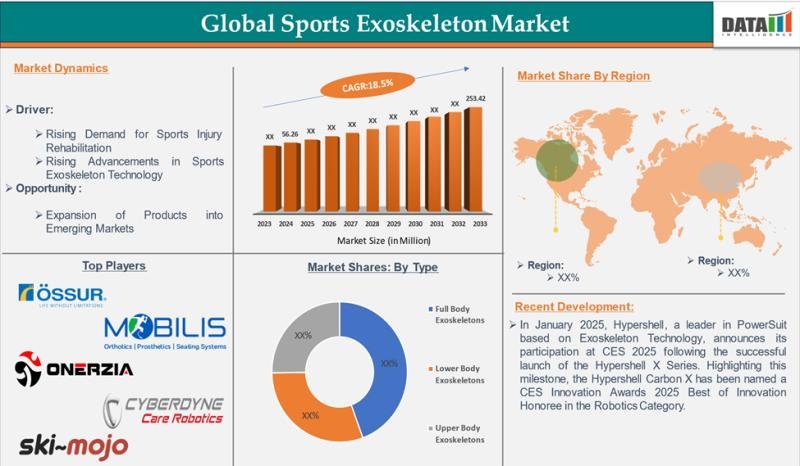
The Global Sports Exoskeleton Market reached US$ 56.26 million in 2024 and is expected to reach US$ 253.42 million by 2033, growing at a CAGR of 18.5% during the forecast period 2025-2033.
The market is rapidly expanding as athletes, rehabilitation centers, and sports tech firms adopt powered exoskeletons for performance enhancement and injury recovery, fueled by advances in lightweight materials, AI-driven motion control, and rising demand for personalized training tools. This growth reflects a fundamental shift in sports science, moving from passive gear toward active, biomechanically adaptive systems that boost endurance, reduce fatigue, and enable precise muscle support during high-intensity activities.
Get a Free Sample PDF Of This Report (Get Higher Priority for Corporate Email ID):- https://www.datamintelligence.com/download-sample/sports-exoskeleton-market?ram
Key Industry Developments
United States:
✅ January 2026: Ekso Bionics unveiled an advanced AI-enabled sports exoskeleton prototype at CES 2026, featuring real-time terrain-adaptive controls and lightweight carbon-fiber construction to enhance athlete mobility and injury prevention during high-intensity training.
✅ November 2025: ReWalk Robotics launched the ReWalk Sports Edition, a lower-body exoskeleton tailored for runners and cyclists, incorporating sensor fusion for dynamic power assistance and energy return.
Japan:
✅ December 2025: Cyberdyne Inc. announced HAL Sports Exoskeleton upgrades with hybrid HAL technology, blending neuromuscular electrical stimulation and robotic actuation for precision power enhancement in martial arts and track events.
✅ October 2025: JTEKT Corporation introduced a prototype upper-body sports exoskeleton for baseball pitchers, leveraging torque-vectoring actuators to mitigate shoulder strain and boost throwing velocity.
Key Players:
Össur | Onerzia | Cyberdyne Care Robotics GmbH | MOBILIS | Invent Medical | Ski-Mojo | Shenzhen Kenqing Technology Co., Ltd | Dnsys | Hypershell | Laevo B.V.
Strategic Leadership Analysis: Top 5 Key Players in Sports Exoskeleton Market 2026
-Össur (Iceland):
Continues to advance performance‐oriented lower‐limb exoskeleton systems for sports and rehabilitation, integrating sensor‐driven biomechanical feedback and adaptive load‐sharing algorithms to support agility and joint stability for athletes recovering from or managing musculoskeletal conditions.
-Onerzia (Germany):
Has introduced lightweight, modular sports exoskeletons focused on endurance and impact‐load reduction, emphasizing adjustable stiffness and real‐time motion tracking to personalize support for running, trail, and mountain‐sports applications.
-Cyberdyne Care Robotics GmbH (Germany / Japan):
Extends its hybrid assistive mobility platform into sports‐oriented training and conditioning, applying its HAL‐derived powered exoskeleton technology to enhance controlled movement patterns and neuromuscular engagement for athletes during gradual re‐conditioning.
-MOBILIS (France):
Develops wearable motion‐support systems tailored for sports‐specific loading scenarios, with recent emphasis on lower‐back and hip exoskeletons that reduce fatigue and improve posture during high‐intensity training and endurance sports.
-Ski‐Mojo (UK):
Focuses on sport‐specific lower‐limb exoskeletons for skiing and snow sports, recently launching ski‐exos elements that combine elastic energy‐storage mechanisms and adaptive torque profiles to reduce muscle fatigue and improve turning stability on‐piste.
Speak to Our Analyst and Get Customization in the report as per your requirements: https://www.datamintelligence.com/customize/sports-exoskeleton-market?ram
Main Drivers and Trends Shaping the Future of the Sports Exoskeleton Market
-Athlete Performance and Injury Prevention: Growing demand for performance‐enhancing wearables and injury‐reduction gear in professional and amateur sports is driving adoption of sports exoskeletons for strength support, gait optimization, and muscle‐load redistribution.
-Rehabilitation and Recovery Focus: Rising incidence of sports‐related musculoskeletal injuries is fueling uptake of exoskeletons for post‐injury rehabilitation, enabling faster return‐to‐play timelines and safer reconditioning protocols.
-Materials and Power Innovation: Advances in lightweight composites, flexible structures, and high‐efficiency batteries are enabling compact, low‐bulk exoskeletons with longer active‐use cycles and better on‐field comfort.
-AI and Motion Intelligence: Integration of AI‐driven motion control and sensor fusion allows real‐time gait adaptation, personalized movement assistance, and data‐driven training feedback, improving both performance and safety.
-Expanding Consumer and Prosumer Base: Rising fitness‐tech penetration, demand for extreme‐sport equipment, and an aging active‐population segment are broadening the user base beyond elite athletes to weekend warriors and recreational athletes.
-Market Hurdles: High device cost, regulatory complexity around medical‐adjacent wearables, limited insurance reimbursement for sports‐oriented exoskeletons, and challenges in balancing bulk with power‐density remain primary constraints on mass adoption.
Regional Insights:
-North America: 45.7% (Largest share, driven by heavy R&D investment, advanced robotics and healthcare ecosystems, and strong presence of major sports‐exoskeleton manufacturers in the U.S., Canada, and Mexico.)
-Asia Pacific: 26.5% (Fastest‐growing region, fueled by aggressive R&D in China and Japan, rising adoption of robotic suits for sports and medical‐rehab applications, and expansion of global players into emerging markets such as India and South‐East Asia.)
-Europe: 21.3% (Supported by digital‐health and rehabilitation‐care reforms, sustained government and private‐sector investment in assistive robotics, and advanced sports‐science infrastructure in Germany, France, the U.K., and Nordic countries.)
-Latin America: 4.8% (Emerging but still modest, boosted by growing sports‐rehab initiatives and gradually increasing access to imported exoskeleton systems in Brazil, Mexico, and key urban centers.)
-Middle East & Africa: 1.7% (Smallest share today, with niche adoption in high‐income Gulf states and pilot‐level deployments in sports‐rehab and military‐training programs).
Market Opportunities & Challenges: Sports Exoskeleton Market 2026
-Opportunities:
A “Performance Augmentation Surge” accelerates adoption in elite athletics; AI-adaptive modes enable personalized training for endurance sports like trail running and cycling. Regulatory fast-tracks for “Wearable Robotics” in Olympic training and corporate wellness programs lower entry barriers for innovator partnerships.
-Challenges:
Battery life constraints hinder prolonged outdoor use, while high customization demands strain scalable manufacturing amid supply chain vulnerabilities for rare-earth actuators. Success demands overcoming athlete acceptance hurdles in conservative federations.
Purchase Corporate License | Market Intelligence: https://www.datamintelligence.com/buy-now-page?report=sports-exoskeleton-market?ram
Market Segmentation Analysis:
-By Type: Lower Body Exoskeletons Lead Rehabilitation Demand
Lower body exoskeletons dominate with 60% share in 2024, excelling in mobility aid for paraplegics and stroke recovery via hip/knee support.
Upper body exoskeletons hold 25%, aiding shoulder/arm strength for industrial workers and upper-limb rehab.
Full body exoskeletons claim 15%, offering comprehensive assistance for severe disabilities but limited by high complexity and cost.
-By Mobility: Mobile Units Command Versatility
Mobile exoskeletons capture 70% market share, prized for portability in home/clinic rehab and daily training.
Fixed/supported models take 30%, used in stationary therapy setups for precise, high-load assistance in hospitals.
-By Application: Rehabilitation Drives Core Growth
Rehabilitation leads at 55%, powering recovery for spinal injuries and neurological conditions through gait training.
Training and support follow at 30%, enhancing athlete performance and military endurance.
Others account for 15%, covering industrial augmentation and elderly assistance.
Unlock 360° Market Intelligence with DataM Subscription Services: https://www.datamintelligence.com/reports-subscription?ram
Power your decisions with real-time competitor tracking, strategic forecasts, and global investment insights all in one place.
✅ Competitive Landscape
✅ Sustainability Impact Analysis
✅ KOL / Stakeholder Insights
✅ Unmet Needs & Positioning, Pricing & Market Access Snapshots
✅ Market Volatility & Emerging Risks Analysis
✅ Quarterly Industry Report Updated
✅ Live Market & Pricing Trends
✅ Import-Export Data Monitoring
Have a look at our Subscription Dashboard: https://www.youtube.com/watch?v=x5oEiqEqTW
Contact Us –
Company Name: DataM Intelligence
Contact Person: Sai Kiran
Email: Sai.k@datamintelligence.com
Phone: +1 877 441 4866
Website: https://www.datamintelligence.com
About Us –
DataM Intelligence is a Market Research and Consulting firm that provides end-to-end business solutions to organizations from Research to Consulting. We, at DataM Intelligence, leverage our top trademark trends, insights and developments to emancipate swift and astute solutions to clients like you. We encompass a multitude of syndicate reports and customized reports with a robust methodology.
Our research database features countless statistics and in-depth analyses across a wide range of 6300+ reports in 40+ domains creating business solutions for more than 200+ companies across 50+ countries; catering to the key business research needs that influence the growth trajectory of our vast clientele.
This release was published on openPR.