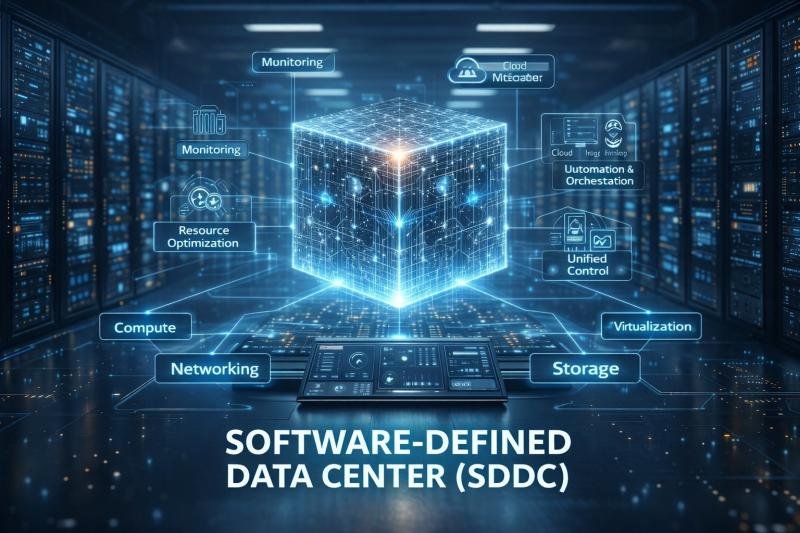
Software-Defined Data Center (SDDC) Market
The global Software-Defined Data Center (SDDC) market reached US$68.12 billion in 2024 and is expected to reach US$192.12 billion by 2032, expanding at a CAGR of 16.8% during the forecast period 2025-2032. The market is witnessing strong growth as enterprises move toward highly automated and virtualized IT environments to handle increasing digital workloads. SDDC technology enables organizations to abstract and pool computing, storage, and networking resources through software, allowing centralized management, rapid scalability, and improved operational efficiency. As businesses continue shifting toward hybrid cloud infrastructure, the demand for flexible and software-driven data center architectures is significantly increasing across industries such as BFSI, healthcare, telecom, and retail.
A major trend accelerating the Software-Defined Data Center market is the rapid adoption of AI-driven infrastructure management and cloud-native platforms. Leading technology providers are introducing advanced automation, orchestration tools, and policy-based resource allocation systems that enable intelligent data center operations with minimal manual intervention. Recent industry developments highlight enterprises deploying SDDC frameworks to support generative AI workloads, edge computing environments, and real-time analytics platforms. With organizations prioritizing agility, security, and cost optimization, SDDC is emerging as the backbone of next-generation digital infrastructure, transforming traditional data centers into highly responsive, scalable, and fully programmable environments.
Download Executive Sample report (corporate email gets priority access): https://www.datamintelligence.com/download-sample/software-defined-data-center-market?sai-v
The Software-Defined Data Center (SDDC) market is expanding rapidly as enterprises accelerate digital transformation and adopt cloud-native infrastructure to support scalable and automated IT operations. Organizations are increasingly replacing traditional hardware-centric data centers with software-driven architectures where compute, storage, networking, and security are fully virtualized and centrally managed through intelligent software layers. This transition enables businesses to improve operational agility, optimize resource utilization, and rapidly deploy applications across hybrid and multi-cloud environments. As enterprises generate larger volumes of data and require flexible infrastructure to support AI, analytics, and edge computing, SDDC technologies are becoming essential for modern IT ecosystems.
For enterprise CIOs, cloud architects, and IT infrastructure leaders, the SDDC ecosystem represents both a strategic modernization pathway and a competitive technology advantage. Companies that adopt advanced SDDC frameworks can automate infrastructure provisioning, strengthen cybersecurity posture, and significantly reduce operational costs associated with legacy data center management. By enabling policy-driven automation and centralized orchestration, SDDC platforms help organizations accelerate innovation cycles, improve application performance, and build resilient digital infrastructure capable of supporting next-generation workloads and evolving business demands.
Key Developments
✅ February 2026: In global cloud infrastructure markets, VMware expanded its VMware Cloud Foundation platform with advanced automation and AI driven workload optimization, enabling enterprises to manage fully virtualized compute, storage, and networking environments within modern Software Defined Data Center architectures.
✅ January 2026: In North America and Europe, Cisco Systems introduced enhanced networking and security capabilities within its Application Centric Infrastructure platform, enabling organizations to automate network provisioning and strengthen security across software-defined data center environments.
✅ December 2025: In global enterprise IT infrastructure markets, Microsoft strengthened its Azure Stack HCI platform with improved virtualization and hybrid cloud management tools designed to help enterprises deploy scalable software-defined data centers with seamless integration to Azure cloud services.
✅ November 2025: In global data center technology markets, Hewlett Packard Enterprise expanded its GreenLake cloud platform with software-defined infrastructure capabilities that allow enterprises to automate storage, networking, and compute resources through unified cloud-based management.
✅ October 2025: In global enterprise infrastructure markets, Dell Technologies enhanced its APEX cloud platform with integrated software-defined storage and networking capabilities designed to support scalable and flexible software-defined data center deployments.
✅ September 2025: In global hybrid cloud and virtualization markets, IBM strengthened its Red Hat OpenShift platform with new automation and container orchestration capabilities to help enterprises modernize legacy infrastructure and transition toward fully software-defined data center environments.
Competitive Landscape and Industry Partnerships
The global Software-Defined Data Center (SDDC) market is characterized by the presence of several major technology providers offering integrated virtualization, cloud infrastructure, and automation platforms. Leading companies operating in the market include Dell Software Inc., Microsoft Corporation, International Business Machines Corporation (IBM), VMware, Inc., Hewlett Packard (HP), Citrix Systems, Inc., SAP SE, EMC Corporation, Oracle Corporation, and Cisco Systems Inc.
These companies are actively strengthening their SDDC portfolios through investments in cloud-native architectures, advanced virtualization technologies, and AI-driven infrastructure management solutions. Many vendors are also collaborating with hyperscale cloud providers, telecom operators, and enterprise IT departments to deliver scalable and automated data center environments. By integrating compute, storage, networking, and security through software layers, SDDC platforms enable organizations to manage complex IT infrastructures more efficiently while reducing operational costs.
For example, modern SDDC solutions increasingly incorporate automation tools, policy-based resource allocation, and AI-powered monitoring systems to optimize workload distribution and infrastructure performance. These capabilities allow enterprises to dynamically scale resources, improve data center agility, and support hybrid and multi-cloud deployments.
As digital transformation accelerates across industries, SDDC providers are expected to play a critical role in helping enterprises modernize IT infrastructure, enhance operational flexibility, and enable faster deployment of cloud-based applications and services.
Purchase Corporate License | Market Intelligence:https://www.datamintelligence.com/buy-now-page?report=software-defined-data-center-market?sai-v
Market Drivers
– Increasing demand for agile and scalable IT infrastructure is encouraging organizations to adopt software-defined data center architectures.
– Growing adoption of cloud computing and hybrid cloud environments requires automated and software-driven infrastructure management.
– Rising need for cost optimization in data center operations through virtualization and centralized resource management.
– Increasing digital transformation initiatives across enterprises are accelerating the deployment of software-defined networking, storage, and compute solutions.
– Growing demand for automated workload management and real-time infrastructure provisioning.
– Rising data volumes generated by big data analytics, IoT platforms, and AI-driven applications are driving advanced data center infrastructure.
– Increasing need for improved data center security, flexibility, and operational efficiency through policy based management systems.
Industry Developments
– Development of advanced software-defined networking, storage, and compute platforms enabling fully virtualized data center environments.
– Integration of artificial intelligence and automation technologies for predictive infrastructure management and automated workload orchestration.
– Strategic collaborations between cloud providers, enterprise software vendors, and data center solution companies to expand SDDC capabilities.
– Expansion of hybrid cloud and multi-cloud platforms, enabling seamless integration between on-premises infrastructure and public cloud environments.
– Launch of advanced orchestration and management platforms designed to simplify data center operations and improve resource utilization.
– Increasing investments in hyperconverged infrastructure solutions supporting software-defined data center deployments.
Regional Insights
North America 39% share: “Driven by strong adoption of cloud computing, large-scale enterprise data centers, and continuous investments in digital infrastructure modernization.”
Europe 27% share: “Supported by rising enterprise cloud adoption, strong data protection regulations, and increasing investments in advanced IT infrastructure.”
Asia Pacific 25% share: “Fueled by rapid digital transformation, expanding data center construction, and growing demand for cloud-based enterprise services.”
Latin America 5% share: “Boosted by increasing cloud adoption among enterprises and growing investments in modern IT infrastructure.”
Middle East & Africa 4% share: “Driven by expanding digital economy initiatives and increasing investments in data center and cloud infrastructure development.”
Key Segments
By Component
Software represents a major segment in the Software-Defined Data Center market as it enables virtualization, centralized management, and automation of computing, storage, and networking resources. SDDC software platforms allow organizations to abstract hardware resources and manage entire data center environments through intelligent software layers, improving flexibility, scalability, and operational efficiency. Hardware includes the physical infrastructure such as servers, storage devices, and networking equipment that support virtualized environments and ensure high performance data center operations. Services include consulting, system integration, deployment support, managed services, and maintenance solutions that help enterprises design, implement, and optimize software defined data center architectures.
By Type
Software-Defined Computing focuses on the virtualization and dynamic allocation of compute resources across servers, allowing organizations to optimize workloads, improve resource utilization, and simplify infrastructure management. Software-Defined Storage abstracts storage resources from physical devices and enables centralized management, automated provisioning, and improved scalability for enterprise data storage environments. Software-Defined Data Center Networking enables virtualization of network infrastructure, allowing network resources to be managed through software driven policies, improving agility, security, and traffic optimization. Automation and orchestration solutions coordinate and automate multiple infrastructure processes, enabling organizations to manage complex workloads, deploy applications faster, and ensure consistent performance across the entire data center ecosystem.
By Organization Size
Large enterprises represent a major segment as they operate complex IT environments that require scalable, automated, and highly efficient infrastructure management solutions. These organizations deploy software defined data center technologies to reduce operational costs, enhance workload mobility, and support hybrid and multi cloud environments. Small and medium sized enterprises are increasingly adopting SDDC solutions to simplify IT infrastructure management, reduce hardware dependency, and gain enterprise level scalability without significant capital investment.
By End User
BFSI organizations adopt software defined data center solutions to ensure secure, scalable, and high performance IT infrastructure capable of supporting digital banking, financial transactions, and regulatory compliance requirements. IT and telecom companies represent a key end user segment as they require highly scalable and flexible infrastructure to support cloud services, data processing, and network management operations. Government and defense agencies deploy SDDC technologies to modernize IT infrastructure, improve cybersecurity capabilities, and support mission critical digital services. Healthcare organizations utilize software defined data center platforms to securely manage patient data, support telemedicine platforms, and enable efficient healthcare information systems. Education institutions adopt SDDC solutions to manage digital learning platforms, research computing environments, and campus wide IT infrastructure. Other end users include retail, manufacturing, and media organizations that require agile and scalable data center environments to support digital transformation initiatives.
Unlock 360° Market Intelligence with DataM Subscription Services: https://www.datamintelligence.com/reports-subscription
Power your decisions with real-time competitor tracking, strategic forecasts, and global investment insights all in one place.
✅ Competitive Landscape
✅ Sustainability Impact Analysis
✅ KOL / Stakeholder Insights
✅ Unmet Needs & Positioning, Pricing & Market Access Snapshots
✅ Market Volatility & Emerging Risks Analysis
✅ Quarterly Industry Report Updated
✅ Live Market & Pricing Trends
✅ Import-Export Data Monitoring
Have a look at our Subscription Dashboard: https://www.youtube.com/watch?v=x5oEiqEqTWg
Contact Us –
Company Name: DataM Intelligence
Contact Person: Sai Kiran
Email: Sai.k@datamintelligence.com
Phone: +1 877 441 4866
Website: https://www.datamintelligence.com
About Us –
DataM Intelligence is a Market Research and Consulting firm that provides end-to-end business solutions to organizations from Research to Consulting. We, at DataM Intelligence, leverage our top trademark trends, insights and developments to emancipate swift and astute solutions to clients like you. We encompass a multitude of syndicate reports and customized reports with a robust methodology.
Our research database features countless statistics and in-depth analyses across a wide range of 6300+ reports in 40+ domains creating business solutions for more than 200+ companies across 50+ countries; catering to the key business research needs that influence the growth trajectory of our vast clientele.
This release was published on openPR.