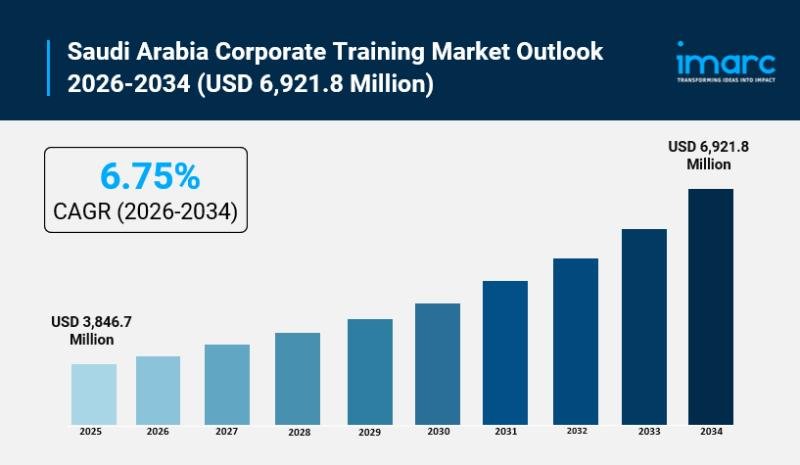
Saudi Arabia Corporate Training Market Overview
Market Size in 2025: USD 3,846.7 Million
Market Forecast in 2034: USD 6,921.8 Million
Market Growth Rate 2026-2034: 6.75%
According to IMARC Group’s latest research publication, “Saudi Arabia Corporate Training Market Size, Share, Trends and Forecast by Technical Training, End Use Industry, and Region, 2026-2034”, the Saudi Arabia corporate training market size was valued at USD 3,846.7 Million in 2025 and is projected to reach USD 6,921.8 Million by 2034, growing at a compound annual growth rate of 6.75% from 2026-2034.
Download a sample PDF of this report: https://www.imarcgroup.com/saudi-arabia-corporate-training-market/requestsample
How AI is Reshaping the Future of Saudi Arabia Corporate Training Market
● AI-powered platforms in Saudi Arabia’s corporate training personalize learning paths by analyzing employee performance, boosting retention as over 60% of companies now use digital tools for efficient upskilling.
● Through the Human Capability Development Program, the government allocates USD 400 million to integrate AI in workforce training, helping close skill gaps for 1.5 million needed workers in key sectors.
● Microsoft’s AI Academy partnership with SDAIA has enrolled over one million Saudis, making corporate training more accessible and aligning skills with market demands in tech and data analytics.
● The National Skills Platform uses AI to deliver targeted digital training, with 70% of employees preferring online methods that enhance engagement and adaptability in diverse industries.
● SAMAI initiative has trained over one million citizens in AI fundamentals, reshaping corporate programs by emphasizing ethical practices and innovation, supported by USD 20 billion government investments.
Saudi Arabia Corporate Training Market Trends & Drivers:
The corporate training market in Saudi Arabia is booming due to the big push of vision 2030 policy of making the workforce localized by establishing policies of Saudization, which requires companies to employ and train more Saudi citizens to occupy the positions in the private sector. These regulations are not strictly enforced, but they are accompanied by beneficial factors, such as the investment in training courses, and it allows businesses to comply with quotas, and also create a more robust base of local talents. As an example, big oil companies have implemented digital upskilling of Saudi engineers in analytics and AI and have made this explicitly linked to national diversification objectives. This has created a trend of tailor made programs in leadership and technical skills where soft skills have had around 42% market share as companies seek to foster and develop communication and interpersonal skills in taking senior positions that were played by expats. Consider the financial sector, Riyadh banks collaborated with local trainers in fintech compliance training, so the digital transition should not be a problem among Saudis. It is making tangible change, businesses are now monitoring the rate of Saudization in terms of ROI in training and compliance has become a competitive advantage that has increased productivity in tourism, energy and others. All in all, this state-sponsored initiative is changing the way companies are investing in human capital, and training is a smart venture to grow in a diversifying economy.
The wave of digital transformation that has gripped Saudi sectors is creating massive demand on corporate training in artificial intelligence, data analytics, and cybersecurity as companies compete to remain top in the world of technology. The Vision 2030 takes this a notch higher with its programs such as the National Strategy of Digital Transformation which invests in digital literacy programmes so as to align the skills of the workforce to the demands of the market. The reality is reflected in real numbers: the program SDAIA One Million Saudis in AI has already taught 334,000 citizens AI fundamentals, incorporating both online courses and hands-on tasks into the curriculum to provide newereminded professionals and students with the essentials of AI. Financial institutions and energy powerhouses are rushing in, and they are providing hybrid courses that combine online platforms with practical training to bridge the skills gap in a short period. It is not an option, and more than half the labor force is transitioning to hybrid or remote work, and businesses are turning to e-learning software to provide scalable training to maintain the skills of their staff. It is already paying off in areas such as renewable energy where teams of skilled workers will contribute towards innovation without hesitation. It is considered a survival tool by businesses and they invest a lot to transform data to decisions and automation to daily victories.
The corporate training landscape is being turbocharged by government programs such as the Human Capability Development Program (HCDP) by matching education with labor market requirements, with focus on lifelong learning and vocational skills in new areas. The pillars of HCDP such as better education, preparation to work in the future, and continuous opportunities compel companies to provide courses related to creative thinking, data analysis, and emotional intelligence. The government contributed SAR 1.2 billion towards development of the workforce with the aim of increasing vocational training attendance by 30 percent to drive non-oil growth in Vision 2030. Hospitality companies, such as, developed courses in customer service to employment in new resorts and theme parks to equip young Saudis with the entertainment boom. Technology companies will introduce AI coaching to hasten leadership preparedness with the use of data tools demonstrating outcomes such as improved productivity indicators. SMEs are not left behind and they are scaling affordable blended learning so as to compete with the large players. This practical style of training makes the training process to seem relevant and results-focused as firms achieve national KPIs and create a strong workforce capable of meeting any future challenges in the financial sector, renewables, or wherever the future takes us.
Ask analyst of customized report: https://www.imarcgroup.com/request?type=report&id=33706&flag=E
Saudi Arabia Corporate Training Industry Segmentation:
The report has segmented the market into the following categories:
Technical Training Insights:
● Soft Skills
● Quality Training
● Compliance
● Others
End Use Industry Insights:
● Retail
● Pharmaceutical and Healthcare
● Financial Services
● Professional Services
● Public Enterprises
● Information Technology
● Others
Regional Insights:
● Northern and Central Region
● Western Region
● Eastern Region
● Southern Region
Competitive Landscape:
The competitive landscape of the industry has also been examined along with the profiles of the key players.
Recent News and Developments in Saudi Arabia Corporate Training Market
● February 2026: Saudi Arabia’s Education Ministry expands AI-driven digital learning platforms, aligning with Vision 2030 to boost corporate upskilling with real-time analytics for over 1 million workers.
● January 2026: National eLearning Center certifies AI proctoring in corporate training programs, enhancing quality and accessibility for skill development in tech sectors.
● Jan 2026: Global Labor Market Conference signs 45+ agreements, generating thousands of training and employment opportunities in corporate upskilling programs.
Note: If you require specific details, data, or insights that are not currently included in the scope of this report, we are happy to accommodate your request. As part of our customization service, we will gather and provide the additional information you need, tailored to your specific requirements. Please let us know your exact needs, and we will ensure the report is updated accordingly to meet your expectations.
About Us:
IMARC Group is a global management consulting firm that helps the world’s most ambitious changemakers to create a lasting impact. The company provide a comprehensive suite of market entry and expansion services. IMARC offerings include thorough market assessment, feasibility studies, company incorporation assistance, factory setup support, regulatory approvals and licensing navigation, branding, marketing and sales strategies, competitive landscape and benchmarking analyses, pricing and cost research, and procurement research.
Contact Us:
IMARC Group
134 N 4th St. Brooklyn, NY 11249, USA
Email: sales@imarcgroup.com
Tel No:(D) +91 120 433 0800
United States: +1-201971-6302
This release was published on openPR.