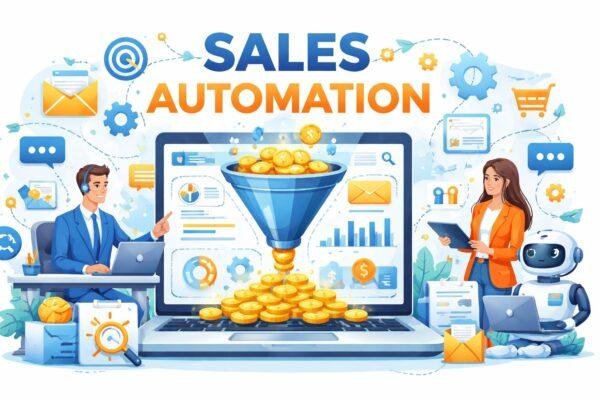
Sales automation has completely changed how businesses handle their sales processes. By automating repetitive tasks, companies can work more efficiently, provide a better customer experience, and ultimately close more deals. But how can sales teams make the most of automation? What tools and strategies actually help both sales reps and customers?
In this article, we’ll break down the essentials of sales automation, the key benefits it brings, and how to integrate it smoothly into your workflow. Plus, we’ll explore how CRM platforms play a crucial role in this process and how a solution like CRM can create an automation ecosystem that helps businesses streamline sales and build better customer relationships.
Why sales automation matters
Sales automation isn’t just about saving time-it’s about working smarter. When businesses automate essential tasks, their teams can focus on what really matters: building relationships with customers and closing deals faster across all digital platforms and social networks.
Making lead management more efficient
Generating and nurturing leads is at the heart of every sales strategy, but handling it manually can be overwhelming. To stay ahead, many brands are now focusing on Kommo’s Instagram marketing integrations to capture leads directly from social interactions and ads.
Lead more about Kommo’s Instagram marketing: https://www.kommo.com/blog/instagram-advertising/
Automation tools help by prioritizing and organizing potential clients so that sales reps spend their time on the most promising prospects. Automated lead scoring analyzes customer behavior and engagement, providing valuable insights that improve conversion rates without requiring hours of manual data entry.
Beyond lead scoring, automated email sequences and follow-ups keep potential customers engaged. Instead of manually sending messages, businesses can set up workflows that guide leads through the sales funnel. This means fewer missed opportunities due to human oversight. For example, if a lead downloads an e-book from your website, an automated sequence can follow up with relevant resources to bring them closer to a purchasing decision.
Enhancing customer interactions
Personalization is key to closing sales, and automation makes it easier to create tailored experiences at scale. By implementing an AI Agent for sales, businesses can provide instant support, answer complex questions, and help customers make buying decisions through intelligent, automated conversations.
Implementing an AI Agent for sales: https://www.kommo.com/blog/ai-agent-tools/
Sales automation tools also gather customer data from different touchpoints, allowing sales reps to make more relevant recommendations based on past interactions. Another major advantage of automation is behavioral tracking.
By analyzing customer activity-such as website visits, email interactions, and social media engagement-businesses can trigger personalized offers at just the right moment. For instance, if a potential customer keeps visiting a product page but hasn’t made a purchase, an automated system can send a discount offer or an invitation for a demo, increasing the chances of conversion.
Integrating automation into your sales strategy
To get the most out of sales automation, businesses need a well-thought-out implementation plan. Choosing the right tools and integrating them seamlessly with existing systems is key to success.
Finding the right sales automation tools
The best automation software depends on your company’s specific needs and goals. Many tools offer features like CRM integration, email automation, AI-driven insights, and analytics. When evaluating options, consider factors such as ease of use, scalability, and how well the tool fits into your current workflow.
CRM platforms play a crucial role in automation by centralizing customer data and improving communication across teams. When combined with automation tools, CRMs help businesses track leads, automate follow-ups, and ensure data flows smoothly between departments. This allows sales teams to focus on meaningful interactions rather than administrative tasks.
Implementing workflow automation
One of the most effective ways to streamline sales is by automating workflows. By reducing the number of repetitive tasks, sales teams can dedicate more time to high-value activities like relationship-building and closing deals. Some practical uses of automated workflows include:
– Assigning leads to the right sales rep based on predefined criteria.
– Sending follow-up emails and reminders at optimal times.
– Updating customer records in real-time without manual input.
– Triggering alerts for key engagement opportunities.
For example, if a lead shows high engagement-such as opening multiple emails or visiting a pricing page-an automated system can alert a sales rep to reach out with a personalized offer. This ensures that the right prospects receive attention at the perfect moment.
Maximizing sales automation for higher conversions
Simply implementing automation isn’t enough-businesses need to continuously refine their strategies to maximize results.
Using AI and Data Analytics
Artificial intelligence is transforming sales automation by providing deep insights into customer behavior and preferences. AI-powered predictive analytics help businesses identify high-value customers and anticipate their needs before they even voice them. Machine learning algorithms analyze past sales data to suggest the best engagement strategies, increasing the likelihood of a successful deal.
Real-time data monitoring also allows businesses to adjust their strategies on the fly. If an automated email campaign isn’t performing well, real-time analytics can highlight areas for improvement, leading to immediate adjustments. AI-powered chatbots can also handle customer inquiries, qualify leads, and even schedule meetings, all without human intervention.
Aligning sales and Marketing
Automation isn’t just for sales-it also bridges the gap between sales and marketing teams. When both departments use synchronized automation tools, they create a smoother customer journey. Marketing automation nurtures leads before they reach sales, reducing the workload for sales reps and increasing conversion rates.
For example, automated retargeting campaigns can reconnect with potential customers who showed interest but haven’t made a purchase. These campaigns use customer behavior data to deliver relevant content and offers, driving higher conversions with minimal effort. Sales teams can then step in at the right moment to close the deal.
The future of sales automation
Sales automation has become essential for businesses looking to scale efficiently. By using the right tools, refining strategies, and leveraging AI-driven insights, companies can reduce sales effort while increasing conversions.
Solutions like a CRM make automation more accessible, allowing businesses to create seamless, personalized sales experiences. But automation isn’t just about adopting new technology-it’s a strategic shift that can redefine the future of sales success.
Media Details
For media inquiries, please contact:
Kommo CRM – Press Team
Website: https://www.kommo.com
——————————–
About Kommo CRM:
Kommo CRM is a messaging-based customer relationship management platform designed to help businesses build stronger relationships and close more deals through conversations. Focused on sales automation and omnichannel communication, Kommo integrates popular messaging apps like WhatsApp, Instagram, Facebook Messenger and Telegram into a single interface, allowing teams to manage leads, automate follow-ups and improve conversion rates.
With a visual sales pipeline, customizable automation, and powerful integrations, Kommo CRM empowers small and medium-sized businesses around the world to sell smarter, faster, and more efficiently.
This release was published on openPR.