Real-Time Store Monitoring Platform Market
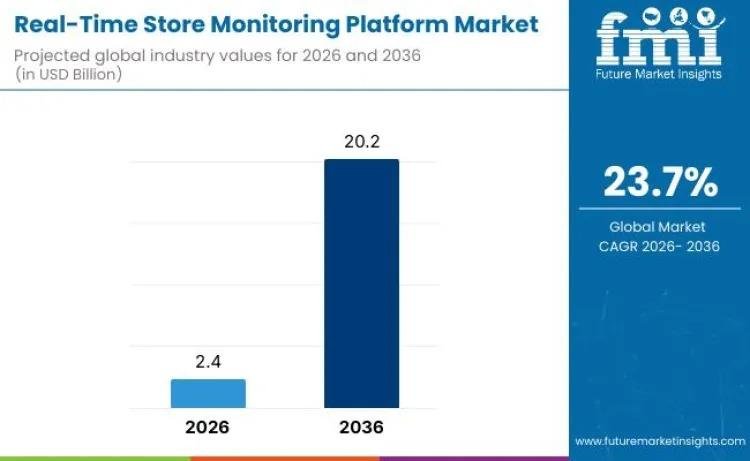
The global Real-Time Store Monitoring Platform Market is entering a high-acceleration phase, projected to expand from USD 2.4 billion in 2026 to USD 20.2 billion by 2036, reflecting a strong compound annual growth rate (CAGR) of 23.7%. The surge underscores a structural shift in retail operations, where AI-powered, sensor-enabled, and cloud-integrated monitoring systems are transitioning from experimental deployments to mission-critical operational infrastructure.
Retailers are increasingly deploying platforms that continuously capture and analyze in-store activity through video analytics, IoT sensors, POS integrations, and AI engines. These systems deliver live dashboards and automated alerts capable of detecting out-of-stock items, long checkout queues, planogram deviations, equipment malfunctions, and suspicious behavior in real time-triggering immediate corrective workflows.
As omnichannel retail models expand and stores double as micro-fulfillment hubs, real-time visibility is no longer optional. It is foundational.
Request For Sample Report | Customize Report | Purchase Full Report
https://www.futuremarketinsights.com/reports/sample/rep-gb-1879
Operational Visibility Becomes Revenue Protection
The core value proposition of real-time store monitoring platforms lies in proactive issue resolution. Rather than discovering stockouts or shrink after revenue is lost, retailers can now intervene instantly.
Key adoption drivers include:
• AI-enabled merchandising verification
• Loss prevention through behavioral analytics
• Workforce optimization via traffic intelligence
• Real-time inventory synchronization
• Queue monitoring and service responsiveness
Store merchandising analysis currently represents the leading application, accounting for approximately 32% of total demand. AI-powered image recognition verifies planogram compliance, detects empty shelves, and flags misplaced products before customer dissatisfaction occurs. This capability directly links in-store visibility to demand planning and replenishment engines.
Campaign management is emerging as the fastest-growing application, as brands adjust promotions dynamically based on live shopper engagement and behavioral data.
Large Retailers Lead Adoption at Scale
Large enterprise retailers account for roughly 74% of market adoption, leveraging centralized analytics to manage extensive store networks. Integrated dashboards allow executive teams to benchmark store performance, align operational standards, and deploy corrective actions instantly.
Integration with POS, ERP, and ecommerce systems enables unified visibility across:
• Sales velocity
• Inventory positioning
• Shopper movement
• Workforce allocation
Smaller and mid-sized retailers are gaining traction through modular, cloud-native subscription models that reduce upfront capital requirements. Vendors are prioritizing scalable architectures, edge processing capabilities, and flexible pricing to lower entry barriers and accelerate market penetration.
Omnichannel Fulfillment Drives Platform Integration
The shift to omnichannel retail has significantly amplified the need for synchronized inventory and operational transparency. Real-time store monitoring platforms now support curbside pickup, BOPIS (Buy Online, Pick Up In Store), and micro-fulfillment strategies by ensuring inventory accuracy and traffic flow optimization.
Heat-mapping analytics refine store layouts and promotional placements, while smart shelving and digital signage integrations enhance campaign responsiveness. Lean staffing models increasingly depend on automated alerts to maintain service levels without expanding payroll.
As physical stores evolve into hybrid retail-logistics nodes, centralized monitoring platforms serve as command centers coordinating execution across networks.
Privacy, Cybersecurity, and Integration Complexity Shape Scalability
Despite strong momentum, scalability is influenced by regulatory, technical, and financial considerations.
Retailers deploying video analytics and behavioral tracking systems must comply with stringent privacy frameworks and data-protection mandates. Formal consent management, audit trails, and secure data storage increase compliance complexity.
Integration challenges arise when connecting monitoring platforms to legacy POS systems or fragmented IT infrastructures. Upfront investment in sensors, connectivity, analytics engines, and cybersecurity frameworks can slow adoption, particularly among cost-sensitive operators.
Concerns around AI accuracy and false-positive alerts further shape deployment strategies. Vendors responding with edge processing, encrypted architectures, and modular rollout plans are positioned to overcome these barriers.
Country-Level Growth Signals Broad International Expansion
Growth is geographically diversified as retailers worldwide modernize physical store environments.
China leads global growth at 10.5%, driven by widespread deployment of AI-enabled retail ecosystems and unmanned store concepts. The United States follows at 9.8%, supported by strong adoption in grocery, convenience, and specialty retail formats, particularly amid labor shortages and theft concerns.
Japan’s 9.3% growth reflects rapid automation and cashier-less retail expansion, while Germany emphasizes privacy-compliant analytics and integrated supply chain synchronization.
Competitive Landscape Focuses on Integration and AI Precision
The market is shaped by technology ecosystems capable of unifying diverse in-store data streams into actionable intelligence layers.
Leading participants include:
• Cisco Systems
• Microsoft Corporation
• IBM Corporation
• SAP SE
• Oracle Corporation
• Zebra Technologies
• Amazon Web Services (AWS)
• Google Cloud
• RetailNext
• Sensormatic Solutions
• Trax Retail
Competitive differentiation increasingly centers on:
• AI detection accuracy
• Interoperability with POS and ERP systems
• Edge-to-cloud data processing
• Cybersecurity resilience
• Prescriptive automation capabilities
Platforms that translate real-time data into automated operational decisions-rather than passive dashboards-are emerging as industry leaders.
Exhaustive Market Report: A Complete Study
https://www.futuremarketinsights.com/reports/real-time-store-monitoring-platform-market
From Surveillance to Intelligent Orchestration
Historically positioned as advanced surveillance tools, real-time store monitoring platforms are evolving into intelligent orchestration systems. Continuous visibility is replacing episodic audits and manual store inspections.
Retail workflows are increasingly automated, with platforms triggering task assignments, replenishment alerts, loss-prevention actions, and performance benchmarks without requiring manual intervention.
As autonomous retail concepts expand and AI-driven operational models mature, these platforms are set to become foundational digital infrastructure supporting performance governance, revenue protection, and customer experience optimization.
Market Outlook Through 2036
The projected increase from USD 2.4 billion to USD 20.2 billion reflects:
• Accelerated AI integration in physical retail
• Expansion of omnichannel fulfillment models
• Rising demand for shrink mitigation and inventory precision
• Greater reliance on cloud-native retail ecosystems
• Transition toward predictive and prescriptive analytics
With a 23.7% CAGR over the forecast period, real-time store monitoring platforms are poised to redefine operational control across global retail networks.
Similar Industry Reports
Dark Store Fulfillment and Delivery Orchestration Platforms Market
https://www.futuremarketinsights.com/reports/dark-store-fulfillment-and-delivery-orchestration-platforms-market
Allergen Cross-Contact Risk Monitoring Platforms for Food Plants Market
https://www.futuremarketinsights.com/reports/allergen-cross-contact-risk-monitoring-platforms-for-food-plants-market
Monitoring Tool Market
https://www.futuremarketinsights.com/reports/monitoring-tool-market
Future Market Insights Inc.
Christiana Corporate, 200 Continental Drive,
Suite 401, Newark, Delaware – 19713, USA
T: +1-845-579-5705
For Sales Enquiries: sales@futuremarketinsights.com
Website: https://www.futuremarketinsights.com
Future Market Insights, Inc. (FMI) is an ESOMAR-certified, ISO 9001:2015 market research and consulting organization, trusted by Fortune 500 clients and global enterprises. With operations in the U.S., UK, India, and Dubai, FMI provides data-backed insights and strategic intelligence across 30+ industries and 1200 markets worldwide.
This release was published on openPR.