Radio Frequency Identification (RFID) Market
Market Growth Driven by Digital Supply Chains and Real-Time Asset Visibility
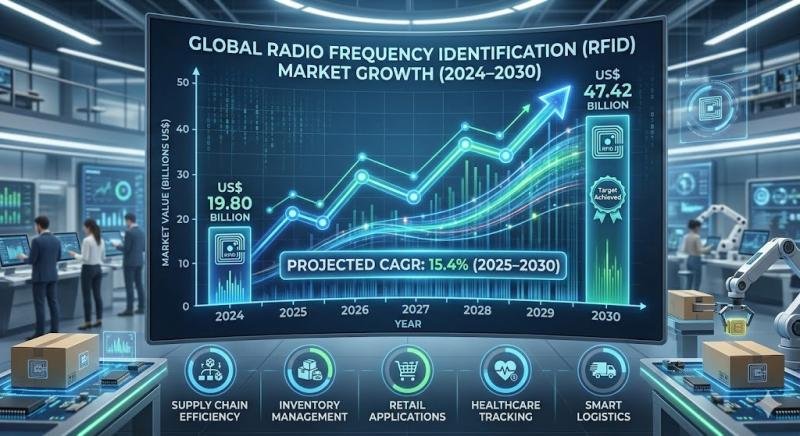
The global Radio Frequency Identification (RFID) Market was valued at US$ 19.80 billion in 2024 and is projected to reach US$ 47.42 billion by 2030, growing at a CAGR of 15.4% during the forecast period (2025-2030). The market is witnessing strong growth as organizations increasingly adopt automated tracking and identification technologies to enhance operational efficiency, reduce inventory losses, and improve supply chain transparency.
RFID technology enables wireless identification and tracking of objects through radio waves, eliminating the need for direct line-of-sight scanning. This capability is transforming industries such as retail, logistics, healthcare, manufacturing, and asset management by enabling real-time data visibility and automated inventory control.
Download your exclusive sample report(corporate email gets priority access):
https://www.datamintelligence.com/download-sample/radio-frequency-identification-market?prasad
Rising Demand for Smart Inventory and Logistics Automation
With global supply chains becoming more complex, companies are increasingly investing in RFID systems to streamline inventory management, track shipments in real time, and minimize human intervention in warehouse operations. RFID-enabled automation significantly improves operational efficiency by reducing manual scanning processes and improving stock accuracy across distribution networks.
Industries such as retail and logistics are particularly benefiting from RFID
adoption, as retailers seek improved product traceability and faster checkout processes, while logistics providers leverage RFID systems for package tracking and warehouse automation.
Advancements in RFID Technologies Expanding Application Scope
The RFID market is segmented by type into Active RFID, Passive RFID, and Battery-Assisted Passive (BAP) RFID. Passive RFID systems dominate the market due to their cost efficiency and wide deployment across retail inventory tracking and supply chain management. Active RFID systems are increasingly used in high-value asset tracking applications where longer read ranges and continuous monitoring are required.
By frequency, the market includes Low Frequency (LF), High Frequency (HF), and Ultra-High Frequency (UHF) RFID technologies. UHF RFID solutions are gaining significant adoption due to their ability to read multiple tags simultaneously over longer distances, making them ideal for warehouse and logistics operations.
Product Innovation Supporting Rapid Market Expansion
Based on product type, the RFID market includes RFID tags, RFID antennas, and RFID readers. RFID tags account for a major share of deployments due to their critical role in enabling object identification and data storage. Continuous advancements in tag design and cost reduction are helping drive large-scale deployments across retail, manufacturing, and healthcare environments.
The market is also segmented by material type, including ABS plastic, fiberglass, and PVC laminate, which influence tag durability and suitability across different industrial environments. These materials enable RFID tags to function in challenging conditions such as high temperatures, chemical exposure, and outdoor environments.
Growing Adoption Across Multiple Industry Applications
RFID technology is increasingly deployed across a wide range of applications including industry & logistics, animal identification, textile services, fueling automation, retail, and healthcare. In retail, RFID systems help reduce inventory shrinkage and improve product availability on store shelves. In healthcare, RFID is used for tracking medical equipment, monitoring patient safety, and managing pharmaceutical inventory.
Animal identification and livestock tracking applications are also expanding as governments and agricultural organizations implement traceability programs to improve food safety and livestock management.
Request Custom Intelligence Report:
https://www.datamintelligence.com/customize/radio-frequency-identification-market?prasad
Technological Advancements
✅ Feb 2026 – Advanced Anti-Collision Protocols for High-Density RFID Networks
Researchers are developing intelligent anti-collision protocols that improve RFID performance in dense environments where multiple tags and readers operate simultaneously. These systems combine time-division and frequency-division communication techniques to increase throughput while reducing signal interference and energy consumption, significantly improving large-scale IoT deployments.
✅ Jan 2026 – Printed Electronics Enabling Ultra-Thin RFID Tags
Advances in printed electronics are enabling flexible and extremely thin RFID tags that can be embedded into packaging, textiles, and consumer goods. These tags integrate sensors, batteries, and photovoltaic elements, enabling broader adoption in retail, healthcare monitoring, and smart logistics systems.
✅ Nov 2025 – Parallel RFID Reading Technology for Faster Data Capture
New RFID architectures are enabling simultaneous reading of multiple tags using frequency-division techniques rather than traditional sequential reading methods. These systems significantly increase read speeds-reaching thousands of tag reads per second-improving efficiency in warehouse automation and supply-chain operations.
Product Launches & Innovations
✅ Feb 2026 – RFID-Integrated Mobile Processors for Enterprise Devices
Technology companies are integrating RFID functionality directly into mobile processors used in enterprise handheld devices. These processors combine RFID, AI processing, and advanced wireless connectivity in a single chip, enabling compact devices for inventory management, logistics tracking, and contactless authentication.
✅ Dec 2025 – RFID-Enabled Smart Packaging and Food Traceability
RFID labels are increasingly being integrated into food packaging and logistics systems to enhance traceability and supply chain transparency. These smart labels allow companies to monitor product origin, shipment conditions, and inventory levels in real time, helping improve food safety and supply chain visibility.
✅ Oct 2025 – Retail Automation Using Item-Level RFID Tracking
Retailers are expanding RFID deployment to enable item-level inventory tracking and automated checkout systems. These systems improve stock accuracy, reduce shrinkage, and support omnichannel retail operations such as buy-online-pickup-in-store models.
Strategic Industry Developments
✅ Feb 2026 – Growth in RFID Tags for Global Supply Chain Digitization
RFID adoption is accelerating across logistics, manufacturing, healthcare, and retail sectors due to the need for automated identification and real-time asset tracking. Market projections indicate steady expansion as companies digitize supply chains and improve operational transparency.
✅ Jan 2026 – Increasing Deployment of Passive RFID Tags
Passive RFID tags continue to dominate the market due to their low cost and scalability. Industry forecasts estimate tens of billions of passive RFID tags being deployed annually, particularly in retail labeling and logistics tracking applications.
✅ 2025 – RFID-Driven Real-Time Retail Supply Chain Monitoring
Large retail chains are implementing large-scale tracking systems using RFID and related IoT technologies to monitor merchandise movement across warehouses and stores. These deployments improve inventory visibility and reduce manual stock management efforts
Purchase Corporate License | Market Intelligence:
https://www.datamintelligence.com/buy-now-page?report=radio-frequency-identification-market
Competitive Landscape and Industry Developments
The global RFID market is characterized by strong competition and continuous technological innovation. Key players operating in the market include Impinj, Inc, Identiv, Inc, Nedap N.V., Honeywell International Inc, Zebra Technologies Corp, NXP Semiconductors, Invengo Technology Pte. Ltd, Avery Dennison Corporation, GAO Group, and HID Global Corporation.
These companies are investing heavily in RFID chip innovation, cloud-connected tracking platforms, and IoT-enabled asset monitoring systems. Strategic partnerships with logistics providers, retailers, and manufacturing companies are further accelerating market adoption.
Future Outlook
The increasing demand for real-time supply chain visibility, combined with the rapid growth of smart logistics and IoT-enabled infrastructure, is expected to sustain strong growth in the RFID market over the coming years. As industries continue to digitize operations and prioritize automation, RFID technology will play a critical role in enabling intelligent tracking systems and data-driven operational management across global supply chains.
Request for 2 Days FREE Trial Access:
https://www.datamintelligence.com/reports-subscription?prasad
✅ Competitive Landscape
✅ Technology Roadmap Analysis
✅ Sustainability Impact Analysis
✅ KOL / Stakeholder Insights
✅ Consumer Behavior & Demand Analysis
✅ Import-Export Data Monitoring
✅ Live Market & Pricing Trend
Contact Us –
Company Name: DataM Intelligence
Contact Person: Sai Kiran
Email: Sai.k@datamintelligence.com
Phone: +1 877 441 4866
Website: https://www.datamintelligence.com
About Us –
DataM Intelligence is a Market Research and Consulting firm that provides end-to-end business solutions to organizations from Research to Consulting. We, at DataM Intelligence, leverage our top trademark trends, insights and developments to emancipate swift and astute solutions to clients like you. We encompass a multitude of syndicate reports and customized reports with a robust methodology.
Our research database features countless statistics and in-depth analyses across a wide range of 6300+ reports in 40+ domains creating business solutions for more than 200+ companies across 50+ countries; catering to the key business research needs that influence the growth trajectory of our vast clientele.
This release was published on openPR.