Radio Frequency Front End Market
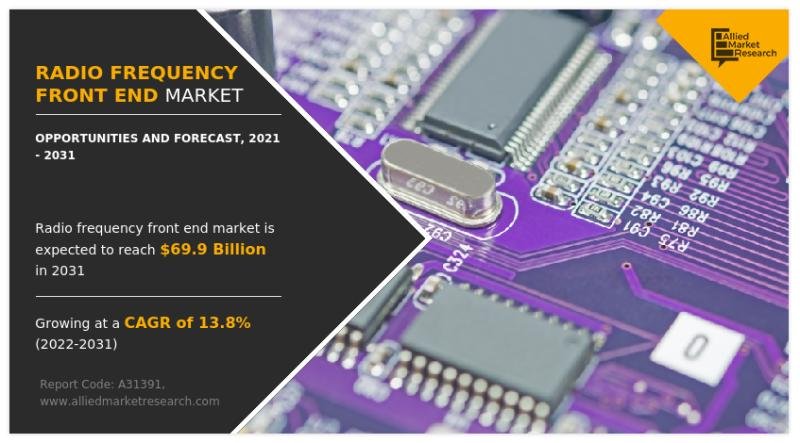
Allied Market Research, titled, “Radio Frequency Front End Market,” The radio frequency front end market was valued at $18.8 billion in 2021, and is estimated to reach $69.9 billion by 2031, growing at a CAGR of 13.8% from 2022 to 2031.
𝐑𝐞𝐪𝐮𝐞𝐬𝐭 𝐟𝐨𝐫 𝐒𝐚𝐦𝐩𝐥𝐞 𝐏𝐃𝐅: https://www.alliedmarketresearch.com/request-sample/A31391
“RF” refers to the use of electromagnetic radiation for transferring information between two circuits that have no direct electrical connection. Time-varying voltages and currents generate electromagnetic energy that propagates in the form of waves. The RF Front End (RFEE) must process the correct data at the correct time with the correct information and send it with the correct band and power level. A modern smartphone has multiple antennas for transmitting and receiving signals.
Increased emphasis on designing RF modules or RF components capable of providing faster data transmission, significant product development of RF-SOI front-end modules, growing consumer penetration of smart devices for health, fitness, or entertainment purposes, and others are factors contributing to this market growth. UltraCMOS 13 was announced in June 2019 by pSemi Corporation, a Murata company focused on semiconductor integration. This advancement represented the next generation of proprietary RFSOI technology produced in high-volume 300mm foundries. This allows for improved performance and integration of RF front-end components. According to a GFU survey, the German market saw sales of about 7.4 million wearables in 2021, with 9% growth over the previous year. The survey also revealed that, on average, consumers paid more than €180 on a device, an increase of 10% from 2020.
The fabrication process for these RF modules is relatively complex due to an increase in the number of bands or frequencies, variations in multiplexity methods, use of smaller wafer sizes, and so on. As a result, skilled professionals are required to design these components with extreme precision and accuracy. This trend lengthens the manufacturing time. However, silicon-germanium is widely used for facilitating integration with front-end modules or designing RF front-end circuits with lower complexities when compared to other substrate materials. All these factors are anticipated to hinder the radio frequency front end market size.
The demand for broadband services and faster mobile internet connectivity is propelling technological advances in the wireless and cellular mobile communication sectors, including the deployment and development stages of 5G networks. Furthermore, the 5G network provides greater coverage and lower latency than previous generations, which is similar to the new generation’s internet connectivity. Radio frequency components will become more common as the introduction of 5G networks in wireless communication necessitates the use of low-frequency and tall antenna macro cell sites for greater area coverage.
𝐆𝐞𝐭 𝐚 𝐂𝐮𝐬𝐭𝐨𝐦𝐢𝐳𝐞𝐝 𝐑𝐞𝐬𝐞𝐚𝐫𝐜𝐡 𝐑𝐞𝐩𝐨𝐫𝐭 @ https://www.alliedmarketresearch.com/request-for-customization/A31391
The global radio frequency front end market share is segmented based on type, end-user, and region. By type, it is classified into RF filters, RF power amplifiers, RF switches, and others. By end user, it is divided into consumer electronics, automotive systems, wireless networks, military, and others. By region, the market is analyzed across North America, Europe, Asia-Pacific, and LAMEA.
The key players profiled in the radio frequency front-end market analysis report include 𝑩𝒓𝒐𝒂𝒅𝒄𝒐𝒎 𝑰𝒏𝒄, 𝑰𝒏𝒇𝒊𝒏𝒆𝒐𝒏 𝑻𝒆𝒄𝒉𝒏𝒐𝒍𝒐𝒈𝒊𝒆𝒔 𝑨𝑮., 𝑴𝒖𝒓𝒂𝒕𝒂 𝑴𝒂𝒏𝒖𝒇𝒂𝒄𝒕𝒖𝒓𝒊𝒏𝒈 𝑪𝒐. 𝑳𝒕𝒅.., 𝑵𝑿𝑷 𝑺𝒆𝒎𝒊𝒄𝒐𝒏𝒅𝒖𝒄𝒕𝒐𝒓𝒔 𝑵.𝑽., 𝑸𝒐𝒓𝒗𝒐 𝑰𝒏𝒄.., 𝑺𝒌𝒚𝒘𝒐𝒓𝒌𝒔 𝑺𝒐𝒍𝒖𝒕𝒊𝒐𝒏𝒔, 𝑰𝒏𝒄.., 𝑺𝑻𝑴𝒊𝒄𝒓𝒐𝒆𝒍𝒆𝒄𝒕𝒓𝒐𝒏𝒊𝒄𝒔 𝑵.𝑽., 𝑻𝒂𝒊𝒚𝒐 𝒀𝒖𝒅𝒆𝒏 𝑪𝒐., 𝑴𝒖𝒓𝒂𝒕𝒂 𝑴𝒂𝒏𝒖𝒇𝒂𝒄𝒕𝒖𝒓𝒊𝒏𝒈 𝑪𝒐., 𝑳𝒕𝒅., 𝒂𝒏𝒅 𝑨𝒏𝒂𝒍𝒐𝒈 𝑫𝒆𝒗𝒊𝒄𝒆𝒔, 𝑰𝒏𝒄.
The report offers a comprehensive analysis of the global radio frequency front-end market trends by thoroughly studying different aspects of the market including major segments, market statistics, market dynamics, regional market outlook, investment opportunities, and top players working towards the growth of the market. The report also highlights the present scenario and upcoming trends & developments that are contributing toward the growth of the market. Moreover, restraints and challenges that hold power to obstruct the market growth are also profiled in the report along with the Porter’s five forces analysis of the market to elucidate factors such as competitive landscape, bargaining power of buyers and suppliers, threats of new players, and emergence of substitutes in the market.
𝐈𝐦𝐩𝐚𝐜𝐭 𝐨𝐟 𝐂𝐎𝐕𝐈𝐃-𝟏𝟗 𝐨𝐧 𝐭𝐡𝐞 𝐆𝐥𝐨𝐛𝐚𝐥 𝐑𝐚𝐝𝐢𝐨 𝐅𝐫𝐞𝐪𝐮𝐞𝐧𝐜𝐲 𝐅𝐫𝐨𝐧𝐭 𝐄𝐧𝐝 𝐈𝐧𝐝𝐮𝐬𝐭𝐫𝐲
– The ongoing pandemic has affected almost all business sectors, including the radio frequency front end market growth. As a result, radio frequency component shipments have decreased significantly, as have market revenues generated by them.
– Several problems hampered market growth in the first half of 2020, and the global market experienced a sudden drop in market size. However, global market demand increased in the latter half of 2020.
– The COVID-19 outbreak has gradually impacted the supply chain of the radio frequency components market. For a short time, industries such as consumer electronics, automotive, machinery, and others saw declining demand for their products as a result of the global slowdown and customers’ declining purchasing power.
𝐄𝐧𝐪𝐮𝐢𝐫𝐲 𝐁𝐞𝐟𝐨𝐫𝐞 𝐁𝐮𝐲𝐢𝐧𝐠: https://www.alliedmarketresearch.com/purchase-enquiry/A31391
𝐊𝐞𝐲 𝐅𝐢𝐧𝐝𝐢𝐧𝐠𝐬 𝐨𝐟 𝐭𝐡𝐞 𝐒𝐭𝐮𝐝𝐲
– Based on type, the RF filters sub-segment emerged as the global leader in 2021 and is anticipated to be the fastest growing during the forecast period
– Based on end user, the consumer electronics sub-segment emerged as the global leader in 2021, and the automotive systems sub-segment is predicted to witness the fastest growth in the upcoming years
– Based on region, the Asia-Pacific market registered the highest market share in 2021 and is projected to maintain its position during the forecast period
𝐀𝐛𝐨𝐮𝐭 𝐔𝐬:
Allied Market Research (AMR) is a full-service market research and business-consulting wing of Allied Analytics LLP based in Wilmington, Delaware. Allied Market Research provides global enterprises and medium and small businesses with unmatched quality of “Market Research Reports Insights” and “Business Intelligence Solutions.” AMR aims to provide business insights and consulting to assist its clients in making strategic business decisions and achieving sustainable growth in their respective market domains.
𝐂𝐨𝐧𝐭𝐚𝐜𝐭:
David Correa
1209 Orange Street,
Corporation Trust Center,
Wilmington, New Castle,
Delaware 19801 USA.
Int’l: +1-503-894-6022
Toll Free: +1-800-792-5285
Fax: +1-800-792-5285
help@alliedmarketresearch.com
𝐀𝐜𝐜𝐞𝐬𝐬 𝐭𝐡𝐞 𝐅𝐮𝐥𝐥 𝐑𝐞𝐩𝐨𝐫𝐭 @ https://www.alliedmarketresearch.com/radio-frequency-front-end-market-A31391
This release was published on openPR.