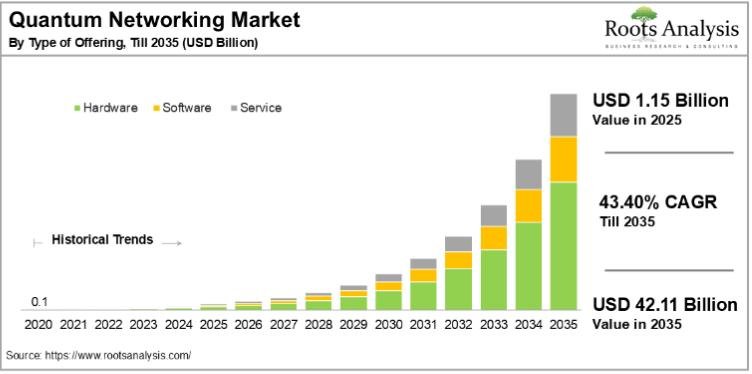
The global quantum networking market, valued at USD 1.15 billion in 2025, will grow to USD 42.11 billion by 2035, advancing at a CAGR of 43.40% over the forecast period. This growth reflects mounting enterprise and government urgency around quantum-safe communication, next-generation encryption, and distributed quantum computing infrastructure across critical sectors including defense, finance, and healthcare.
To explore the complete findings, request a free sample of the report at https://www.rootsanalysis.com/quantum-networking-market/request-sample
MARKET OVERVIEW
Quantum networking applies the principles of quantum mechanics, specifically quantum entanglement and superposition, to build communication networks that are fundamentally more secure than anything classical encryption can offer. Where classical networks depend on mathematical complexity to secure data, quantum networks make eavesdropping physically detectable. For industries handling classified or financially sensitive data, this distinction is not theoretical; it is a present operational need.
What is accelerating the quantum networking market right now is the convergence of three forces: rising cyber threat sophistication, government funding programs reaching multi-billion-dollar scale, and a maturing supply chain that is moving from lab demonstrations to commercial deployment. In December 2024, U.S. senators introduced legislation that would allocate USD 2.7 billion in federal funding over five years to support quantum research and development at federal agencies and government-funded research centers. Boeing separately announced plans in September 2024 to launch Q4S, an experimental quantum networking satellite, in 2026, with the goal of connecting widely separated quantum sensors for ultra-precise long-baseline measurement.
The integration of quantum networking with existing telecommunications infrastructure is also widening the market scope. Quantum key distribution (QKD) systems are being deployed to create encrypted channels that are immune to both current and future computational attacks, making the technology especially attractive to organizations that need to protect data over decades, not just years.
KEY GROWTH DRIVERS
Escalating cybersecurity threats across critical industries. Governments, banks, and defense agencies face an intensifying wave of cyber attacks, and classical encryption is increasingly viewed as insufficient against adversaries with access to quantum computing power. Quantum networking solutions provide unconditional security, making them attractive wherever data breaches carry catastrophic consequences. This urgency is translating directly into procurement budgets.
Government investment and national quantum programs. Public funding is the single most important accelerant in this market right now. The United States is directing USD 2.7 billion toward quantum R&D. India launched its National Quantum Mission in 2023 to build indigenous quantum technologies. China continues its investment in programs like the Micius Quantum Satellite and intercity quantum communication networks. These national commitments de-risk early commercialization and draw private capital into the sector.
Advances in quantum repeaters and memory technologies. One of the core engineering problems in quantum networking has been maintaining quantum coherence over long distances. Progress in quantum repeaters and quantum memory is solving this problem, enabling networks to extend their reach without losing signal fidelity. This directly expands the addressable market from short-range enterprise deployments to city-scale and eventually global quantum internet infrastructure.
Rising demand for distributed quantum computing. Organizations are beginning to explore distributed quantum computing, where processing power is shared across geographically separated quantum nodes linked by quantum networks. The distributed quantum computing segment is forecast to grow at a CAGR of 44.72% through 2035, making it the fastest-growing application in the quantum networking market. QKD and quantum entanglement are the enabling technologies holding these distributed systems together securely.
Commercialization momentum among established technology firms. Companies like IBM, Cisco, and Toshiba are no longer treating quantum networking as a research project; they are integrating it into secure communication products, pursuing government contracts, and forming partnerships with research institutions. IonQ’s acquisition of the majority of Qubitekk’s operating assets in November 2024 signals that consolidation-driven commercialization is underway.
To request quote of this report, please visit:
https://www.rootsanalysis.com/quantum-networking-market/request-quote
MARKET SEGMENTATION
By type of offering, the quantum networking market divides into hardware, software, and services. Hardware dominates today, anchored by quantum processors, quantum memory, quantum repeaters, and quantum random number generators (QRNGs). QRNGs alone are projected to capture approximately 46% of the hardware segment’s market share by 2035, reflecting the foundational role they play in generating the cryptographic keys that secure quantum networks. The software segment, though smaller, is the fastest-growing sub-segment at a projected CAGR of 45.18%, driven by adoption of quantum encryption algorithms and network protocol software that optimize hardware performance.
By application, secure communication holds the commanding position, forecast to account for approximately 42% of total quantum networking market share by 2035. Government agencies, healthcare providers, and financial institutions are the primary adopters, all facing regulatory and operational pressure to protect sensitive data against both current and quantum-era threats. By end user, the government segment leads with an expected 44% share by 2035, while banking and finance is the fastest-growing vertical at a CAGR of 44.3%, driven by the need for quantum-safe encryption in financial operations and risk management.
REGIONAL INSIGHTS
North America holds and will continue to hold the largest share of the quantum networking market, projected at approximately 45% of total revenue by 2035. The United States has been the primary driver, supported by heavy federal investment in quantum R&D, a dense ecosystem of technology companies including IBM, Cisco, IonQ, and Rigetti, and strong demand from defense, healthcare, and finance sectors. The region’s early-mover advantage in quantum computing research is translating directly into commercial quantum networking deployments.
Asia is the fastest-growing region, forecast to register a CAGR of 45.01% through 2035, marginally outpacing the global average. China is the regional anchor, having invested heavily in the Micius Quantum Satellite and built quantum communication networks linking major cities. India is scaling up quickly, with its 2023 National Quantum Mission directing resources toward indigenous quantum technology development. Singapore, Japan, and South Korea are also expanding their quantum programs, making Asia a critical arena for both commercial deployment and standards setting in this market.
COMPETITIVE LANDSCAPE
Key players in the quantum networking market include Aliro Technologies, Arqit, Cisco, Crypta Labs, HEQA Security, IBM, ID Quantique, IonQ, MagiQ Technology, Miraex, Quantum Xchange, QuantumCtek, QuBalt, Qubitekk, QuintessenceLabs, Qunnect, Rigetti, Terra Quantum, Toshiba, and Xanadu.
The competitive structure reflects a market in early consolidation. Established technology giants such as IBM, Cisco, and Toshiba are competing on depth of R&D and government contract relationships, while specialist quantum firms like ID Quantique, Arqit, and Aliro Technologies compete on focused product expertise in QKD and quantum network architecture. The main battlegrounds are intellectual property, partnerships with national laboratories and universities, and the race to secure long-term government procurement contracts. M&A activity, illustrated by IonQ’s acquisition of Qubitekk assets and Juniper Networks’ investment in Quantum Bridge, signals that the market is beginning to consolidate around players who can deliver integrated, enterprise-ready quantum networking solutions.
Browse Full Report Description + Research Methodology + Table of Content + Infographics here:
https://www.rootsanalysis.com/quantum-networking-market
Contact Details for Roots Analysis
Chief Executive: Gaurav Chaudhary
Email: Gaurav.chaudhary@rootsanalysis.com
Website: https://www.rootsanalysis.com/
About Roots Analysis
Roots Analysis is a global leader in the market research. Having worked with over 750 clients worldwide, including Fortune 500 companies, start-ups, academia, venture capitalists and strategic investors for more than a decade, we offer a highly analytical / data-driven perspective to a network of over 450,000 senior industry stakeholders looking for credible market insights. All reports provided by us are structured in a way that enables the reader to develop a thorough perspective on the given subject. Apart from writing reports on identified areas, we provide bespoke research / consulting services dedicated to serve our clients in the best possible way.
This release was published on openPR.