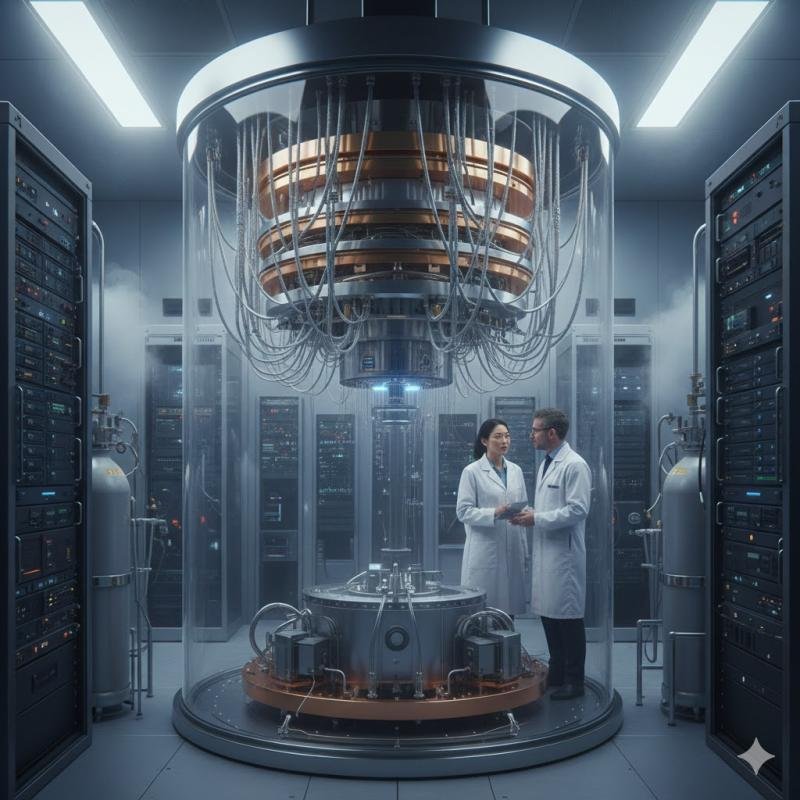
Quantum Computing
Market Overview:
The Global Quantum Computing Market reached US$ 650.1 million in 2022 and is projected to reach US$ 8,788.8 million by 2031, registering a robust CAGR of 38.9% during the forecast period 2024-2031. Quantum computing is rapidly gaining adoption across multiple industries due to its potential to perform complex calculations far beyond the capabilities of classical computers. Sectors such as logistics, materials science, and pharmaceuticals are leveraging quantum computing to optimize processes, enhance simulations, and accelerate innovation. In the pharmaceutical industry, for instance, quantum computing enables molecular simulation and structure optimization, significantly accelerating drug discovery and development cycles.
Get a Free Sample PDF Of This Report (Get Higher Priority for Corporate Email ID):-https://www.datamintelligence.com/download-sample/quantum-computing-market?Juli
Investment and Technological Advancements
Rising investments by key players are fueling the expansion of the quantum computing ecosystem. On November 2, 2023, Nu Quantum secured £7 million to develop networking infrastructure for quantum computers, advancing the creation of entanglement fabrics essential for scalable quantum computing.
Similarly, strategic expansions and technology developments in North America are boosting regional market growth. For example, on October 26, 2023, Alice & Bob expanded operations in North America, focusing on the race toward logical qubits capable of delivering fault-tolerant quantum computing solutions with significant commercial applications.
Recent Industry Developments:
✅ November 2023 – UK: Nu Quantum secured £7 million in funding to build networking infrastructure for quantum computers, enabling the creation of entanglement fabrics required for scalable quantum computing.
✅ October 2023 – North America: Alice & Bob expanded operations in North America, focusing on developing logical qubits for fault-tolerant quantum computing and accelerating the commercial quantum-ready ecosystem.
✅ September 2023 – United States: IBM unveiled its latest Quantum System Two, integrating next-generation qubit technology with enhanced error correction to improve computational stability for enterprise applications.
✅ July 2023 – Germany: IQM Quantum Computers launched a cloud-accessible quantum computing platform for research institutions, enabling advanced simulations for materials science and chemical research.
✅ June 2023 – Canada: D-Wave Systems introduced its Advantage Quantum Cloud service with expanded capacity and lower latency, targeting optimization and machine learning workloads for commercial clients.
✅ April 2023 – China: Alibaba Quantum Laboratory demonstrated a 60-qubit superconducting quantum processor capable of handling complex combinatorial optimization tasks, strengthening China’s position in the global quantum computing market.
✅On August 15, 2023, StackPath, a leading Quantum Computing platform launched StackPath Edge Compute Virtual Machine and Container instances featuring higher virtual CPU (vCPU) core counts and included RAM.
✅On March 21, 2023, NVIDIA, announced a new system to accelerate Quantum-Classical Computing. It has the potential to build extraordinarily powerful applications that combine quantum computing with state-of-the-art classical computing, enabling calibration, control, quantum error correction and hybrid algorithms.
Buy Now & Unlock 360° Market Intelligence:-https://www.datamintelligence.com/buy-now-page?report=quantum-computing-market?Juli
Quantum Computing Market Dynamics:
Rising Government Investment in Quantum Technology
Global governments are increasingly recognizing the strategic importance of quantum technologies and are investing heavily in research, development, and commercialization. Such initiatives provide substantial funding to academic institutions, research organizations, and private companies to advance quantum computing technologies. According to Qureca (2023), global investment in quantum science and technology exceeds US$38.6 billion, with projections indicating the quantum technology market could reach US$106 billion by 2040. Australia, for instance, invested US$85.4 million through federal programs to support quantum research, while the U.S., European Union, and China allocated US$1.8 billion, US$1.2 billion, and US$15.3 billion, respectively, in recent years. These substantial investments are driving innovation, commercialization, and adoption across multiple sectors.
Growing Adoption Across Industries
Quantum computing is increasingly adopted across industries for its ability to solve complex problems more efficiently than classical computing. In logistics and supply chain management, quantum solutions optimize inventory, routing, and distribution, improving operational efficiency and reducing costs. The pharmaceutical and healthcare sectors are leveraging quantum computing to simulate molecular interactions, accelerate drug discovery, and support personalized medicine initiatives. Similarly, industries such as aerospace, finance, energy, and automotive are exploring quantum technologies for optimization, simulation, and predictive analytics. The public sector’s involvement and investments further stimulate market growth by supporting infrastructure development and fostering collaboration between research institutions and private enterprises.
Challenges: Stability and Error Correction Issues
Despite its potential, quantum computing faces significant technical challenges. Quantum systems are highly sensitive to environmental factors, causing decoherence and instability, which impact reliability and user confidence. High error rates in quantum computations limit accuracy, particularly in critical applications such as cryptography and complex simulations. Implementing quantum error correction is resource-intensive, requiring additional qubits and complex algorithms, which affects scalability and computational efficiency. These stability and error correction challenges remain key restraints that could slow adoption until more robust and fault-tolerant quantum systems are developed.
Key Players:
IBM Quantum, Google, Honeywell, Rigetti Computing, Telstra Corporation Limited, IonQ Inc., Silicon Quantum Computing, Huawei Technologies Co. Ltd., Alphabet Inc., Rigetti & Co Inc., Microsoft Corporation, D-Wave Systems Inc. and Zapata Computing Inc.
Highlights:
IBM Quantum – Pioneering superconducting qubit-based quantum systems and cloud-accessible quantum computing services.
Google – Developer of the Sycamore quantum processor and leader in quantum supremacy experiments.
Honeywell – Innovator in trapped-ion quantum computing platforms.
Rigetti Computing / Rigetti & Co Inc. – Provider of cloud-based quantum computing and hybrid quantum-classical solutions.
Market Segmentation:
By Offering, the market is divided into Hardware, Software, and Services. Hardware dominates the market due to the high demand for quantum processors, qubits, and supporting infrastructure, while software solutions, including quantum algorithms and platforms, are gaining traction as enterprises adopt quantum computing. Service offerings, such as consulting, managed services, and hybrid quantum-classical integration, are also expanding rapidly, accounting for approximately 20-25% of the market share.
By Deployment Type, quantum computing solutions are categorized into On-premises and Cloud-based deployments. Cloud-based deployment is witnessing faster growth due to easier access, lower upfront costs, and the scalability offered by cloud infrastructure. This segment is expected to account for nearly 60% of the deployment market by 2031, especially with the increasing adoption of platforms like IBM Quantum, Microsoft Azure Quantum, and Amazon Braket.
By Technology, the market includes Quantum Dots, Trapped Ions, and Quantum Annealing. Trapped ion technology is growing rapidly due to high precision and scalability potential, while quantum annealing is widely adopted for optimization problems in industries such as logistics and finance. Quantum dots are emerging as a promising approach for scalable qubits in semiconductor-based quantum computers.
By Application, the market is segmented into Optimization, Simulation and Data Problems, Sampling, and Machine Learning. Optimization applications are currently leading, used for supply chain management, portfolio optimization, and complex industrial processes. Simulation and data problem-solving, including molecular modeling and chemical simulations, are becoming increasingly significant, particularly in pharmaceuticals and materials science. Machine learning applications are expanding rapidly as companies leverage quantum computing to accelerate AI algorithms.
By End-User, the market spans multiple industries including Banking, Financial Services and Insurance (BFSI), Aerospace & Defense, Manufacturing, Healthcare, IT & Telecom, and Energy & Utilities. BFSI and healthcare are early adopters due to their need for complex simulations and secure computations, whereas manufacturing, aerospace, and energy sectors are leveraging quantum computing for optimization, predictive maintenance, and efficient resource management.
Speak to Our Analyst and Get Customization in the report as per your requirements:-https://www.datamintelligence.com/customize/quantum-computing-market?Juli
Regional Insights:
North America is currently the largest regional market for quantum computing and is expected to maintain its dominance throughout the forecast period. The strong presence of major technology companies such as IBM, Google, Microsoft, Rigetti, and IonQ, coupled with significant investments in research and development, accelerates adoption in the region. The United States, in particular, benefits from government-backed initiatives such as the National Quantum Initiative (NQI), which supports development in quantum hardware, software, and workforce training. Canada is also emerging as a hub for quantum research, especially in trapped-ion and superconducting qubit technologies.
Europe is witnessing rapid growth due to the EU Quantum Flagship program and investments by countries like Germany, France, and the UK in quantum research infrastructure. The region is focusing on developing quantum communication, cybersecurity, and industrial applications. Key collaborations between research institutions and private companies are driving innovation, particularly in superconducting and trapped-ion technologies.
The Asia-Pacific region is expected to exhibit the fastest growth rate during the forecast period. Countries such as China, Japan, South Korea, and Australia are heavily investing in quantum computing research. China leads the region in quantum hardware and quantum communication initiatives, including the development of quantum satellites and national quantum labs. Japan and South Korea are focusing on commercial applications, such as optimization for manufacturing and AI acceleration, while Australia is advancing cold-atom and quantum annealing technologies.
📌 Request for 2 Days FREE Trial Access: https://www.datamintelligence.com/reports-subscription
☛ Power your decisions with real-time competitor tracking, strategic forecasts, and global investment insights all in one place.
✅ Competitive Landscape
✅ Sustainability Impact Analysis
✅ KOL / Stakeholder Insights
✅ Unmet Needs & Positioning, Pricing & Market Access Snapshots
✅ Market Volatility & Emerging Risks Analysis
✅ Quarterly Industry Report Updated
✅ Live Market & Pricing Trends
✅ Import-Export Data Monitoring
☛ Have a look at our Subscription Dashboard: https://www.youtube.com/watch?v=x5oEiqEqTWg?Juli
Contact Us –
Company Name: DataM Intelligence
Contact Person: Sai Kiran
Email: Sai.k@datamintelligence.com
Phone: +1 877 441 4866
Website: https://www.datamintelligence.com
About Us –
DataM Intelligence is a Market Research and Consulting firm that provides end-to-end business solutions to organizations from Research to Consulting. We, at DataM Intelligence, leverage our top trademark trends, insights and developments to emancipate swift and astute solutions to clients like you. We encompass a multitude of syndicate reports and customized reports with a robust methodology.
Our research database features countless statistics and in-depth analyses across a wide range of 6300+ reports in 40+ domains creating business solutions for more than 200+ companies across 50+ countries; catering to the key business research needs that influence the growth trajectory of our vast clientele.
This release was published on openPR.