The Digital Crossroads in Critical Communication
The landscape of professional mobile radio (PMR) communications is undergoing a fundamental shift. For decades, analog technology served as the backbone of site-based communication, valued for its simplicity and immediate voice delivery. However, as global industries face increasing complexity, the limitations of analog-spectral inefficiency, susceptibility to noise, and lack of data capabilities-have become significant bottlenecks. The transition from analog to digital is no longer a luxury but a strategic necessity for sectors requiring mission-critical reliability.
Within this global transition, Fujian BelFone Communications Technology Co., Ltd.(BelFone)(https://global.belfone.com/about/index) has emerged as a pivotal player. Established in 1989 and recognized as a China Top 10 Professional Walkie Talkie Brand, the company represents over three decades of evolution in wireless technology. As a state-level high-tech enterprise that integrates R&D, manufacturing, and sales, BelFone provides a unique lens through which to examine how contemporary digital solutions compare against legacy systems and international benchmarks. Professional walkie talkies today are far more than mere voice tools; they are sophisticated endpoints in complex data ecosystems used by public safety, utilities, and transportation sectors to ensure operational continuity.
Hardware Reliability: The Foundation of Performance
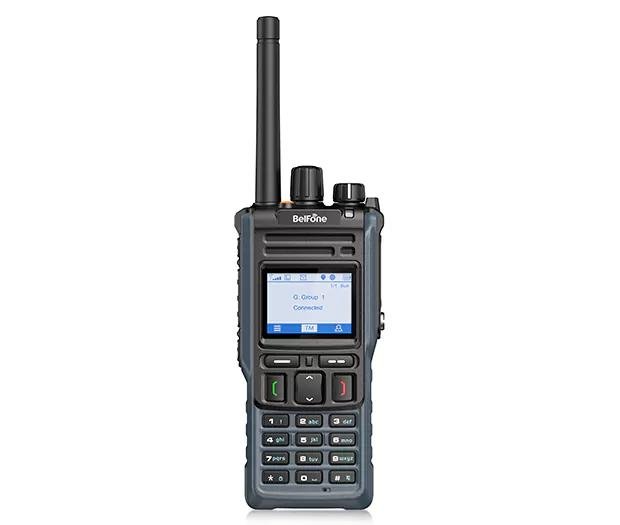
In the professional sector, digital transition begins with the physical integrity of the device. A common critique of early digital migrations was that the hardware became more “fragile” as it became more “intelligent.” A comparative analysis of modern digital units, such as the BelFone BP860(https://global.belfone.com/product-view/professional-dmr-radio-bp860) , against traditional analog hardware reveals a significant leap in industrial design.
While legacy analog radios often prioritized basic impact resistance, modern professional digital radios are engineered for extreme environments. High-tier digital models now routinely achieve IP68 ratings, ensuring they remain functional after prolonged submersion in water or exposure to fine particulate dust. Adherence to MIL-STD-810 standards means these devices withstand thermal shock, vibration, and solar radiation-factors that often caused failure in older generations.
Furthermore, the “digital” aspect extends to ergonomics. The transition has introduced high-resolution color displays and intuitive interfaces that allow for text messaging and status updates. Crucially, dedicated emergency buttons and programmable keys are now positioned using biometric data to ensure that in high-stress scenarios-such as a chemical leak or a fire response-the user can trigger a distress signal without looking at the device. This hardware evolution ensures that the intelligence of digital software is protected by an unyielding physical shell.
Communication Efficiency: Beyond Simple Voice
The most profound performance difference in the digital era lies in signal processing. Analog signals degrade linearly; as a user moves further from a base station, the “hiss” of static increases until the voice is lost. Digital technology, specifically through the application of Time Division Multiple Access (Two-slot TDMA) technology, changes this dynamic entirely.
By dividing a single 12.5kHz channel into two independent time slots, digital systems effectively double the spectrum efficiency. This allows two simultaneous conversations on one frequency, a critical advantage for congested urban environments or large-scale industrial sites. Beyond capacity, the clarity of communication is enhanced by digital vocoders and Forward Error Correction (FEC) algorithms. In high-noise environments like mining operations or construction zones, digital radios filter out ambient background noise, delivering only the human voice. This ensures that critical commands are understood the first time, reducing the risk of operational errors.
Ecosystem Integration: From Radios to Solutions
Performance in the modern era is measured by the strength of the network, not just the handheld unit. The transition has shifted the focus from simple point-to-point communication to integrated “Smart Dispatch” environments.
Where analog systems offered little more than voice, digital ecosystems integrate GPS positioning, voice recording, and remote management features. For instance, the ability to “stun” or “kill” a radio remotely if it is lost or stolen is a digital-only security feature that protects the integrity of a private network.
The industry is also seeing a move toward “Converged Communications.” This involves the hybridization of Private Mobile Radio (DMR) with Public Networks (LTE/PoC). This multi-mode approach allows a supervisor in a city office to communicate directly with a worker in a remote plant via a PoC-DMR gateway, bridging the gap between localized high-reliability hardware and global cellular connectivity. This level of topology was mathematically impossible in the analog era.
Strategic Value: Customization and Cost-Effectiveness
When comparing “China-designed” solutions like those from BelFone against high-premium international brands, the distinction often lies in flexibility. Many global legacy brands offer “locked” ecosystems with rigid firmware. In contrast, the current leaders in the Chinese market have gained significant ground by offering deep firmware customization. Whether it is a specific encryption requirement for maritime security or a unique signaling protocol for forestry management, the ability to adapt the digital software to the industry’s specific workflow provides immense strategic value.
Furthermore, the Total Cost of Ownership (TCO) is a major factor in the digital transition. The high entry barrier of digital infrastructure once deterred small to medium enterprises. By optimizing the manufacturing chain and focusing on open standards like DMR and PDT, brands are now providing high-performance digital transitions at a price point that facilitates faster ROI, making professional-grade safety accessible to a broader range of global industries.
Global Case Studies: Proving the Transition
The efficacy of these digital transitions is best evidenced by large-scale deployments. In international railway projects, such as those in Africa, the move from legacy systems to digital trunking has resulted in measurable improvements in dispatch efficiency and collision avoidance. By utilizing digital repeaters and centralized management, rail operators have achieved 100% coverage across vast, geographically challenging terrains where analog signals previously failed.
In Southeast Asian smart factories, the integration of digital radios with IoT sensors has allowed for automated emergency alerts to be broadcast directly to handsets, reducing response times by significant margins. These real-world applications demonstrate that the transition is not merely about better sound quality, but about creating a safer, more data-driven operational environment.
Conclusion: Leading the Next Generation of PMR
The transition from analog to digital represents a coming-of-age for the professional communications industry. As evidenced by the performance of China’s leading brands, the focus has shifted from being a global manufacturer to being a global innovator. Organizations like BelFone have demonstrated that “Designed in China” now signifies high-end R&D in digital integration and mission-critical reliability.
Looking forward, the convergence of 5G, Artificial Intelligence, and PMR will further redefine the sector. With AI-driven noise cancellation and 5G-enabled video dispatching on the horizon, the role of professional radio communications will only grow in importance. For industries navigating the complexities of the modern world, choosing a partner that understands both the heritage of radio and the future of digital connectivity is the key to a successful transition.
For more information on digital communication solutions, please visit: https://global.belfone.com/
Fujian BelFone Communications Technology Co., Ltd.
A-15, Huaqiao Economic Development Zone, Shuangyang, Luojiang District, Quanzhou, Fujian Province, China
overseas@belfone.com
+86 595 2839 6717
Founded in 1989, BelFone, a state-level high-tech enterprise, is a leading technology and solution provider of mission and business critical communications, with our focus on the field of professional radio communications and our clientele all over the globe.
With over 30 years of experience and expertise, we are dedicated to bringing the best out of the evolvement of different communications technologies and empowering our customers with integrated radio solutions such as broadband trunking, narrowband trunking, PoC trunking, emergence response communication systems as well as command and dispatch systems.
Our products and solutions provide enhanced efficiency, safety, stability and connectivity, helping users to achieve communication coverage, flexible networking, rapid deployment, visual command and trunking features, benefiting a wide spectrum of sectors such as public safety, utilities, emergency response, energy, transportation, enterprises and businesses.
BelFone values innovation and continues to invest over 10% of its annual revenue in R&D. At present, BelFone has 5 R&D centers in China and its R&D personnel account for about 30% of the total staff number. BelFone is the proud owner of nearly 100 intellectual property patents.
BelFone has been actively pioneering the development of PMR technologies though relentless R&D efforts and has now mastered the mainstream open standard technologies, such as PDT, DMR, PoC, LTE, 5G, and traditional analog communications. BelFone’s comprehensive product portfolio includes narrowband, broadband, convergent, mesh, as well as command and dispatch systems, which effectively help users to realize the integration of communication and management.
This release was published on openPR.