Network Interface Card (NIC) Market
The Network Interface Card (NIC) market is entering a decisive growth phase as digital infrastructure scales to meet the demands of cloud computing, artificial intelligence, and real-time data processing. NICs serve as the fundamental bridge between computing systems and networks, enabling data transmission with speed, reliability, and security. As enterprises migrate workloads to cloud-native and virtualized environments, the importance of high-performance NICs has grown significantly.
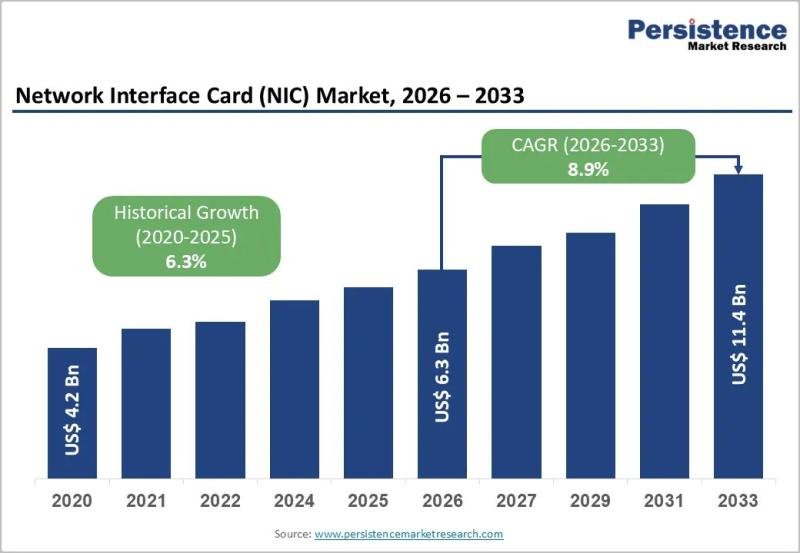
The global NIC market size is projected to increase from US$6.3 billion in 2026 to US$11.4 billion by 2033, registering a CAGR of 8.9% during the forecast period. This growth is primarily driven by the need for ultra-low-latency data transfer, scalable bandwidth, and efficient packet processing. Data-intensive workloads such as AI/ML training, hyperscale cloud operations, and high-performance computing (HPC) are reshaping NIC design priorities toward programmability, security acceleration, and energy efficiency.
Elevate your business strategy with comprehensive market data. Request a sample report now: https://www.persistencemarketresearch.com/samples/33426
Market Statistics, Leading Segments, and Regional Dominance
From a segmentation standpoint, wired NICs dominate the market, accounting for over 58% share in 2026 and projected to reach US$5.4 billion by 2033. Their dominance stems from superior reliability, consistent throughput, and low-latency performance, making them indispensable in data centers, cloud infrastructure, and AI-driven workloads. In contrast, wireless NICs are witnessing faster growth, supported by rapid adoption of Wi-Fi 6, 6E, and emerging Wi-Fi 7 standards, especially across enterprise campuses and IoT deployments.
Regionally, North America leads the NIC market with approximately 33% share in 2026, valued at nearly US$2.1 billion. The region benefits from advanced semiconductor ecosystems, large-scale AI data center investments, and widespread 5G adoption. Meanwhile, Asia Pacific emerges as the fastest-growing region, expanding at a 14.3% CAGR and expected to surpass US$4.5 billion by 2033, driven by telecom upgrades, expanding manufacturing hubs, and increasing broadband penetration across India, Japan, and South Korea.
Key Highlights from the NIC Market Report
Wired NICs hold the largest market share due to superior reliability and low-latency performance in data center environments.
Wireless NICs are growing rapidly, supported by Wi-Fi 6/6E/7 upgrades and IoT expansion.
1-40 Gbps NICs dominate current deployments, balancing cost and performance for enterprises and SMEs.
Above 100 Gbps NICs represent the fastest-growing data-rate segment driven by hyperscale AI data centers.
Data centers remain the largest end-user segment, accounting for over 38% market share in 2026.
Asia Pacific is the fastest-growing region due to telecom modernization and local chip manufacturing initiatives.
Network Interface Card (NIC) Market Segmentation Analysis
The NIC market is segmented by product type, data rate, end-user, and connectivity type, each reflecting different performance and deployment requirements. By product type, the market includes Ethernet NICs, wireless NICs, smart NICs, and programmable NICs. Ethernet-based NICs remain the most widely deployed due to their compatibility with existing infrastructure and support for high-speed data transfer in enterprise and cloud environments.
In terms of end-user segmentation, data centers dominate market demand, driven by cloud service providers, hyperscale operators, and colocation facilities. Telecom and networking providers represent another fast-growing segment as 5G rollouts, fiber broadband expansion, and edge computing architectures demand high-bandwidth and ultra-low-latency network interfaces. Enterprises and industrial users also contribute steadily, especially with increased adoption of private networks and Industry 4.0 applications.
Regional Insights and Market Dynamics
North America continues to lead the NIC market due to early adoption of advanced networking technologies, strong cloud infrastructure investments, and rapid deployment of AI-first data centers. The presence of major semiconductor manufacturers and cloud service providers further strengthens regional dominance and accelerates innovation in high-speed Ethernet and smart NIC solutions.
Asia Pacific, on the other hand, is witnessing the fastest growth fueled by expanding digital economies, aggressive 5G deployments, and increasing investments in domestic semiconductor production. Countries such as India, China, South Korea, and Japan are rapidly upgrading telecom infrastructure and data center capacity, creating strong demand for both wired and wireless NIC solutions.
Key Market Drivers
The primary driver of the Network Interface Card (NIC) market is the explosive growth of cloud computing and hyperscale data centers. As enterprises increasingly rely on virtualized and containerized workloads, high-performance NICs become critical for maintaining low latency and high throughput. The shift toward AI/ML workloads further intensifies demand for NICs capable of handling massive parallel data flows.
Another significant growth driver is the rapid adoption of high-speed Ethernet standards, including 25G, 40G, 100G, and beyond. These upgrades are essential for supporting modern applications such as real-time analytics, NVMe-over-Fabrics storage, and distributed computing. Additionally, the rise of SDN and NFV architectures is pushing demand for programmable and smart NICs.
Market Restraints Impacting Growth
Despite strong growth prospects, the NIC market faces challenges related to high development and deployment costs, particularly for advanced smart and programmable NICs. Smaller enterprises and cost-sensitive markets may delay upgrades due to budget constraints, limiting short-term adoption in certain segments.
Another restraint is supply chain volatility in the semiconductor industry, which can disrupt component availability and pricing. Fluctuations in raw material costs and geopolitical trade restrictions may also impact manufacturing timelines, creating uncertainty for vendors and end-users alike.
Emerging Market Opportunities
The growing adoption of AI-driven networking and edge computing presents significant opportunities for NIC manufacturers. Smart NICs with built-in acceleration for security, storage, and virtualization tasks are gaining traction as organizations seek to offload workloads from CPUs and improve overall system efficiency.
Additionally, the expansion of 5G networks and private enterprise networks opens new avenues for high-performance NICs tailored for telecom and industrial applications. As sustainability becomes a priority, energy-efficient NIC designs also offer differentiation opportunities for vendors targeting environmentally conscious data center operators.
Do You Have Any Query Or Specific Requirement? Request Customization of Report: https://www.persistencemarketresearch.com/request-customization/33426
Reasons to Buy the Network Interface Card (NIC) Market Report
✔ Gain in-depth insights into market size, growth forecasts, and emerging trends through 2033
✔ Understand key drivers, restraints, and opportunities shaping the global NIC industry
✔ Analyze competitive dynamics and strategic developments of leading market players
✔ Identify high-growth segments and regions for targeted investment decisions
✔ Support strategic planning with reliable, data-driven market intelligence
Frequently Asked Questions (FAQs)
How big is the Network Interface Card (NIC) market globally?
Who are the key players in the global Network Interface Card (NIC) market?
What is the projected growth rate of the Network Interface Card (NIC) market?
What is the market forecast for the NIC market through 2032?
Which region is estimated to dominate the NIC industry during the forecast period?
Company Insights and Competitive Landscape
Intel Corporation
Broadcom Inc.
NVIDIA Corporation
Marvell Technology Group
Mellanox Technologies
Cisco Systems, Inc.
Hewlett Packard Enterprise (HPE)
Dell Technologies
Fujitsu Limited
Huawei Technologies
Recent Developments:
Leading semiconductor vendors have introduced 400G and 800G Ethernet NICs to support next-generation AI and hyperscale data center workloads.
Increased investment in smart NIC and DPU technologies is reshaping data center architectures by offloading networking and security functions from CPUs.
Related Reports:
Roll-to-roll Printing Market https://www.persistencemarketresearch.com/market-research/roll-to-roll-printing-market.asp
System Basis Chips Market https://www.persistencemarketresearch.com/market-research/system-basic-chip-market.asp
DNA Data Storage Platform Market https://www.persistencemarketresearch.com/market-research/dna-based-data-storage-platform-market.asp
About Persistence Market Research:
At Persistence Market Research, we specialize in creating research studies that serve as strategic tools for driving business growth. Established as a proprietary firm in 2012, we have evolved into a registered company in England and Wales in 2023 under the name Persistence Research & Consultancy Services Ltd. With a solid foundation, we have completed over 3600 custom and syndicate market research projects, and delivered more than 2700 projects for other leading market research companies’ clients.
Our approach combines traditional market research methods with modern tools to offer comprehensive research solutions. With a decade of experience, we pride ourselves on deriving actionable insights from data to help businesses stay ahead of the competition. Our client base spans multinational corporations, leading consulting firms, investment funds, and government departments. A significant portion of our sales comes from repeat clients, a testament to the value and trust we’ve built over the years.
Contact Us:
Persistence Market Research
Second Floor, 150 Fleet Street,
London, EC4A 2DQ, United Kingdom
USA Phone: +1 646-878-6329
UK Phone: +44 203-837-5656
Email: sales@persistencemarketresearch.com
Web: https://www.persistencemarketresearch.com
This release was published on openPR.