Multi-Agent AI Orchestration
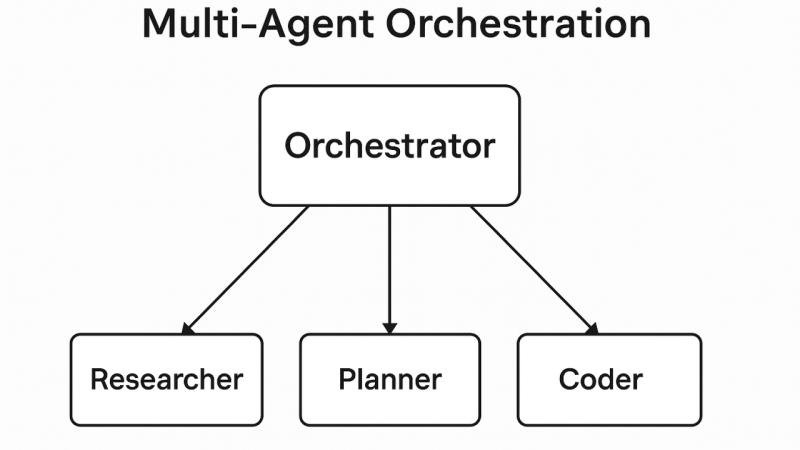
The Multi-Agent AI Orchestration Market represents the critical control layer of the next-generation digital economy. While the initial wave of Generative AI focused on single models answering prompts, the current paradigm has shifted to Multi-Agent Systems (MAS). In this architecture, specialized AI agents-such as a Coder, a Researcher, and a Critic-collaborate to solve complex, multi-step problems that are beyond the capability of any single Large Language Model. The Orchestration Market consists of the platforms, frameworks, and protocols that manage these digital workforces. It handles the assignment of tasks, the resolution of conflicts between agents, memory management, and the routing of information. As of 2026, this market has evolved from open-source experiments into robust enterprise infrastructure, serving as the “Manager” for the digital workforce and enabling companies to automate end-to-end business processes rather than just isolated tasks.
Recent Developments
February 2026 – The Agent Interlink Protocol: A consortium of cloud giants and AI startups ratified the Agent Interlink Protocol (AIP). This open standard allows agents running on different underlying models-for example, a GPT-4 agent and a Claude 3 agent-to communicate, negotiate, and hand off tasks securely within a unified workflow. This interoperability breakthrough effectively killed the “walled garden” approach to agent deployment.
December 2025 – Self-Correcting Swarms: A leading orchestration platform introduced a “Recursive Debugging” feature. If a swarm of agents fails to complete a task or enters an infinite loop, a specialized “Supervisor Agent” is automatically spawned to analyze the logs, identify the logic error, rewrite the prompt instructions for the subordinate agents, and restart the workflow, all without human intervention.
September 2025 – Cost-Optimized Routing: A major cloud provider launched “Token Arbitrage” within its orchestration layer. The system dynamically routes tasks to the cheapest possible model capable of handling that specific sub-task (e.g., using a small model for summarizing emails but a massive model for legal analysis), reducing the operational cost of multi-agent systems by approximately 40 percent.
Get Sample: https://marketresearchcorridor.com/request-sample/16104/
Strategic Market Analysis: Dynamics and Future Trends
The innovation trajectory in this sector is pivoting from “Chain-of-Thought” to “Graph of Thoughts.” Early orchestration was linear: Step A leads to Step B. The current market dynamic utilizes non-linear, graph-based execution where agents can explore multiple solution paths simultaneously, backtrack if a path fails, and merge insights from different branches. This mimics human brainstorming and problem-solving more closely than rigid workflows.
Operationally, there is a decisive move toward “Hierarchical Orchestration.” Just as human organizations have CEOs, managers, and interns, AI systems are adopting tiered structures. A high-level “Architect Agent” breaks down a strategic goal into sub-tasks and assigns them to “Worker Agents.” This hierarchy prevents context overflow and ensures that the overarching strategy is maintained while detailed work is executed.
Looking forward, the future outlook is centered on the “Human-Agent Interface.” The market is moving away from chat interfaces to “Dashboard Control.” Humans will no longer prompt individual agents; they will monitor dashboards showing the status of agent swarms, approving high-stakes decisions and tweaking the “Constitution” or rule sets that govern agent behavior.
SWOT Analysis: Strategic Evaluation of the Market Ecosystem
Strengths
The primary strength of Multi-Agent Orchestration is Specialization. By allowing different agents to use different tools and prompts, the system achieves a higher quality of output than a single generalist model. A “Math Agent” equipped with a calculator tool will always outperform a generic LLM trying to do arithmetic. Furthermore, the Resilience of these systems is superior; if one agent fails, the orchestrator can reassign the task to another, preventing total system failure.
Weaknesses
A significant weakness is Latency and Cost. Multi-agent loops require multiple round-trips to the LLM, which can be slow and expensive. A complex task might consume thousands of tokens before a result is produced. Additionally, the “Infinite Loop” risk is real; agents can get stuck arguing with each other or repeating tasks if the stop conditions in the orchestration layer are not rigorously defined.
Opportunities
A massive opportunity exists in Legacy Modernization. Orchestration layers can wrap around legacy software. Agents can be given tools to interact with old “Green Screen” mainframes via APIs or screen reading, allowing enterprises to automate core banking or logistics processes without rewriting the underlying code. There is also significant potential in the “Agent Economy,” where specialized agents are rented out on a marketplace-companies can hire a “Tax Audit Agent” for a week rather than buying the software.
Threats
The primary threat is Alignment Drift. As agents interact and learn, there is a risk they optimize for the wrong metric (e.g., closing tickets quickly by providing low-quality answers). Maintaining strict behavioral guardrails across a swarm is difficult. Cybersecurity is another critical threat; “Prompt Injection” attacks against an orchestrator can compromise the entire swarm, potentially allowing an attacker to hijack the digital workforce to exfiltrate data or execute unauthorized transactions.
Drivers, Restraints, Challenges, and Opportunities Analysis
Market Driver – The Limits of Single Models: Even the most powerful LLMs have limited context windows and reasoning capabilities. Enterprises have hit the ceiling of what a chatbot can do. The need to execute complex projects-like coding an entire app or writing a compliance report-requires the decomposition capabilities that only multi-agent orchestration provides.
Market Driver – Tool Use Capabilities: The ability of AI models to reliably use external tools (browsers, code interpreters, SQL clients) drives the need for an orchestration layer to manage these tools and permissions. The orchestrator acts as the secure gateway between the AI brain and the enterprise’s digital infrastructure.
Market Restraint – Debugging Complexity: When a multi-agent system fails, it is incredibly difficult to know why. Did the Planner Agent fail to define the task? Did the Coder Agent write bad code? Or did the Reviewer Agent hallucinate an error? This “attribution problem” makes maintenance difficult and slows down enterprise adoption.
Key Challenge – Synchronization: Managing shared state memory is a massive technical hurdle. If Agent A learns a new fact, Agent B needs to know it immediately to avoid redundant work. Building a “Shared Brain” or dynamic memory store that updates in real-time for all agents without latency is the central engineering challenge.
Deep-Dive Market Segmentation
By Architecture
Hierarchical Swarms (Manager/Worker)
Joint Collaboration (Peers brainstorming)
Competitive Swarms (Debate/Red Teaming)
Sequential Flows (Chain-based)
By Deployment
Cloud-Native Orchestration (SaaS)
On-Premise / Edge Orchestration (For privacy)
Hybrid Frameworks
By Application
Software Development (Devin-style agents)
Market Research and Analysis
Supply Chain Optimization
Automated Customer Support Resolution
Financial Modeling and Auditing
By End User
Tech and Software Companies
BFSI (Banking, Financial Services, Insurance)
Manufacturing and Logistics
Healthcare and Pharma
Government and Defense
Click Here, Download a Free Sample Copy of this Market: https://marketresearchcorridor.com/request-sample/16104/
Regional Market Landscape
North America: This region acts as the Global Architecture Hub. Silicon Valley is the birthplace of the major agent frameworks (like LangChain and AutoGen). The U.S. market is characterized by rapid experimentation and the integration of agent swarms into SaaS products to create “Autonomous Software.”
Europe: The market here is shaped by Industrial Automation. German and French manufacturers are using orchestration layers to manage digital twins and robotic agents in factories. The focus is on reliability, safety, and compliance with the EU AI Act, favoring deterministic orchestration over open-ended reasoning.
Asia-Pacific: This is the Scale Leader. China is aggressively deploying multi-agent systems in e-commerce and logistics to manage massive scale. The region is pioneering the use of agents in “Social Commerce,” where swarms of buying and selling agents interact to optimize supply chains in real-time.
Competitive Landscape
Framework Pioneers:
LangChain (LangGraph), Microsoft (AutoGen), CrewAI, LlamaIndex (Data agents).
Cloud Hyperscalers:
Amazon Web Services (Bedrock Agents), Google Cloud (Vertex AI Agent Builder), OpenAI (Assistants API).
Enterprise Platforms:
Salesforce (Agentforce), ServiceNow (Now Assist), UiPath (Autopilot), Palantir (AIP).
Strategic Insights
The “Router” is the Product: In a world of commoditized LLMs, the value captures moves to the Router-the part of the orchestration layer that decides which model to call and what tools to use. Companies that build the most intelligent, cost-efficient routing logic will become the essential middleware of the AI stack.
Red Teaming as a Service: Before deploying a swarm, it must be stress-tested. A new niche is emerging for “Adversarial Orchestration,” where a swarm of “Attacker Agents” tries to break or trick the “Worker Agents” to find vulnerabilities before deployment.
Standardized Agent Resumes: We are moving toward a standard definition of an agent’s capabilities. Just as humans have resumes, agents will have “Manifests” declaring their skills, tool access, and performance benchmarks, allowing orchestrators to dynamically “hire” the right agent for the job from a global pool.
Get Sample: https://marketresearchcorridor.com/request-sample/16104/
Contact Us:
Avinash Jain
Market Research Corridor
Phone : +91 750 750 2731
Email: Sales@marketresearchcorridor.com
Address: Market Research Corridor, B 502, Nisarg Pooja, Wakad, Pune, 411057, India
About Us:
Market Research Corridor is a global market research and management consulting firm serving businesses, non-profits, universities and government agencies. Our goal is to work with organizations to achieve continuous strategic improvement and achieve growth goals. Our industry research reports are designed to provide quantifiable information combined with key industry insights. We aim to provide our clients with the data they need to ensure sustainable organizational development.
This release was published on openPR.