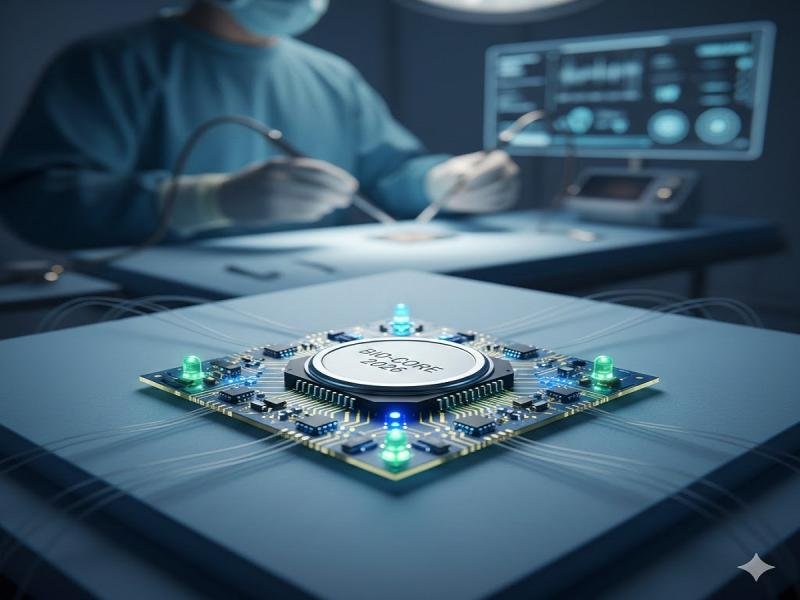
Medical Microcontrollers Market
Market Overview
The Global Medical Microcontrollers Market reached US$ 27.5 billion in 2022 and is projected to grow to US$ 48.3 billion by 2030, expanding at a CAGR of 10.8% during the forecast period (2023-2030). The growth is primarily driven by the increasing adoption of medical microcontrollers in advanced medical devices, as healthcare technology evolves toward smaller, portable, and highly connected devices. Medical microcontrollers are essential for enabling data collection, communication, and remote monitoring, which are increasingly required in telemedicine, wearable health devices, and IoT-enabled healthcare solutions.
Get a Free Sample PDF Of This Report (Get Higher Priority for Corporate Email ID):-https://www.datamintelligence.com/download-sample/medical-microcontrollers-market?Juli
The market is further supported by the rising trend of personalized medicine, where medical devices adapt to patients’ specific health needs and conditions. Microcontrollers facilitate the integration of connectivity features, enabling real-time monitoring, improved diagnostic accuracy, and enhanced patient outcomes. The North American market plays a dominant role, driven by rapid growth in the medical device sector and technological adoption. The U.S., in particular, accounts for over 40% of the global medtech market, leveraging AI, machine learning, and IoT-enabled solutions to improve healthcare delivery.
Key Developments:
✅ Expansion of Ultra‐Low‐Power Medical MCUs
Leading semiconductor manufacturers are expected to continue introducing next‐generation ultra‐low‐power microcontrollers tailored for wearable medical devices and battery‐operated healthcare equipment. These MCUs will likely feature integrated AI inference engines to support on‐device analytics for real‐time health monitoring and predictive alerts.
✅ March 14, 2023 – Silicon Labs, a leader in wireless technology, launched two new integrated circuits: the xG27 family of Bluetooth systems and the BB50 microcontroller unit (MCU). The BB50 MCU is optimized for small, battery-powered devices, making it ideal for connected medical devices, wearables, smart sensors, and asset monitoring applications.
✅ April 11, 2023 – Renesas Electronics Corporation announced the launch of a next-generation microcontroller based on 22-nm process technology, offering improved power efficiency, processing speed, and integration capabilities for modern medical devices.
✅ September 10, 2022 – STMicroelectronics (STM) introduced the STM32U5 Extreme Low-Power Microcontrollers, designed with enhanced cybersecurity features. The STM32U5 series targets wearables, personal medical devices, home automation, and industrial sensor applications, combining ultra-low power consumption with robust security.
Buy Now & Unlock 360° Market Intelligence:-https://www.datamintelligence.com/buy-now-page?report=medical-microcontrollers-market?Juli
Key Players:
Renesas Electronics – Holds a 15.2% share, driven by its portfolio of ultra-low-power MCUs and integrated AI-enabled microcontrollers for wearable and IoT medical devices.
Microchip Technology Inc. – Holds a 13.8% share, supported by its 8-bit and 32-bit MCU product lines optimized for connectivity, remote monitoring, and medical instrumentation.
STMicroelectronics (STM) – Holds a 12.5% share, fueled by its STM32U5 and STM32L series of low-power, secure, and AI-ready MCUs for personal and hospital medical devices.
Texas Instruments – Holds a 10.9% share, strengthened by its analog and embedded MCU solutions for precision medical measurement and portable diagnostic devices.
Infineon Technologies – Holds a 9.7% share, focusing on secure, energy-efficient microcontrollers and sensors for medical IoT applications.
Silicon Laboratories (Silicon Labs) – Holds a 8.6% share, recognized for Bluetooth, wireless, and sensor-integrated MCUs in connected medical wearables and smart devices.
GIE Media, Inc. – Holds a 6.4% share, providing market intelligence and integration support services that enhance adoption of medical microcontrollers.
Market Segmentation:
By Type
The 32-bit microcontrollers segment dominates the medical microcontrollers market with a 45% share, driven by their high processing power, energy efficiency, and ability to integrate AI and connectivity features for advanced medical devices. 8-bit microcontrollers account for 30% of the market, favored for simple medical devices, battery-powered wearables, and cost-sensitive applications. Meanwhile, 16-bit microcontrollers hold a 25% share, offering a balance between performance and power efficiency for monitoring and diagnostic equipment that require moderate computational capability. The growing trend toward compact, connected, and IoT-enabled medical devices continues to fuel the adoption of 32-bit MCUs across hospitals, home care, and wearable health applications.
By Application
In 2026, monitoring equipment represents the largest application segment with 40% market share, supported by the increasing use of remote patient monitoring, wearable health trackers, and IoT-connected medical devices. Detection and diagnosis applications follow with a 35% share, including AI-powered diagnostic devices, point-of-care testing instruments, and imaging systems that rely on fast, low-latency processing. Treatment equipment accounts for 25% of the market, encompassing devices like infusion pumps, ventilators, and other automated therapeutic systems that require precise control enabled by microcontrollers. Rising adoption of personalized medicine and connected healthcare devices is expected to further expand these application segments.
Speak to Our Analyst and Get Customization in the report as per your requirements:-https://www.datamintelligence.com/customize/medical-microcontrollers-market?Juli
(Single User Report: USD 4350 & One Year Database Subscription: USD 12K)
Regional Insights:
North America leads the global medical microcontrollers market with a 38% share, driven by the presence of major medical device manufacturers, high healthcare expenditure, and rapid adoption of IoT-enabled and AI-powered medical devices. The U.S. in particular dominates due to a strong medtech ecosystem and supportive regulatory environment encouraging innovation in connected and portable medical devices.
Europe holds a 27% market share, fueled by advancements in wearable medical technology, digital health initiatives, and rising investment in personalized healthcare solutions across countries like Germany, the U.K., and France. The region’s stringent safety and quality standards also promote adoption of reliable and low-power microcontrollers in medical equipment.
The Asia-Pacific region captures 25% of the market, driven by rapid industrialization in healthcare, expanding medical device manufacturing hubs in China, Japan, and India, and increasing demand for affordable diagnostic and monitoring equipment. Rising healthcare infrastructure investment and telemedicine adoption further support market growth.
Market Dynamics:
Driver:
The increasing applications of medical instrumentation are driving the growth of the medical microcontrollers market. Microcontrollers integrate ROM, RAM, CPU, clock circuits, and I/O circuitry into a single package, eliminating the need for additional support chips like traditional microprocessors. This integration allows signal processing functions such as limiting, rectification, comparison, integration, differentiation, and filtering to be handled in software rather than complex analog circuits. For example, the PIC18-Q40 family offers low pin count, large flash memory, small footprint packages, and versatile analog and digital CIPs, making it ideal for portable devices like telehealth equipment, nebulizers, and syringe pumps. According to the American Hospital Association, approximately 76% of U.S. hospitals utilize telehealth, highlighting the growing need for microcontroller-enabled remote monitoring solutions. The use of microcontrollers reduces IC package complexity, lowers costs, saves space, and improves reliability through features such as self-calibration and error detection, making them increasingly popular in compact, portable medical devices.
The high demand for smart medical applications further fuels market expansion. The rise of telemedicine, wearable devices, and biometric monitoring has increased the adoption of microcontroller-equipped medical devices. Wearable medical devices are expected to grow at a CAGR of 18%, reaching US$ 380.5 billion by 2028, creating a significant opportunity for microcontroller manufacturers. These devices are integral to remote patient monitoring, continuous health tracking, and personalized care, boosting demand for reliable, low-power MCUs in the healthcare sector.
Additionally, automation, Industry 4.0, and consumer electronics growth are contributing to market momentum. The integration of AI, IoT, and robotics into medical device manufacturing has increased the need for microcontrollers to monitor, control, and optimize smart production systems. For instance, in 2019, remote surgical procedures in China utilized microcontroller-based devices to operate on patients thousands of miles away. Healthcare robots equipped with sensors and MCUs are also being used for neurological rehabilitation and assisted patient care, demonstrating the expanding scope of microcontrollers in advanced healthcare applications.
However, high product costs remain a key restraint. Medical microcontrollers are more expensive than standard MCUs due to stringent design requirements, regulatory compliance, and rigorous quality control. Compliance with FDA regulations and international standards such as IEC 60601, along with the need for reliability, safety, and accuracy, increases production costs. For example, the PIC16F877A costs US$ 6.72 per unit, ATMEGA328P costs US$ 4.98 per unit, and LPC1113FBD48 costs US$ 2.24 per unit, reflecting the premium associated with specialized medical-grade microcontrollers.
📌 Request for 2 Days FREE Trial Access: https://www.datamintelligence.com/reports-subscription
☛ Power your decisions with real-time competitor tracking, strategic forecasts, and global investment insights all in one place.
✅ Competitive Landscape
✅ Sustainability Impact Analysis
✅ KOL / Stakeholder Insights
✅ Unmet Needs & Positioning, Pricing & Market Access Snapshots
✅ Market Volatility & Emerging Risks Analysis
✅ Quarterly Industry Report Updated
✅ Live Market & Pricing Trends
✅ Import-Export Data Monitoring
☛ Have a look at our Subscription Dashboard: https://www.youtube.com/watch?v=x5oEiqEqTWg?Juli
Contact Us –
Company Name: DataM Intelligence
Contact Person: Sai Kiran
Email: Sai.k@datamintelligence.com
Phone: +1 877 441 4866
Website: https://www.datamintelligence.com
About Us –
DataM Intelligence is a Market Research and Consulting firm that provides end-to-end business solutions to organizations from Research to Consulting. We, at DataM Intelligence, leverage our top trademark trends, insights and developments to emancipate swift and astute solutions to clients like you. We encompass a multitude of syndicate reports and customized reports with a robust methodology.
Our research database features countless statistics and in-depth analyses across a wide range of 6300+ reports in 40+ domains creating business solutions for more than 200+ companies across 50+ countries; catering to the key business research needs that influence the growth trajectory of our vast clientele.
This release was published on openPR.