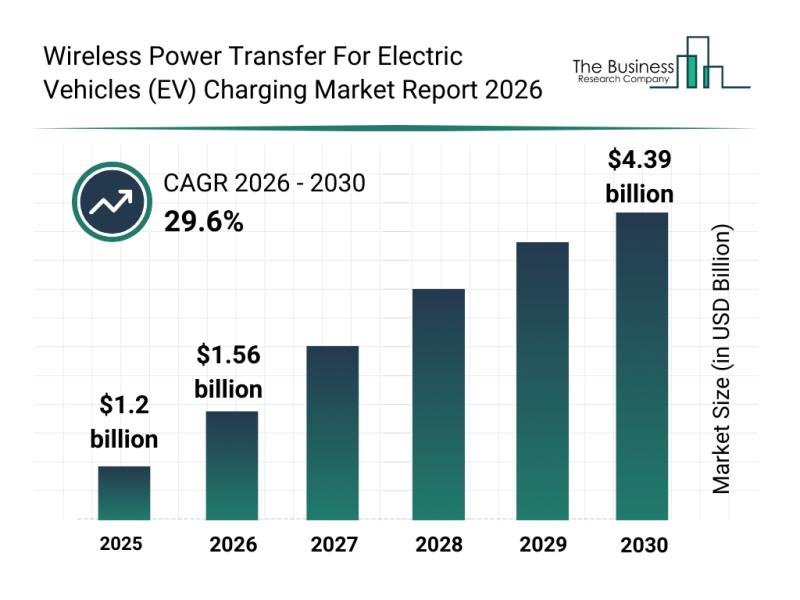
Wireless Power Transfer For Electric Vehicles (EV) Charging Market
The electric vehicle (EV) charging landscape is undergoing a transformative shift with the rapid development of wireless power transfer technology. This innovation promises to make charging more efficient, convenient, and integrated with modern transportation systems. Let’s explore the projected market size, key players, emerging trends, and segmentation within the wireless power transfer for electric vehicles charging sector.
Projected Market Value and Growth of the Wireless Power Transfer for EV Charging Market
The wireless power transfer market for electric vehicle charging is set to experience remarkable expansion in the coming years. By 2030, it is anticipated to reach a valuation of $4.39 billion, growing at an impressive compound annual growth rate (CAGR) of 29.6%. This surge is driven by several factors, including the rollout of dynamic charging lanes, the incorporation of artificial intelligence in charging networks, the increase in fleet electrification, the electrification of public transportation, and advancements in multi-coil and hybrid charging technologies. Key trends shaping this market encompass the expansion of wireless charging infrastructure, adoption of smart charging management systems, standardization of charging protocols, integration with renewable energy sources, and the rise of vehicle-to-grid (V2G) capabilities.
Download a free sample of the wireless power transfer for electric vehicles (ev) charging market report:
https://www.thebusinessresearchcompany.com/sample.aspx?id=29244&type=smp
Prominent Companies Leading the Wireless Power Transfer for EV Charging Industry
The wireless power transfer for electric vehicles charging sector features a number of influential companies shaping its development. Notable market participants include Toyota Motor Corporation, Siemens Aktiengesellschaft, Continental Aktiengesellschaft, Dr. Ing. h.c. F. Porsche Aktiengesellschaft, Qualcomm Incorporated, Toshiba Corporation, Zhongxing Telecommunication Equipment Corporation, DAIHEN Corporation, Mahle Gesellschaft mit beschränkter Haftung, Zhejiang VIE Science & Technology Co. Ltd., ChargePoint Inc., GuRu Wireless Inc., Mojo Mobility Inc., HEVO Inc., Momentum Dynamics Corporation, WiTricity Corporation, Powermat Technologies Ltd., Electreon Wireless Ltd., ENRX Group, and InductEV Inc.
A significant recent event took place in October 2023 when PULS GmbH, a technology firm based in Germany, acquired Wiferion GmbH for an undisclosed sum. This move is aimed at incorporating Wiferion’s cutting-edge wireless charging technology into PULS’s portfolio to enhance industrial charging solutions. Wiferion GmbH is also a German company specializing in wireless power transfer systems for electric vehicle charging.
View the full wireless power transfer for electric vehicles (ev) charging market report:
https://www.thebusinessresearchcompany.com/report/wireless-power-transfer-for-electric-vehicles-ev-charging-global-market-report
Current Trends Impacting the Wireless Power Transfer for EV Charging Sector
Companies in this market are prioritizing the development of advanced inductive wireless charging solutions designed to offer users a hassle-free and cable-free charging experience. Inductive wireless charging transmits electricity via magnetic fields between a charging pad and the vehicle, eliminating the need for physical cables and connectors.
One notable example is from September 2025, when German automaker Dr. Ing. h.c. F. Porsche AG unveiled the Porsche Cayenne Electric equipped with an 11-kW wireless charging system. This system uses an inductive charging floor plate that enables drivers to initiate charging simply by parking over it and activating the parking brake. The technology delivers up to 90% energy transfer efficiency, incorporates motion and foreign object detection to enhance safety, connects with the My Porsche app for easy monitoring and scheduling, and uses ultra-wideband technology combined with Surround View to ensure precise vehicle alignment.
Detailed Segmentation of the Wireless Power Transfer for Electric Vehicles Charging Market
This market is categorized into several segments for better understanding and analysis:
1) Technology:
– Inductive Charging
– Resonant Inductive Charging
– Capacitive Charging
– Other Technologies
2) Power Supply Range:
– Low Power
– Medium Power
– High Power
3) Application:
– Private Vehicles
– Public Transport
– Commercial Vehicles
– Other Applications
4) End-User:
– Private
– Public
– Fleet
Further breakdown of key technology segments includes:
– Inductive Charging: Static Charging Pads, Dynamic Charging Lanes, Onboard Vehicle Coils
– Resonant Inductive Charging: Magnetic Resonance Coupling, Frequency Tuned Systems, Multi Coil Systems
– Capacitive Charging: Plate To Plate Systems, Embedded Roadway Systems, Vehicle To Infrastructure Systems
– Other Technologies: Radio Frequency Charging, Laser Based Charging, Hybrid Charging Systems
This comprehensive classification highlights the diversity and technological advancements fueling the wireless power transfer market for electric vehicle charging.
Reach out to us:
The Business Research Company: https://www.thebusinessresearchcompany.com/,
Americas +1 310-496-7795,
Europe +44 7882 955267,
Asia & Others +44 7882 955267 & +91 8897263534,
Email us at info@tbrc.info.
Follow Us On:
LinkedIn: https://in.linkedin.com/company/the-business-research-company,
Twitter: https://twitter.com/tbrc_info,
YouTube: https://www.youtube.com/channel/UC24_fI0rV8cR5DxlCpgmyFQ
Learn More About The Business Research Company
With over 17500+ reports from 27 industries covering 60+ geographies, The Business Research Company has built a reputation for offering comprehensive, data-rich research and insights. Armed with 1,500,000 datasets, the optimistic contribution of in-depth secondary research, and unique insights from industry leaders, you can get the information you need to stay ahead.Our flagship product, the Global Market Model (GMM), is a premier market intelligence platform delivering comprehensive and updated forecasts to support informed decision-making.
This release was published on openPR.