Magnetic Sensor Market
The magnetic sensor industry is set to experience significant growth over the coming years, driven by advancements in technology and expanding applications across various sectors. Understanding the market’s size, key players, emerging trends, and segmentation offers valuable insights into the future trajectory of this dynamic industry.
Magnetic Sensor Market Size and Growth Projection up to 2030
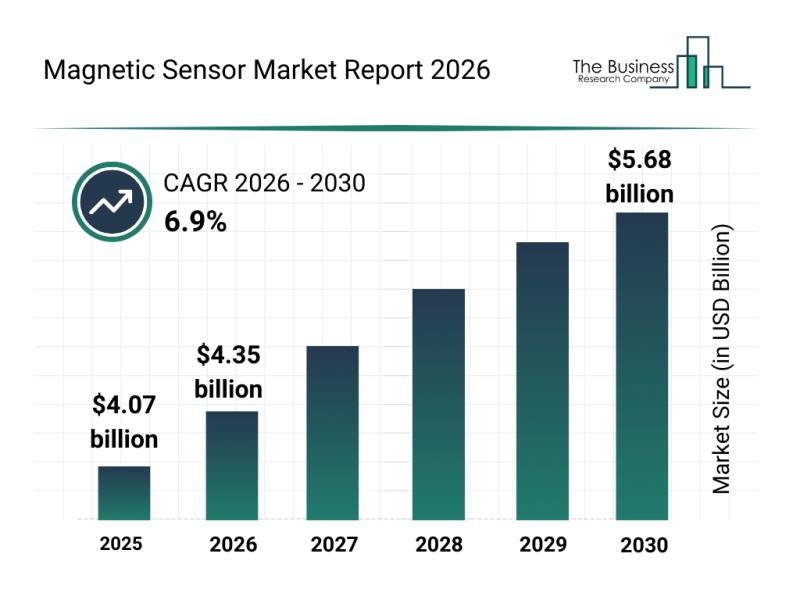
The magnetic sensor market is projected to expand substantially, reaching a valuation of $5.68 billion by 2030. This growth will occur at a compound annual growth rate (CAGR) of 6.9%. The increase is fueled by a rising demand for tunnel magnetoresistive (TMR) and other sophisticated magnetoresistive sensors. Additionally, widespread adoption in navigation systems and electronic compasses, the development of non-destructive testing (NDT) and inspection tools, expansion of automotive advanced driver assistance systems (ADAS), and innovations in high-sensitivity magnetic field sensing technologies contribute significantly to this upward trend. Key market developments also include the integration of smart magnetic field measurement systems, IoT-connected sensors, AI-enhanced magnetic detection platforms, automated industrial magnetic monitoring, and the growth of digitally controlled sensor frameworks.
Download a free sample of the magnetic sensor market report:
https://www.thebusinessresearchcompany.com/sample.aspx?id=9257&type=smp
Emerging Leaders in the Magnetic Sensor Industry
Several influential companies are shaping the magnetic sensor market, including TE Connectivity Ltd., NXP Semiconductors N.V., Texas Instruments Incorporated, STMicroelectronics N.V., Melexis NV, Infineon Technologies AG, TDK Corporation, Allegro MicroSystems LLC, Asahi Kasei Corporation, Honeywell International Inc., NVE Corporation, AMS AG, Robert Bosch GmbH, Kohshin Electric Corporation, Micronas Semiconductor Holding AG, Sensitec GmbH, Murata Manufacturing Co. Ltd., Baumer Ltd., Elmos Semiconductor AG, Analog Devices Inc., Crocus Technology, Omron Corporation, Diodes Incorporated, Silicon Labs Inc., and Pepperl+Fuchs International GmbH.
A notable development occurred in August 2023 when Allegro MicroSystems Inc., a US-based provider of advanced semiconductor technology and specialized algorithms, acquired Crocus Technology for $420 million. This strategic acquisition aims to enhance Allegro’s innovation capabilities in TMR sensing technology and broaden its market footprint. Crocus Technology, also based in the US, is known for manufacturing integrated magnetic field sensors.
Recent Innovations Driving Magnetic Sensor Technology
Leading companies in the magnetic sensor field are focusing on developing cutting-edge products like linear magnetic field sensors to maintain a competitive advantage. Linear magnetic field sensors are devices that measure both the magnitude and direction of magnetic fields. For example, in May 2023, Multidimension Technology Co Ltd., a Chinese manufacturer, introduced the TMR265x series of programmable TMR linear sensors. These sensors are specially designed for high-speed current sensing in power electronics and provide a 2MHz bandwidth, making them highly suitable for monitoring silicon-carbide (SiC) and gallium-nitride (GaN) power switches. The TMR2625x sensors also offer robust temperature stability and customizable sensitivity, with a measurement range of up to ±1000 Gauss.
View the full magnetic sensor market report:
https://www.thebusinessresearchcompany.com/report/magnetic-sensor-global-market-report
Breakdown of Segments Covered in the Magnetic Sensor Market Report
This report categorizes the magnetic sensor market into various segments for a detailed analysis:
1) By Sensor Type: Hall Effect Sensors, Magnetoresistive Sensors, SQUID Sensors, Flux Gate Sensors
2) By Magnetic Field Range: Low Field Sensors (less than 1 Microgauss), Earth Field Sensors (1 Microgauss to 10 Gauss), Bias Magnetic Field Sensors (greater than 10 Gauss)
3) By Application: Speed Sensors, Detection or Non-Destructive Testing (NDT), Position Sensors, Navigation and Electronic Compass, Flow Rate Sensors
4) By End User Industry: Automotive, Aerospace and Defense, Industrial, Consumer Electronics, Banking, Financial Services, and Insurance (BFSI), and other sectors
Further subcategories refine these groups:
– Hall Effect Sensors include Linear, Latch, and Rotary types
– Magnetoresistive Sensors cover Anisotropic Magnetoresistive (AMR), Giant Magnetoresistive (GMR), and Tunnel Magnetoresistive (TMR) sensors
– SQUID Sensors are divided into DC SQUIDs (Direct Current) and RF SQUIDs (Radio Frequency)
– Flux Gate Sensors include 2D and 3D variants
This segmentation provides a comprehensive understanding of the diverse technologies, applications, and end markets driving the magnetic sensor industry forward.
Reach out to us:
The Business Research Company: https://www.thebusinessresearchcompany.com/,
Americas +1 310-496-7795,
Europe +44 7882 955267,
Asia & Others +44 7882 955267 & +91 8897263534,
Email us at info@tbrc.info.
Follow Us On:
LinkedIn: https://in.linkedin.com/company/the-business-research-company,
Twitter: https://twitter.com/tbrc_info,
YouTube: https://www.youtube.com/channel/UC24_fI0rV8cR5DxlCpgmyFQ
Learn More About The Business Research Company
With over 17500+ reports from 27 industries covering 60+ geographies, The Business Research Company has built a reputation for offering comprehensive, data-rich research and insights. Armed with 1,500,000 datasets, the optimistic contribution of in-depth secondary research, and unique insights from industry leaders, you can get the information you need to stay ahead.Our flagship product, the Global Market Model (GMM), is a premier market intelligence platform delivering comprehensive and updated forecasts to support informed decision-making.
This release was published on openPR.