Decentralized Servo Drives Market
The decentralized servo drives market is on track for significant expansion over the coming years, driven by technological advancements and increasing industrial automation. As factories adopt smarter and more connected systems, the demand for efficient and flexible motion control solutions like decentralized servo drives is expected to rise sharply. Let’s explore the market’s projected value, key players, emerging trends, and important segments shaping its future.
Projected Market Value and Growth Outlook for Decentralized Servo Drives
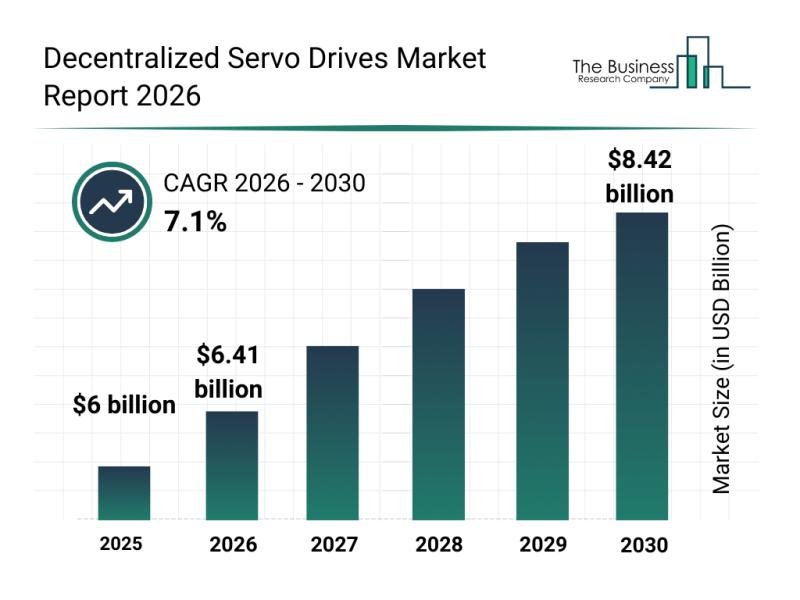
The decentralized servo drives market is forecasted to reach a value of $8.42 billion by 2030. This growth reflects a compound annual growth rate (CAGR) of 7.1% during the forecast period. Several factors contribute to this upward trend, including rising investments in smart factories, the integration of AI-enabled motion control, the widespread adoption of edge computing, growing use of modular production lines, and increasing demand for predictive maintenance solutions. Important trends shaping this market include embedded drive architectures, edge-level motion intelligence, modular automation scalability, reduced cabinet wiring requirements, and real-time motor diagnostics.
Download a free sample of the decentralized servo drives market report:
https://www.thebusinessresearchcompany.com/sample.aspx?id=32579&type=smp&utm_source=OpenPR&utm_medium=Paid&utm_campaign=Feb_PR
Key Players Driving the Decentralized Servo Drives Industry
The decentralized servo drives market features several prominent companies that play a crucial role in its development. Leading market participants include Siemens AG, Panasonic Corp., Schneider Electric SE, Mitsubishi Electric Corp., ABB Ltd., Parker Hannifin Corp., Nidec Servo Corporation, Delta Electric, Danfoss Inc., Rockwell Automation Inc., Bosch Rexroth AG, Omron Corporation, FANUC Corp., SEW-Eurodrive GmbH Co KG, Yaskawa Electric Corporation, Beckhoff Automation GmbH Co KG, Lenze, Sanyo Denki Co. Ltd., Kollmorgen Corp., WITTENSTEIN SE, and AMK Motion GmbH Co KG.
Strategic Collaborations Expanding Capabilities in the Market
In a recent development from September 2024, Germany-based Metronix Automation GmbH, known for its servo drives and motion control solutions, formed a strategic partnership with DPM Digital Product Manufacturing, another German company specializing in decentralized servo drives. This collaboration aims to combine their engineering expertise and system-level experience, enabling Metronix Automation to enhance its application capabilities and deliver more advanced, customer-tailored motion control solutions.
View the full decentralized servo drives market report:
https://www.thebusinessresearchcompany.com/report/decentralized-servo-drives-market-report?utm_source=OpenPR&utm_medium=Paid&utm_campaign=Feb_PR
Emerging Trends Focusing on Safety and Performance
One of the major trends in the decentralized servo drives market is the integration of functional safety directly into servo drives. These drives come equipped with built-in safety features that eliminate the need for external safety modules. They continuously monitor and control torque, speed, and position to comply with certified safety standards such as safety integrity level (SIL) and performance level (PL), thereby improving both machine performance and operator safety.
Advanced Safety Features Setting New Industry Benchmarks
For example, in April 2025, Celera Motion, a US precision motion control technology company, introduced the Denali Safe and Everest Safe servo drives. These products boast advanced integrated functional safety capabilities, including miniature Ethernet for control automation technology and more than 15 safety functions certified to SIL 3/PL e standards. They offer high-performance features such as optimized system responsiveness with control loops reaching up to 50 kilohertz, establishing new benchmarks for safety and efficiency in decentralized motion control systems.
Breakdown of Key Market Segments Influencing Growth
This report segments the decentralized servo drives market based on various criteria:
1) By Type: Hardware, Software, and Services
2) By Voltage Level: Low Voltage Servo Drives and Medium Voltage Servo Drives
3) By Communication Interface: Fieldbus-Based, Ethernet-Based, and Wireless Communication Servo Drives
4) By Application: Motion Control, Robotics Control, Material Handling, Packaging Automation, and Assembly Line Automation
5) By Industry: Automotive, Aerospace, Electronics, Healare, and Logistics
Important Subcategories Within Each Segment
Within these broad segments, the market further divides into subcategories. Hardware includes servo motors, motor controllers, drive modules, power supply units, and feedback devices. Software encompasses motion control software, programming tools, simulation software, diagnostic software, and monitoring software. Services involve installation, commissioning, maintenance, calibration, and technical support offerings. These detailed classifications help in understanding the diverse components contributing to the market’s growth and adoption.
Reach out to us:
The Business Research Company: https://www.thebusinessresearchcompany.com/,
Americas +1 310-496-7795,
Europe +44 7882 955267,
Asia & Others +44 7882 955267 & +91 8897263534,
Email us at info@tbrc.info.
Follow Us On:
LinkedIn: https://in.linkedin.com/company/the-business-research-company,
Twitter: https://twitter.com/tbrc_info,
YouTube: https://www.youtube.com/channel/UC24_fI0rV8cR5DxlCpgmyFQ
Learn More About The Business Research Company
With over 17500+ reports from 27 industries covering 60+ geographies, The Business Research Company has built a reputation for offering comprehensive, data-rich research and insights. Armed with 1,500,000 datasets, the optimistic contribution of in-depth secondary research, and unique insights from industry leaders, you can get the information you need to stay ahead.Our flagship product, the Global Market Model (GMM), is a premier market intelligence platform delivering comprehensive and updated forecasts to support informed decision-making.
This release was published on openPR.